Rational Exponents and Radicals
Transformations of Square Root Functions
Solving Square Root Equations
Rational Function Transformations
100
Rewrite as a radical expression:
x(1/3)
3√ x
100
List the transformations of the following function:
f(x)=-3sqrt(x+4)+3
Reflect over x-axis
Stretched vertically by factor of 3
4 left
3 up
100
-8+sqrt(5a-5)=-3
a = 6
100
This is the name for a line that a function approaches but never actually touches.
Asymptote
200
Rewrite as a radical expression:
(3x)^(3/2)
sqrt((3x)^3
200
What is the domain and range of: 
Use Interval Notation
Domain:
[-5, oo)
Range:
[-2, oo)
200
Solve for x:
sqrt ((2x)/5) = 4
x = 40
200
State the transformations of the following rational function:
y=-2/(x-1)+2
Right 1
Reflected over the x-axis
Stretched vertically by a factor of 2
Up 2
300

(5x)^(10/4)
300
The square root function that has been shifted 2 units right and 7 units up from the parent function
What is
√(x-2)+7
300
Solve for x:
x+4=sqrt(x+10)
x = -1
x = -6 is an extraneous solution
300
Write the equations for the vertical and horizontal asymptotes of the following function:
y=1/(x-3)-1
VA: x=3
HA: y=-1
400
Disregarding wind resistance, the distance a body falls from rest varies directly as the square of the time it falls. If a skydiver falls 64 ft in 2 seconds, how far will he fall in 10 seconds?
What is 1600 ft
400
The square root function that has been reflected over the x-axis, vertically stretched by a factor of 2, horizontally shifted left 3 units, and vertically shifted up 7 units
What is
-2√(x+3)+7
400
Solve for x:
-3sqrt(x+2)-7=-22
What is 23?
400
Write the function represented by this graph (HINT-- Pay attention to where the branches are located compared to the parent function 1/x:
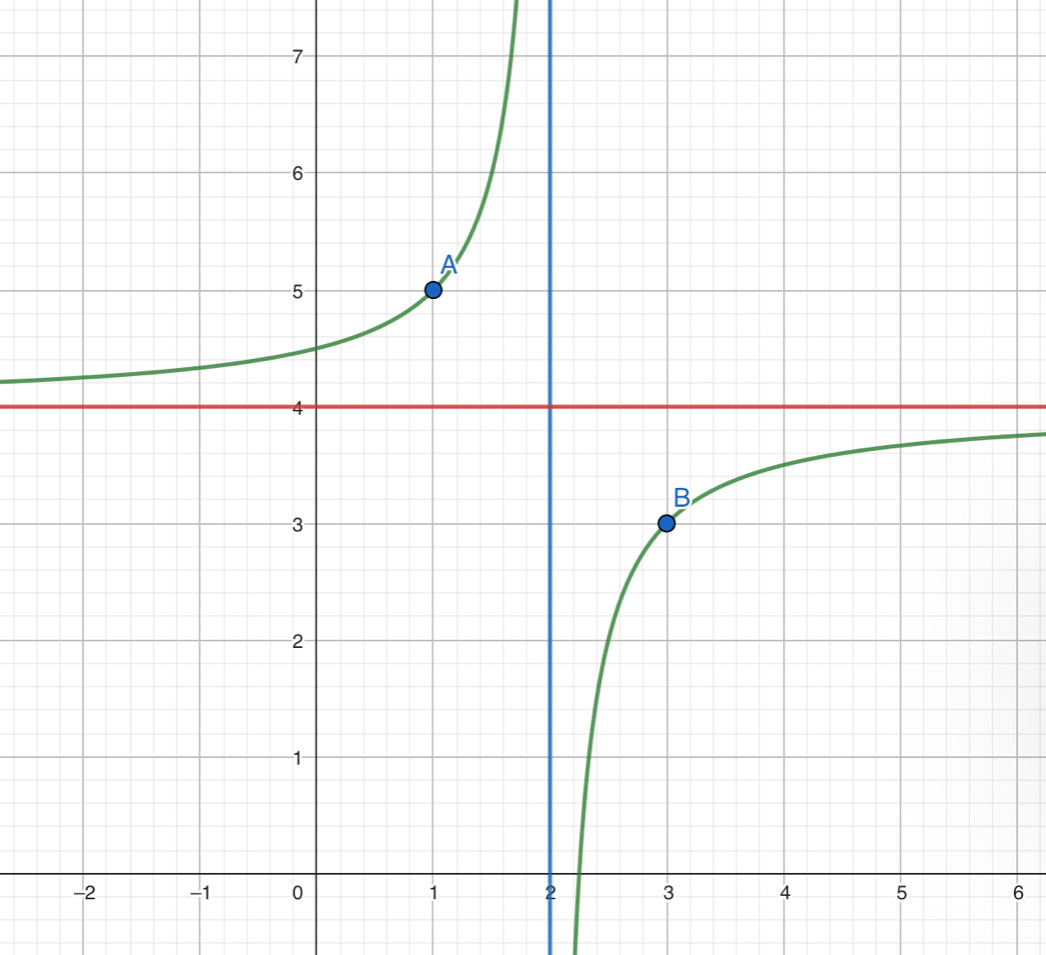
F(x)=-1/(x-2)+4
500
The time taken to cycle a particular distance varies inversely with the speed of the bicycle. Tim takes 3 hours to reach his destination traveling at a constant speed of 12 miles per hour.
How long would it take Tim to reach his destination if he travels at a constant speed of 15 miles per hour?
2.4 Hours
500
The square root function given the following graph. It has not been stretched or compressed. 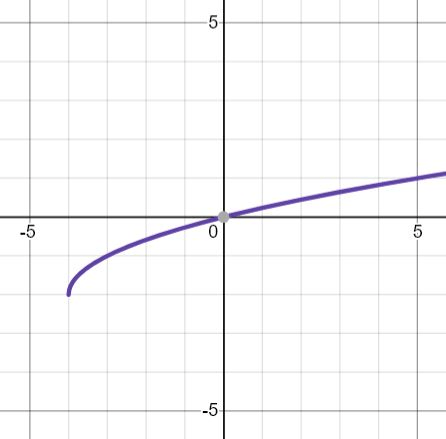
What is
√(x+4)-2
500
Solve for x:
4+sqrt(x+2) = x
x = 7
x=2 is an extraneous soluion
500
Identify the Domain and Range or the following Rational Function (HINT -- Find the Vertical and Horizontal asymptotes first):
y=1/(x-3)-1
Domain:
(-oo, 3)U(3, oo)
Range:
(-oo, -1)U(-1, oo)