Macroevolution
Speciation
Diagrams
Taxonomy
Random
100
This type of evolution occurs on a large scale at or above species level over geologic time.
What is macroevolution?
100
This is a type of natural selection where environmental pressures favor a single phenotype, causing the allele frequency to continuously shift in one direction (ex. Horseshoes prefer higher # of ribs).
What is directional selection/directional changes?
100
Use this diagram to write the scientific name of the common dog: 
Canis familiaris
100
These are the three domains of life.
What are eukarya, archaea, and bacteria?
100
Define Derived traits (synapomorphies)
a characteristic that is found in some or all terminal groups of a clade, and inherited from a common ancestor
200
1)_________ is the transfer of genetic material between populations, while 2)__________ refers to random changes in allele frequencies within a population due to chance events.
What is: 1. Gene Flow and 2. Genetic Drift
200
This type of evolution occurs when unrelated species develop similar traits due to similar environmental pressures.
What is convergent evolution?
200
Use this diagram to define an ingroup vs an outgroup:
•Ingroups – a group of closely related taxa that share common traits
•Outgroups - a more distantly related group that serves as a reference point for the ingroup
200
These are the four kingdoms of eukarya.
What are animalia, plants, fungi, and protists?
200
Molecular clocks are based on:
The rate of genetic mutations over time
300
This type of speciation occurs when there is geographical isolation.
What is allopatric speciation?
300
Describe adaptive radiation vs stasis.
Adaptive Radiation – rapid diversification, an event when many new species arises moderately quickly (can occur after a mass extinction)
Stasis– when a lineage doesn’t change much over a very long time
300
Use this diagram to define a clade (monophyletic groups): 
taxonomic groups that include a common ancestor and all of its descendants
300
This is the formal system of naming species of living organisms using two names, which helps provide a unique and universally accepted identifier for each species.
What is binomial nomenclature?
300
Describe a real-life example of behavioral isolation.
blue-footed booby (Sula nebouxii)
The unique courtship ritual of the blue-footed booby is so elaborate that females only select a mating partner after watching the entire courtship ritual. This behavior prevents interbreeding with closely related species, ensuring that the blue-footed booby remains a distinct species.
400
What is the biological species concept (aka our working definition for "species")?
Organisms that are capable of interbreeding and producing fertile offspring
400
Describe how comparative anatomy is evidence for macroevolution.
Shows that similar structures in different species are often due to shared ancestry.
400
Explain what this graph is showing: 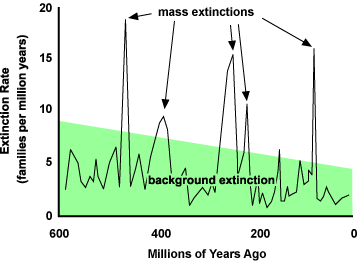
5 mass extinctions
Note the background extinction, which is natural and a very important part of life
400
This is the father of taxonomy.
Who is Carl Linnaeus?
400
Describe how Darwin's Finches are an example of adaptive radiation?
Adaptive radiation is an evolutionary process where organisms rapidly diversify from a common ancestor into a variety of new forms.
This occurred in Darwin's Finches, as the ancestral Finch was the common ancestor. Darwin's Finches then split up and migrated to different islands in the Galapagos, where each island was a slightly different environment. Over time, the Finches diversified in order to have traits that increased their fitness in their specific island.
500
These are five types of reproductive isolation that lead to sympatric speciation.
What are:
•Habitat isolation
•Temporal isolation
•Behavioral isolation
•Mechanical isolation
•Gametic isolation
500
Under a microscope, the cells of mushrooms, plants, and animals all have visible nuclei. This makes them all:
What are: Eukaryotes?
500
Use the diagram to describe the mechanics of speciation. 
A population gets split in two reproductively (could be various reasons, habitat, temporal, behavioral, mechanical, gametic, or geographical). The differences eventually become too great, and they become completely separate species
500
Define monophyletic groups (clades).
taxonomic groups that include a common ancestor and all of its descendants
500
What factors can affect the tempo/rate of evolutionary change?
- Environmental Pressures/Stability: Sudden and drastic changes in habitat, climate, or the presence of new predators or diseases
- Population Size: Smaller populations tend to evolve more rapidly due to stronger effects of genetic drift and selection.
- Genetic Variation: populations with greater diversity have more advantageous traits that can be selected for, enabling quicker adaptation to new conditions.