7.1 - 7.5
True/False Explain!
Evidence for Evolution
Species here and there
Phylogeny
100
This is the term for all of the ecological factors imposed in an ecosystem by nonliving things
What are abiotic factors?
100
(TRUE/FALSE) The first organisms on Earth were likely multicellular
What is False? - They were likely unicellular
100
Give an example of a vestigial strucure
What is [a vestigial structure example]?
100
For two organisms to be considered the same species, they must be able to create...
What is viable, fertile offspring?
100
This is the ordered division and naming of organisms
What is taxonomy?
200
This is the term for natural selection where one end of the phenotypic spectrum is selected for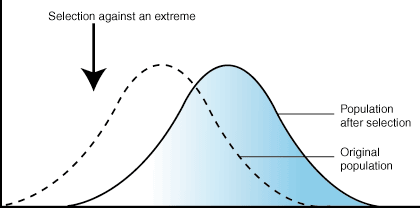
What is Directional Selection?
200
(TRUE/FALSE) Macroevolution refers to broad patterns of evolutionary change above the species level
What is True?
200
Name 3 of the 6 evidences for evolution
What are fossil record, homology, analogy, transitional species, artificial selection, biogeography?
200
This is the term for rapid diversification of species in response to environments with a variety of ecological opportunities
What is adaptive radiation?
200
Taxon A is most closely related to this taxon 
What is taxon B?
300
This is the term for changes in allele frequencies in populations due to change and/or random events
What is Genetic Drift?
300
(TRUE/FALSE) Horses and donkeys are the same species because they can produce offspring; mules
What is False? - mules are unable to reproduce
300
Absolute age of fossils can be determined by this kind of dating
What is radiometric dating?
300
Give an example of current/observable evolution
What is pesticides, herbicides, antibiotic resistance organisms, artificial selection, etc.?
300
A ________ or branching point is symbolic of that clade's common ancestor
What is a node?
400
If allele frequencies change from one generation to the next, the population is said to be doing this
What is evolving?
400
(TRUE/FALSE) A lack of variation cannot contribute to a species' extinction
What is FALSE? - Populations with little genetic variation are at greater risk for extinction
400
This is the difference between homologous and analogous structures
What is homologous shows structural similarities between organisms that indicate common ancestry and analogous structures show similar features between organisms who do not have recent common ancestry - convergent evolution?
400
The first genetic material on Earth was likely this
What is RNA?
400
This is the difference between a phylogenetic tree and a cladogram
What is a phylogenetic tree considers more evidence and/or considers time elapsed and cladograms usually go off of one kind of trait and disregard time elapsed?
500
In the Hardy-Weinberg Equation, the variable 2pq represents this
What is the frequency of heterozygotes in a population?
500
(TRUE/FALSE) Comparative Embryology shows how many organisms have very different embryological traits
What is False? - it shows how there are very similar embryological traits

500
This is (one of) the pieces of evidence that tells use that all life on Earth came from a universal common ancestor
What is using the same ribosomal subunits, active transport proteins, presence of DNA, Anaerobic respiration, etc.?
500
Speciation occurs without geographic isolation, often due to sexual selection
What is sympatric speciation?
500
When considering a clade, this is the species least related to the others in the tree and serves as a basis of comparison
What is an outgroup?