Maps And Geography
Ottoman Empire & Sumerians
Religion & Beliefs
100
Q3
What makes the land between the Tigris and Euphrates Rivers so fertile?
A. Constant desertification
B. Oil deep under the soil
C. Manure from grazing animals
D. Silt deposited by flooding rivers
D. Silt deposited by flooding rivers
100
Q8
How did the Ottoman Empire’s location help it become wealthy and powerful?
Select two correct answers.
A. The busiest trade routes in the region ran through the empire.
B. The capital in Rome controlled Western Europe.
C. It was positioned where Asia and Europe met.
D. The Arabian Peninsula’s energy resources were part of the empire.
E. It controlled the entire length of the Nile from Cairo.
A. The busiest trade routes in the region ran through the empire.
C. It was positioned where Asia and Europe met.
100
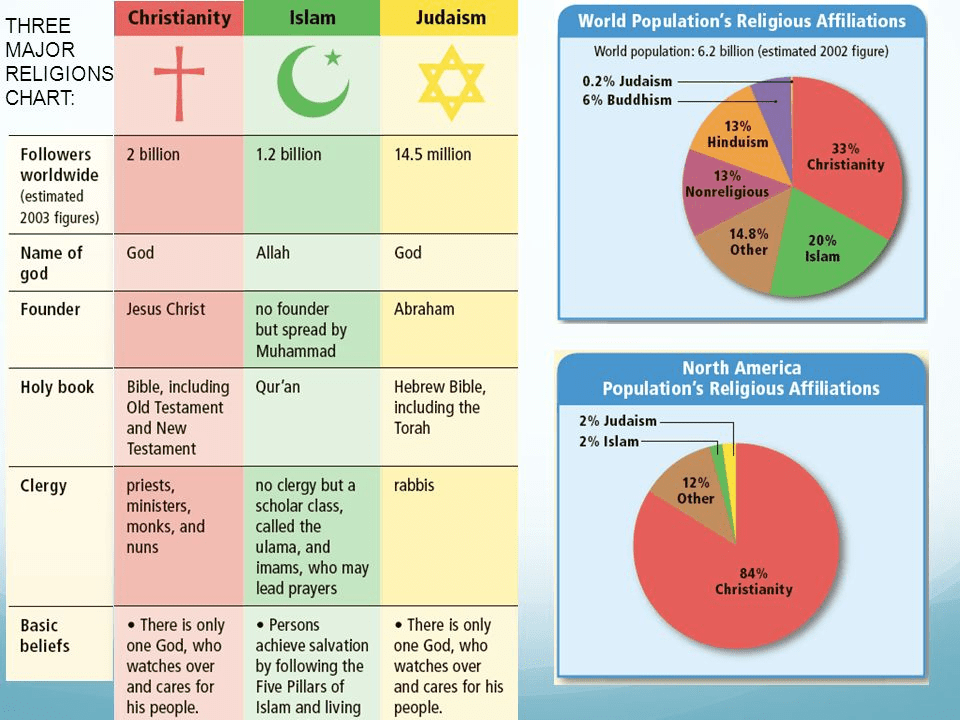 Based on the chart which religion has the least followers?
A. Christianity
B. Hinduism
C. Judaism
D. Islam
C. Judaism
200
Q2
Why do people who live in the Arabian Peninsula choose to live near a source of water?
A. Access to food, agriculture, and trade.
B. Access to raw materials like timber and coal.
C. Access to cultural exchange networks.
D. Access to desert regions.
A. Access to food, agriculture, and trade.
200
The Ottomans controlled trade on rivers, as well as ports on important seas such as the Black Sea and the Mediterranean Sea. When the empire conquered other lands, Ottoman sultans, or leaders, appointed officials to collect taxes from their new subjects. Taxes were a major source of wealth in the Ottoman empire.
Because it covered such a vast area, the Ottoman Empire was composed of many different ethnic groups, including Turks, Greeks, Slavs, Arabs, and Armenians. The Ottomans were Muslim and they spread Islam throughout the empire. They were known for their religious tolerance. Existing religious groups maintained their own practices and communities within the empire.
Source: National Geographic: World Cultures and Geography, 2013 (adapted)
According to the passage about the Ottomans, what were a major source of wealth for the empire?
A. Farming crops and raising livestock
B. Taxes collected from conquered lands and controlling trade on rivers and ports
C. Mining gold and silver within their borders
D. Selling manufactured goods to neighboring empires
B. Taxes collected from conquered lands and controlling trade on rivers and ports
200
Q10
Before 1948, Palestine referred to an approximately 10,000-square-mile area of land bordered by the Jordan River, Egypt, the Mediterranean Sea, Syria, and Lebanon. Jews and Arabs — Muslims as well as Arab Christians — have long lived in Palestine, but ownership is claimed by both groups. Jews believe that Palestine includes the ancient land of Israel, which God promised to them in the Hebrew Bible. By contrast, Palestinian Arabs argue that they should control the region because they have been the majority group in the area for centuries. Hostility between the groups has fueled violence for many decades.
According to the excerpt above, which of the following statements best summarizes the situation in Palestine?
A. Widespread hatred of Christians has led Palestinian Arabs to destroy churches and religious schools in the region.
B. Before 1948, only Jews lived in Palestine, but recent Arab immigration to the region has caused political unrest.
C. The region is politically unstable because neither side is willing to compromise their position.
D. Arab Muslims are the rightful inhabitants of Palestine, but the refusal of Jews and Arab Christians to leave the region has led to frequent skirmishes.
C. The region is politically unstable because neither side is willing to compromise their position.
300
Q1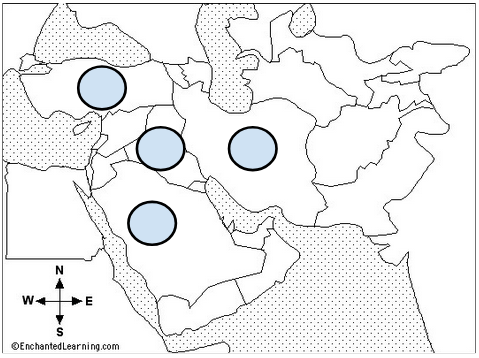
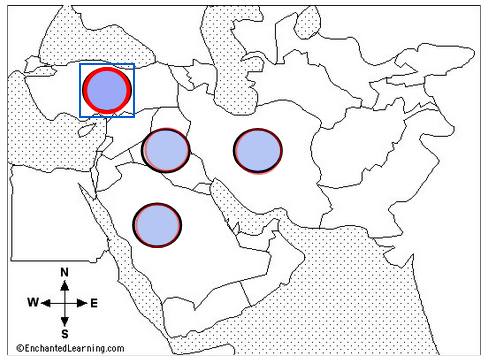
Color the circle on the map that is located inside Turkey.
300
Q6
The Ottomans controlled trade on rivers, as well as ports on important seas such as the Black Sea and the Mediterranean Sea. When the empire conquered other lands, Ottoman sultans, or leaders, appointed officials to collect taxes from their new subjects. Taxes were a major source of wealth in the Ottoman empire.
Because it covered such a vast area, the Ottoman Empire was composed of many different ethnic groups, including Turks, Greeks, Slavs, Arabs, and Armenians. The Ottomans were Muslim and they spread Islam throughout the empire. They were known for their religious tolerance. Existing religious groups maintained their own practices and communities within the empire.
Source: National Geographic: World Cultures and Geography, 2013 (adapted)
Which phrase in the above passage explains what religious tolerance meant in the Ottoman Empire?
A. “The Ottomans controlled trade on rivers, as well as ports on important seas…”
B. “... appointed officials to collect taxes from their new subjects.”
C. “... the Ottoman Empire was composed of many different ethnic groups…”
D. “Existing religious groups maintained their own practices…”
D. “Existing religious groups maintained their own practices…”
300
Directions: The excerpt below is from the Code of Hammurabi, the first important attempt by a ruler to codify (write down) the laws of the land. Hammurabi was king of Babylon (about 1790 BCE). Use the excerpt to answer the question below.
196. If a man put out the eye of another man, his eye shall be put out.
197. If he breaks another man's bone, his bone shall be broken.
198. If he puts out the eye of a freed man, or breaks the bone of a freed man, he shall pay one gold mina.
199. If he puts out the eye of a man's slave, or breaks the bone of a man's slave, he shall pay one-half of its value.
200. If a man knocks out the teeth of his equal, his teeth shall be knocked out.
201. If he knocks out the teeth of a freed man, he shall pay one-third of a gold mina.
What is the common saying we get from the Hammurabi Code?
A. An eye for an eye
B. Treat others as you want to be treated
C. Survival of the fittest
D. United we stand, divided we fall
A. An eye for an eye
400
Q9
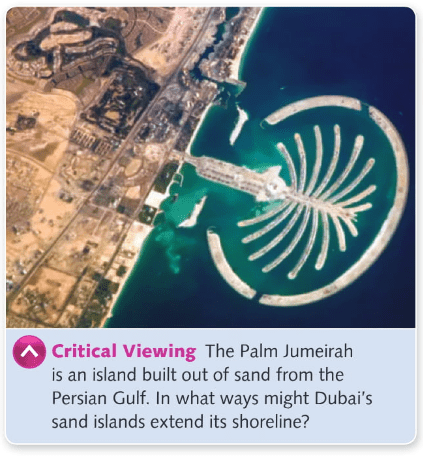
How does the Palm Jumeirah show how a desert society changes the environment to improve life for the humans living there?
A. It shows how by draining the ocean you can expose more land to live on
B. It shows how by building a man-made island people can create more land to live on
C. It shows how by building a sandy island people can decrease the desert so there is more green space
D. It shows how by growing trees in the ocean people can reverse desertification and improve water retention
B. It shows how by building a man-made island people can create more land to live on
400
The Ottomans controlled trade on rivers, as well as ports on important seas such as the Black Sea and the Mediterranean Sea. When the empire conquered other lands, Ottoman sultans, or leaders, appointed officials to collect taxes from their new subjects. Taxes were a major source of wealth in the Ottoman empire.
Because it covered such a vast area, the Ottoman Empire was composed of many different ethnic groups, including Turks, Greeks, Slavs, Arabs, and Armenians. The Ottomans were Muslim and they spread Islam throughout the empire. They were known for their religious tolerance. Existing religious groups maintained their own practices and communities within the empire.
Source: National Geographic: World Cultures and Geography, 2013 (adapted)
Using the Ottoman passage, how did the empire’s ethnic and religious diversity affect its administrative practices?
A. The empire forced all people to follow the same religion and culture
B. The empire avoided collecting taxes from different groups
C. The empire used local officials to collect taxes and allowed religious groups to keep their practices
D. The empire only allowed one ethnic group to hold government positions
C. The empire used local officials to collect taxes and allowed religious groups to keep their practices
400
Q5
Directions: The excerpt below is from the Code of Hammurabi, the first important attempt by a ruler to codify (write down) the laws of the land. Hammurabi was king of Babylon (about 1790 BCE). Use the excerpt to answer the question below.
196. If a man put out the eye of another man, his eye shall be put out.
197. If he breaks another man's bone, his bone shall be broken.
198. If he puts out the eye of a freed man, or breaks the bone of a freed man, he shall pay one gold mina.
199. If he puts out the eye of a man's slave, or breaks the bone of a man's slave, he shall pay one-half of its value.
200. If a man knocks out the teeth of his equal, his teeth shall be knocked out.
201. If he knocks out the teeth of a freed man, he shall pay one-third of a gold mina.
What significant achievement did the Hammurabi Code establish?
A. Consequences to crimes that were equal for everyone, regardless of rank
B. Consequences to crimes that included the establishment of jails
C. Consequences to crimes that did not include violence as punishment
D. Consequences to crimes that were based on the crime committed
D. Consequences to crimes that were based on the crime committed
500
DOUBLE JEPORDY Q11
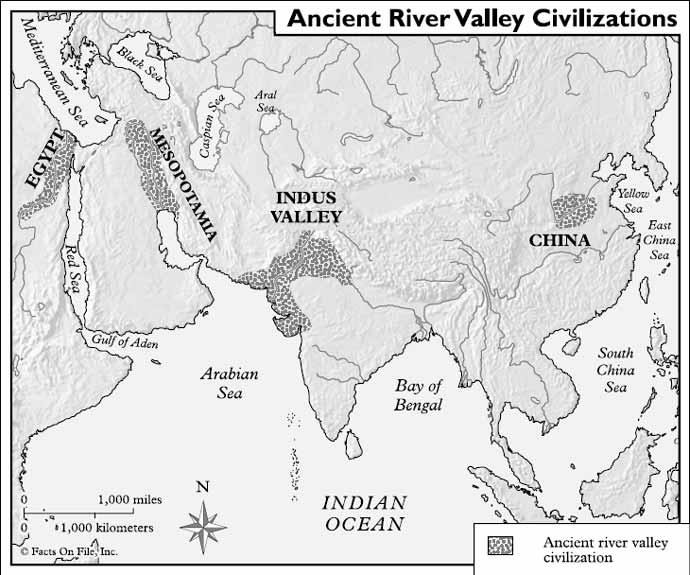
Based on the picture above, what did all locations of early civilizations have in common? What caused early peoples to choose to build settlements in those particular geographic locations?
All locations of early civilizations have in common the river valley because it has access to water to help with farming.
500
Q4
The document below describes the accomplishments of the Sumerians.
The Sumerians lived in southern Mesopotamia. They built a number of cities. Because they lacked stone and timber, they used mud bricks to build walled cities, temples, and palaces. Their architectural innovations included arches, columns, ramps, and the pyramid-shaped ziggurats. These new features and styles influenced building throughout Mesopotamia. In addition, the Sumerians developed copper and bronze tools and weapons.They also developed the world's first known writing, cuneiform. They used it on clay tablets.
Source: Bectu Black, Kriegeq, Naylor, Shabaka World History: Patterns of interaction, McDougal Littell, 1999 (adapted)
According to the document, what were some accomplishments of the Sumerians? Select 3 answers.
A. copper and bronze tools
B. complex political system
C. cuneiform
D. ziggurats
E. new religion
A. copper and bronze tools
C. cuneiform
D. ziggurats
500
Q7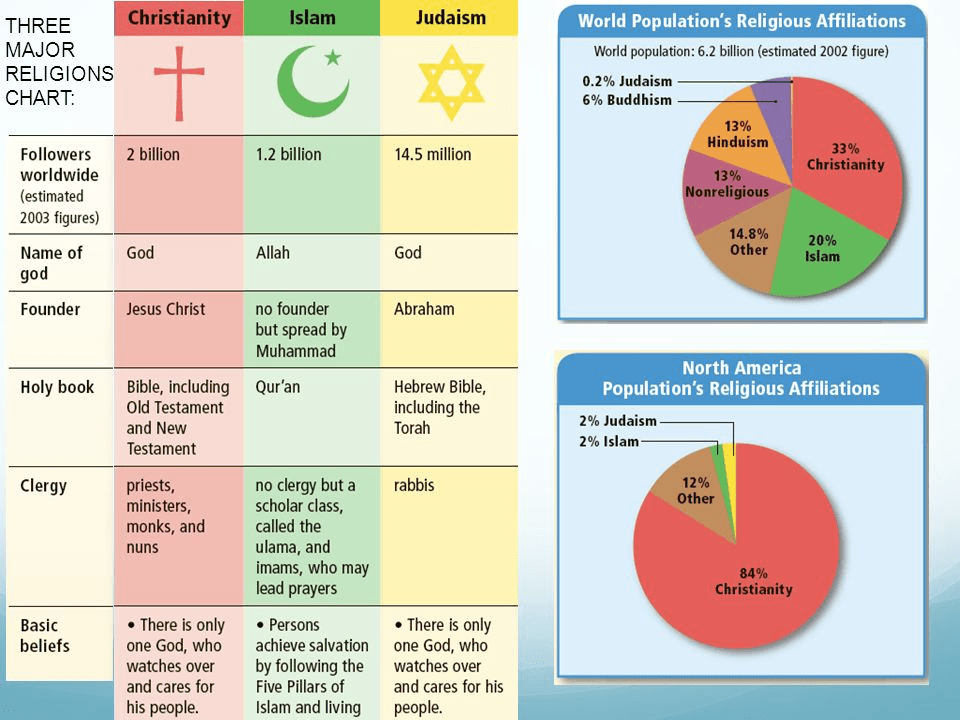
According to the chart above, how are Christianity, Islam, and Judaism similar?
A. Each religion has a clergy
B. Each religion has 14.5 million followers
C. Each religion has a holy book
D. Each religion follows the Five Pillars of Islam
C. Each religion has a holy book