Density
States of Matter
Vocabulary
Energy
Random
100
What is density
Density is how many particles are packed together into one space.
100
Draw a diagram to show how the atoms are arranged in a solid.
Your diagram should show the atoms all close together.
100
What is freezing
changing state from a liquid to a solid
100
Name three types of energy
light, sound heat, kinetic, electrical, chemical potential, gravitational potential, elastic potential.
100
What will happen to your voice if you breath sulfur hexafluoride?
It will get very deep.
200
Why are warm liquids less dense than cold liquids?
Warm liquids have more space between their particles making them less dense. Warm liquids will float on top of cold liquids.
Cold liquids have particles that are closer together because they have less energy and don't move very fast. This makes them more dense than warm liquids.
200
Draw a diagram to COMPARE the atoms in a liquid and a gas.
You should show that the atoms in a gas are more spread out than the atoms in a liquid.
200
What is melting
turning from a solid into a liquid
200
Which particles have more energy, liquids or gases?
Gases have more energy - they are moving faster than the atoms in a liquid and they are more spread out.
200
How can you prove that gas is matter?
Measure the starting mass of an empty balloon.
Add gas to the balloon and tie it up.
Measure the mass of the balloon - find the change in mass to prove that gas has mass (and therefore is matter).
300
How does adding salt to water impact its density?
When you add salt to water you are causing more particles to be in the same space. Adding salt to water INCREASES density.
300
Draw a diagram to show what happens to the atoms when a solid MELTS into a liquid.
You should show that energy is added to the solid.
This makes the particles slowly move faster and spread apart until they are liquid.
300
What is conduction?
How heat travels through a solid.
300
If we can't destroy energy, what happens to it?
Energy changes forms all of the time. So it doesn't disappear it changes into another form.
300
Explain what is happening in this diagram

The light at the bottom heats the wax in the lamp.
The heated wax becomes less dense and rises up.
At the top of the lamp the wax cools down, becomes more dense and sinks.
400
How could you prove that carbon dioxide gas is MORE dense than oxygen gas.
Any reasonable response that involves observing how one floats/sinks in the other.
For example fill a fish tank with carbon dioxide gas and then put a balloon of oxygen gas in it.
The group must agree if a person is correct or not - you can ask a teacher to judge if you can not agree.
400
Divide the examples into two categories 'matter' and not matter':
feathers, oxygen gas, ice cubes, loud music, sand, blue light, carbon dioxide, smoke.
Matter: feathers, oxygen gas, ice cubes, sand, carbon dioxide and smoke.
Not matter: loud music, blue light.
400
What is convection
How heat passes through a liquid or gas
400
A light bulb transforms energy.
a) name the energy that ENTERS a light bulb
b) Name the types of energy that leave the light bulb
c) Which of the energy types you listed in b) could be considered 'wasted energy' .. why?
a) electrical energy
b) heat and light
c) heat is considered wasted energy - we want a light bulb to use most of the electrical energy to make light for us. We don't need heat from the light bulb.
400
Explain what is happening in this diagram

The particles at the end of the solid are getting warmed by the candle.
As the particles above the candle are heated, they start to vibrate more and more.
The vibrating particles bang into the particles next to them - giving them more energy and making them to vibrate more.
The energy is slowly passed all along the solid until it will reach the hand (ouch!).
500
Use this diagram for the questions:
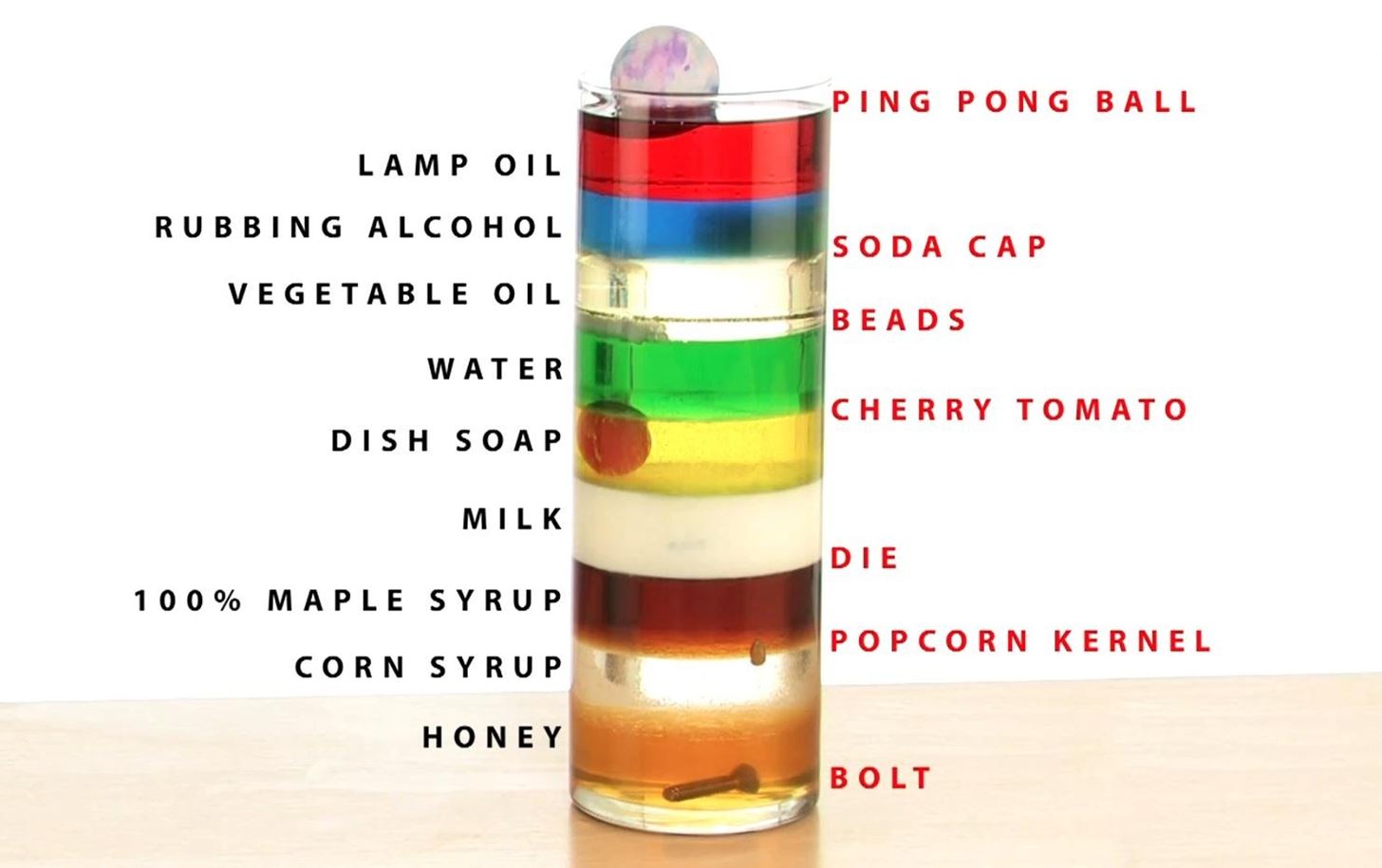
a) Which substance is MOST dense?
b) Which substance is LEAST dense?
c) Name two substances that are MORE dense than the cherry tomato
d) Name two substances that have the SAME density
a) The bolt
b) The ping pong ball
c) Any two of the following: Milk, die, maple syrup, popcorn kernel, corn syrup, honey, bolt.
d) cherry tomato and dish soap OR pop corn kernel and corn syrup OR die and milk OR beads and vegetable oil OR bolt and honey NOT ping pong ball and lamp oil.
500
Samudra was measuring the temperature of wax as it melted.
Here is her graph:
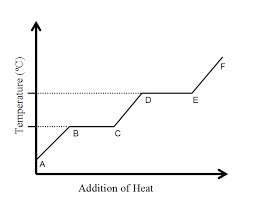
a) Explain why the wax stopped increasing at points B to C in the graph
b) Why did it continue to increase after point C?
c) Why did it stop increasing again at points D to E
a) At points B to C the wax was changing from a solid to a liquid, so the heat energy entering the wax was being used to force the molecules of wax away from each other. There was no energy left over to make the temperature increase.
b) after point C all of the wax had turned into a liquid, so now all of the energy being added to the wax was making the molecules move faster (increasing the temperature of the wax).
c) when the wax turns from a liquid into a gas the temperature will stop increasing again - at points D to E (because the heat energy will be used to make the molecules spread ever further apart).
500
What is matter
Anything that has volume and mass.
500
Name something that can transform CHEMICAL POTENTIAL energy into heat, sound and kinetic energy.
Make sure you explain your answer.
Any answer that the group agrees is correct.
For example, a human! We take energy from food (that is chemical potential) and digest that food turning it into heat (our bodies are warm), we make noises (sound) and we use the energy to move (kinetic)
500
Which state (solid or liquid) will transfer heat faster and why?
A solid will transfer heat faster.
The particles in a solid are closer together - so they bang into each other and share the energy from the heat faster than what can happen in a liquid.