A
B
C
D
E
100
Which statement best compares the structure of the virus versus animal and plant cells?
A. The virus has an outer protein capsid, while both cells have flexible plasma membranes and internal organelles.
b. The virus and the animal cell both have visible nuclei, while only the plant cell contains membrane-bound organelles.
c. The virus and the plant cell have attachment projections, while only the animal cell contains ribosomes and DNA.
d. The virus and plant cell both have protective cell walls of cellulose, while the animal cell lacks any structural boundary.
A. The virus has an outer protein capsid, while both cells have flexible plasma membranes and internal organelles.
100
Penicillin is an antibiotic that is used to treat some bacterial infections by disrupting the formation of bacterial cell walls. Why is penicillin effective against bacterial infections but not viral infections?
a.Bacterial cells have cell walls, while viral cells only have a cell membrane.
b.Viruses reproduce too quickly for penicillin to affect them.
c.Bacterial cells have cell walls, while viruses are not made of cells.
d.Viral cells are smaller than bacterial cells, so penicillin cannot reach them.
c.Bacterial cells have cell walls, while viruses are not made of cells.
100
Which statement best explains why viruses are classified as nonliving organisms?
a.Viruses do not grow, divide, or carry out metabolism on their own.
b.Viruses respond to environmental changes and grow like living cells.
c.Viruses do not contain genetic material or change over time.
d.Viruses synthesize proteins and develop without a host cell.
a.Viruses do not grow, divide, or carry out metabolism on their own.
100
How do virus particles spread throughout the body of an organism and cause disease?
a.Viruses infect cells and cause uncontrolled cell division.
b.Viruses float freely in the bloodstream and take nutrients from host cells.
c.Viruses replicate in the air and destroy cells in the body.
d.Viruses infect cells, reproduce inside, and cause the cells to burst.
d.Viruses infect cells, reproduce inside, and cause the cells to burst.
100
Which statement accurately compares the size of viruses to that of cells?
a.Viruses are smaller than most cells and cannot be seen with a light microscope.
b.Viruses are larger than bacterial cells but smaller than animal cells.
c.Viruses are the same size as most plant cells and can be seen without magnification.
d.Viruses are larger than animal cells but smaller than organelles like the nucleus.
a.Viruses are smaller than most cells and cannot be seen with a light microscope.
200
Green fluorescent protein (GFP) is a naturally fluorescent protein originally derived from jellyfish. Scientists can genetically engineer viruses to carry the GFP gene so that infected cells actively producing viral proteins will glow green when viewed under a fluorescent microscope. In a research study, a scientist uses GFP to tag viruses inside infected cells. In Group A, the presence of GFP indicates that viral particles are forming in the cytoplasm of the host cell. In Group B, no viral particles are observed in the cytoplasm, but viral DNA is detected within the host cell nucleus.
Which statement best explains the results of this study?
a. Group A cells are in the lysogenic cycle and store viral DNA for later release.
b. Group A cells are in the lytic cycle and produce viruses that will exit the cells.
c. Group B cells are in the lytic cycle, but viral particles are still invisible.
d. Group B cells are in the lysogenic cycle and slowly destroy the cytoplasm.
b. Group A cells are in the lytic cycle and produce viruses that will exit the cells.
200
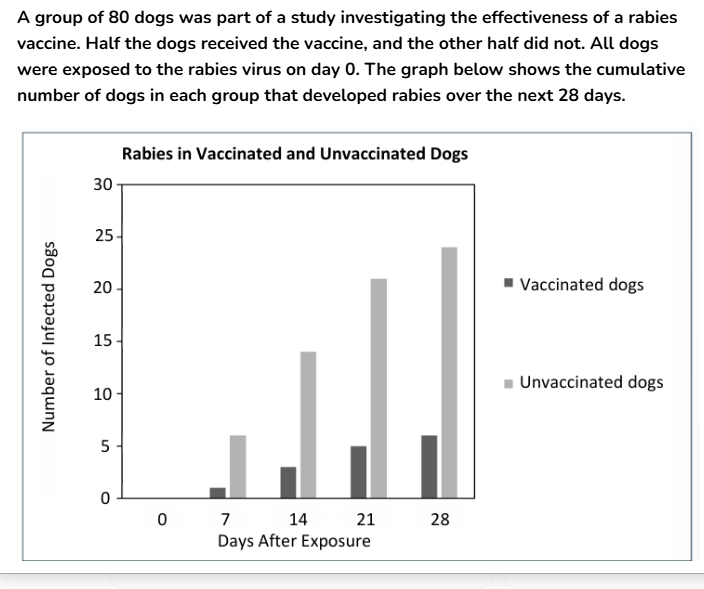
What conclusion can be drawn about the effect of the rabies vaccine on the dogs?
a.Vaccinated dogs were exposed to a smaller dose of the virus, which slowed infection.
b.Vaccinated dogs produced antibodies, but the antibodies did not prevent the virus from entering cells.
c.The rabies vaccine caused the dogs to produce antibodies that protected them from infection.
d.The rabies vaccine caused a temporary increase in immune cells that did not recognize the virus.
c.The rabies vaccine caused the dogs to produce antibodies that protected them from infection.
200
A virus infects bacteria in a wastewater treatment facility. For several weeks, no bacterial death is observed. Then suddenly, many bacterial cells lyse and release large numbers of viruses. Which process most likely occurred in the bacteria before the outbreak?
a.Viral RNA immediately began producing proteins and lysed the host cells.
b.Viral DNA integrated into bacterial DNA and remained dormant before activation.
c.Viral particles fused with host ribosomes and started making bacterial cell walls.
d.Viral DNA destroyed bacterial enzymes and shut down all cellular metabolism.
b.Viral DNA integrated into bacterial DNA and remained dormant before activation.
200
Complete the sentences by selecting the correct answer from each drop-down menu.
A virus infects a cell by first injecting its ______and replicating. The infection spreads and causes disease when the virus forces the cell to ______which releases new viruses that can infect other cells.
Nucleic acid
lyse
200
The varicella-zoster virus (VZV), which causes shingles, can remain dormant in nerve cells for years before producing symptoms.
The norovirus infects the cells of the digestive system and produces symptoms within 12 to 48 hours after infection. It spreads rapidly through contaminated food, water, or surfaces.
Which of the following best describes the viral replication cycles of these viruses?
a.VZV undergoes a lysogenic cycle, and norovirus undergoes a lytic cycle.
b.VZV undergoes a lytic cycle, and norovirus undergoes a lysogenic cycle.
c.Both VZV and norovirus undergo a lysogenic cycle.
d.Both VZV and norovirus undergo a lytic cycle.
a.VZV undergoes a lysogenic cycle, and norovirus undergoes a lytic cycle.
300
Describe the function of each of the following structures in a virus:
DNA/RNA
Capsid
lipid membrane
surface markers
DNA/RNA- provide genetic info
Capsid-enclose the genome
lipid membrane- protects viral particle
surface markers- attach to host cell
300
The tobacco mosaic virus (TMV) is a virus that infects plants, including tomato and tobacco plants. Infected plants may develop mosaic patterns on their leaves, exhibit stunted growth, and produce fewer fruits.
How does the tobacco mosaic virus cause disease in plants?
a.The virus enters plant cells and repairs structures, which disrupts normal development.
b.The virus redirects the activities of plant cells to make new virus parts, which damage the cells.
c.The virus breaks down plant cell walls, which changes nutrient distribution and slows growth.
d.The virus causes mutations in plant DNA, which interfere with normal cell function.
b.The virus redirects the activities of plant cells to make new virus parts, which damage the cells.
300
Which of the following is a natural way humans protect themselves from viral infections?
a.Skin provides a physical barrier, and antibodies recognize and help destroy viruses.
b.Cells produce antibiotics, and enzymes destroy viruses before they enter the body.
c.Stomach acid digests viruses, and red blood cells remove them from the bloodstream.
d.Fever increases body temperature, and oxygen-carrying cells eliminate viruses from tissues.
a.Skin provides a physical barrier, and antibodies recognize and help destroy viruses.
300
Some viruses have an envelope that surrounds their capsid. The image below shows an enveloped virus and an animal cell.
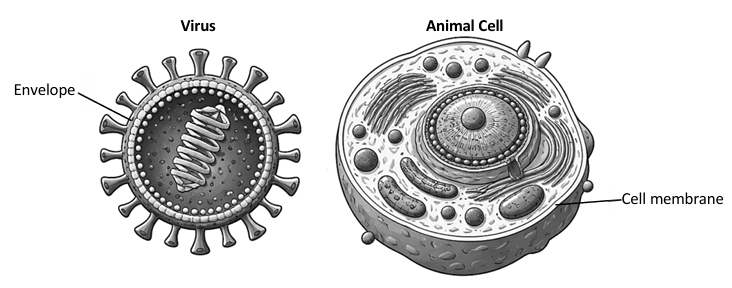
How are the viral envelope and the cell membrane similar?
a.Both contain carbohydrates that help the virus or cell generate energy.
b.Both contain lipids that allow the virus or cell to replicate independently.
c.Both contain proteins that regulate the transport of substances across the virus or cell.
d.Both are lipid bilayers that surround and protect the virus or cell.
d.Both are lipid bilayers that surround and protect the virus or cell.
300
Which statement correctly describes viral genomes?
a.Viruses contain only DNA.
b.Viruses contain only RNA.
c.Viruses contain both DNA and RNA.
d.Viruses contain either DNA or RNA.
d.Viruses contain either DNA or RNA.
400
Viruses and parasites both interact with other organisms in order to carry out their life processes. Which characteristic is shared by both viruses and parasites?
a.They can carry out all life functions independently of a host.
b.They decompose organic material in the environment for nutrients.
c.They are composed of many specialized cells that perform functions.
d.They rely on a host organism for resources and reproduction.
d.They rely on a host organism for resources and reproduction.
400
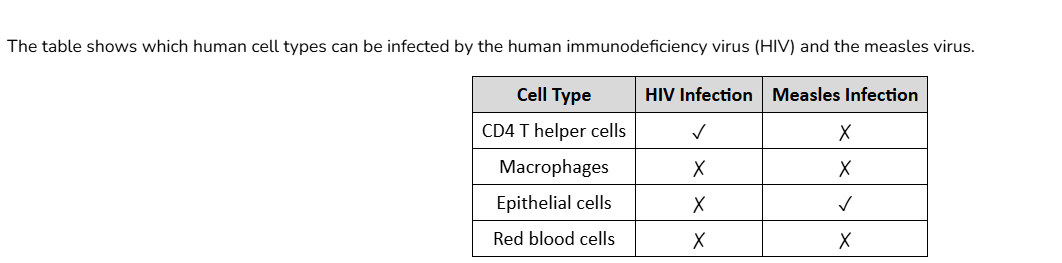
Why does HIV infect only CD4 T helper cells while the measles virus infects only epithelial cells?
a.Each virus can attach to all cells, but only certain cells produce proteins that prevent infection.
b.Each virus infects all immune cells but kills only the target cell type.
c.Each virus can attach only to cells that have specific surface receptors recognized by that virus.
d.Each virus can enter any cell but can replicate only in cells that produce energy rapidly.
c.Each virus can attach only to cells that have specific surface receptors recognized by that virus
400
The image shows a model of an adenovirus.
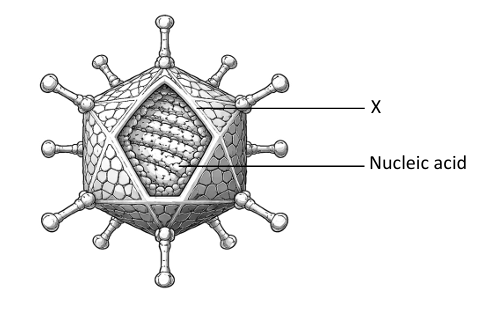
What viral protein structure, labeled X, surrounds and protects the virus’s nucleic acid?
Capsid
400
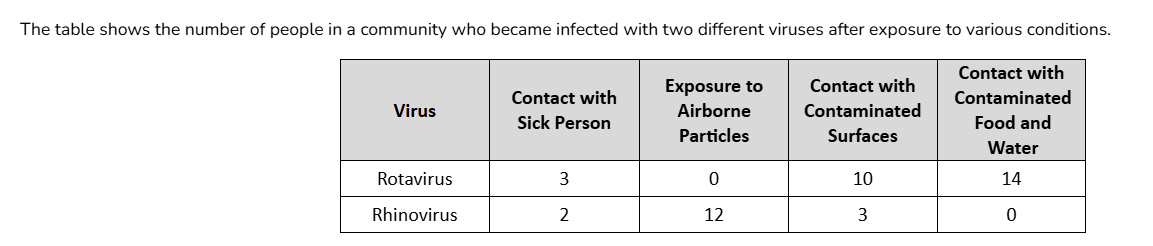
Based on the data above, which statement best describes how each virus is primarily spread?
a.Rotavirus spreads mostly through airborne particles, while rhinovirus spreads mostly through contact with sick people.
b.Rotavirus spreads mostly through contaminated surfaces, food, and water, while rhinovirus spreads mostly through airborne particles.
c.Both rotavirus and rhinovirus spread mostly through contaminated surfaces.
d.Both rotavirus and rhinovirus spread mostly through contact with sick people.
b.Rotavirus spreads mostly through contaminated surfaces, food, and water, while rhinovirus spreads mostly through airborne particles.
500
Several members of a high school basketball team were diagnosed with influenza A after participating in a weekend tournament. During the event, players huddled closely together on the bench, shared water bottles, and used the same locker room facilities between games.
Which statement best explains how influenza A most likely spread and infected some members of the basketball team?
a.The virus entered body cells through mutation and immediately destroyed them.
b.The virus spread through contaminated surfaces and replicated inside the body’s cells.
c.The virus carried out metabolism independently before invading body cells.
d.The virus traveled as airborne spores, entered body cells, and remained dormant.
b.The virus spread through contaminated surfaces and replicated inside the body’s cells.
500
Which characteristics are true of both cells and viruses?
Select TWO correct answers.
a.Reproduce independently
b.Are living organisms
c.Change over time
d.Have a cytoplasm
e.Contain genetic material
c.Change over time
e.Contain genetic material
500
The image shows a bacteriophage interacting with a bacterial cell membrane.
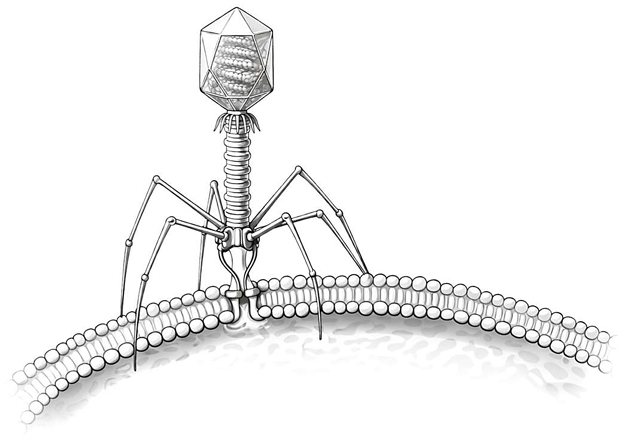
Which statement best describes the process shown in the image?
a.The capsid of the bacteriophage attaches to any receptor molecule on the surface of the bacterial cell membrane, which allows entry into the cell.
b.The tail fibers of the bacteriophage dissolve the phospholipid bilayer of the bacterial cell membrane and create an opening for entry.
c.The tail fibers of the bacteriophage attach to complementary receptor molecules on the bacterial cell membrane and allow the virus to penetrate the cell.
d.The capsid of the bacteriophage releases enzymes into the bacterial cell membrane and forces the virus into the cell.
c.The tail fibers of the bacteriophage attach to complementary receptor molecules on the bacterial cell membrane and allow the virus to penetrate the cell.
500
A teacher lists several traits of a pathogen.
- Contains DNA
- Can mutate
- Has surface markers
- Requires a host cell to replicate
Based on these traits, Student 1 states that the pathogen is a bacterium, Student 2 states that the pathogen is a fungus, and Student 3 states that the pathogen is a virus.
Identify which student is correct AND explain why that student is correct.
Student 3, requires a host