Basic Ecology
Community Interactions
Aquatic food chain/webs
Aquatic food chain/webs pt.2
Population Dynamics
100
A living thing in an ecosystem
Biotic factor
100
Bees get the nectar they need to make honey by traveling between flowers. The bee brings pollen from one plant to another, resulting in pollination.
Mutualism
100
Another word for a consumer
heterotroph
100
Recycles dead organisms back into nutrients for plants
Decomposers
100
The number of organisms that a region can support without environmental degradation
Carrying capacity
200
Consumers that eat only plants
Herbivores
200
Pea crabs live inside mollusks, including mussels, oysters, sea urchins, and sand dollars, stealing food and occasionally taking bites of their hosts.
Parasitism
200

The third-order consumer
Snake
200
The difference between food chains and food webs
Food chains only follow one path of animals finding food. A food web contains multiple food chains.
200
A lion is a predator of deer. If the lions die, the population of the deer goes up or down?
Up
300
a position or role taken by a kind of organism within its community.
niche
300
A lion chases, hunt down, and eats a deer.
Predation
300
Starts all food webs/chains
The sun
300
Percent of energy that is moved up through each level of a food chain
10%
300

Give a brief description of this graph considering that the lynx is a predator of the hare.
As hares increase, the lynxes increase meaning the hares decrease and so on.
400
The distribution of moth species in an ecosystem is affected by environmental changes. A change in which of these factors is least likely to affect the distribution of moths?
A Temperature
B Soil pH
C Availability of water
D Composition of gases in the atmosphere
B
400
Male zebras fight to defend their territory.
(Intraspecific) Competition
400
Each level of a food chain
Trophic level
400
Explain why the base of food pyramids is larger in size then the top of the food pyramid.
There are more producers because they store more energy which is required to sustain an ecosystem.
400
The carrying capacity is this type of growth.
Logistic growth
500
Name three things that organisms within a species might compete for.
Territory, mates, food
500
Kudzu vines cover trees. The trees die because of the lack of sunlight.
(Interspecific) Competition
500
One type of phytoplankton
Cyanobacteria, dinoflagellates, diatom
500
Organic matter produced by the decomposition of organisms
detritus
500
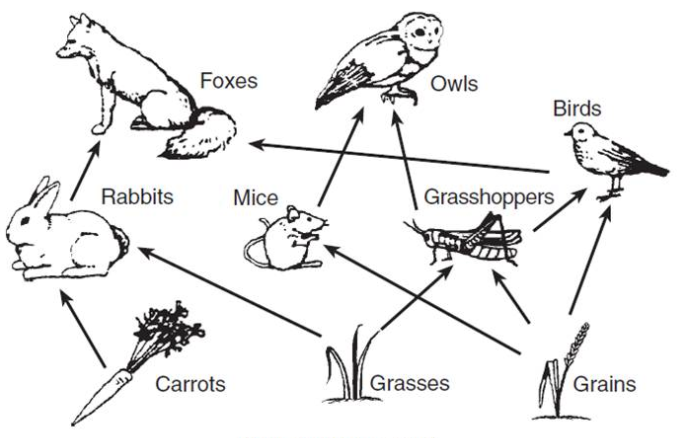
If the rabbits die, name two things that would happen in terms of population increase or decrease
Carrots increase, birds decrease, grasshoppers increase