Waves
Parts of a Wave
L v T
Interference/Amplitude
Trivia
100
waves in which the particles move parallel (same direction) to the direction of the wave
Longitudinal Wave
100
the distance between any two crests or compressions next to each other in a wave
wavelength
100
Sound wave
Longitudinal
100
the two interfering waves have a displacement in the same direction.
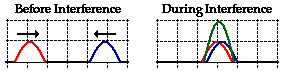
Constructive Interference
100
What is the relationship between periods and the frequency
They are inversely proportional
200
waves in which the particles move perpendicular (up and down) to the direction of the wave
Transverse wave
200
the number of waves produced in a given amount of time
frequency
200
Moving energy
Longitudinal/Transverse
200
the two interfering waves have a displacement going in opposite directions
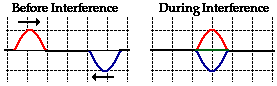
Destructive Interference
200
What do waves carry from one end to the other?
Energy
300
waves that do not require a medium; examples include x-rays
Electromagnetic waves
300
Highest point of a wave
crest
300

transverse
300
If there are single pulses of equal sizes on the same side of a spring, what happens to the amplitude?
It doubles
300
What is the height of the wave called?
The amplitude
400
waves that require a medium; examples include ocean waves and sound waves
Mechanical waves
400
Lowest point of a wave
trough
400

longitudinal
400
If there are pulses of different sizes on the same side of a spring, what happens to the amplitude?
It shrinks
400
What is the state of a wave that does not change over time called?
Equilibrium
500
any disturbance that transmits energy through matter or empty space?
Wave
500
the maximum distance that the particles of a medium vibrate from their rest position
amplitude
500
Electromagnetic waves
Transverse
500
If there are single pulses of the same size on opposite sides of a spring, what is the amplitude?
Zero
500
What is the relationship between a wavelength and a period?
One period = One wavelength