Relationship Statements
Graphs
Math
Random
Vocabulary
100
As frequency increases, the energy of the wave...
increases.
100
What is the amplitude of this wave?
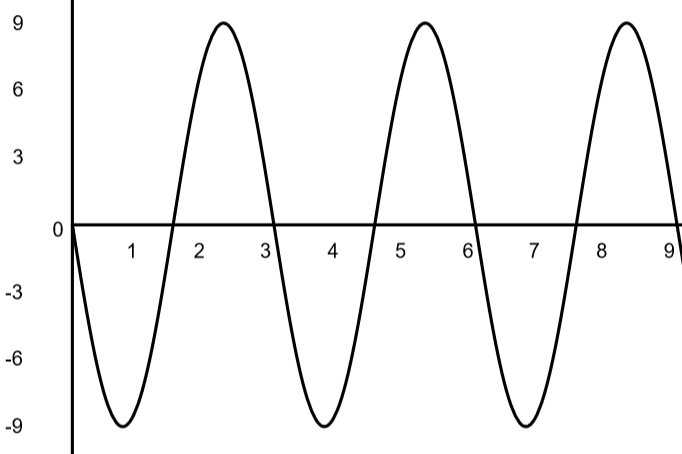
Amplitude = 9
100
One end of the rope is vibrated to produce a wave with a wavelength of .25 m. The Frequency of the wave is 3.0 Hz. What is the speed of the wave?
.75 m/s
100
What unit is wave frequency measured in?
Hz ( Hertz)
100
The high point of a transverse wave
crest
200
As amplitude decreases, the energy of the wave...
decreases.
200
What is the wavelength of this wave?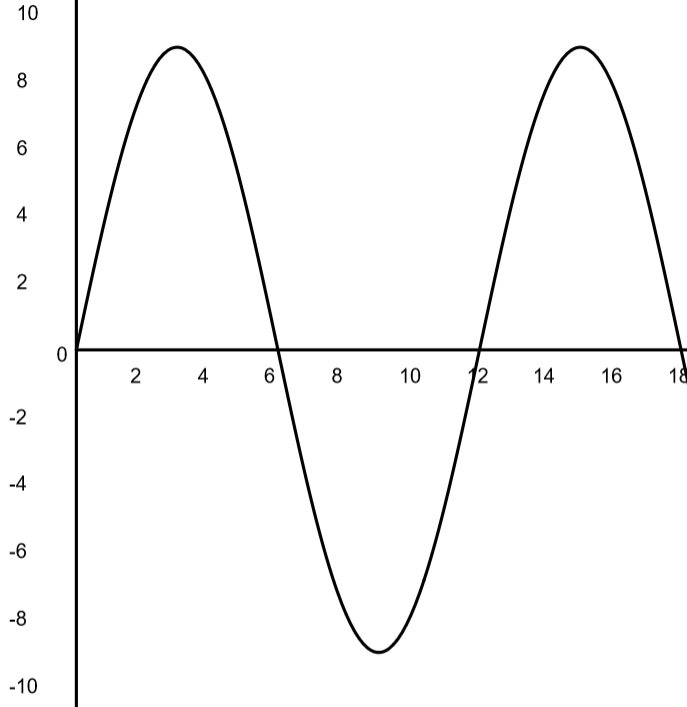
Wavelength = 12
200
A wave has frequency of 50 Hz and a wavelength of 10 m. What is the speed of the wave?
500 m/s
200
What part of a sound wave measures loudness?
Amplitude
200
The low point of a transverse wave
Trough
300
If the energy of the wave increases, the amplitude....
Increases.
300
What is the amplitude of this wave?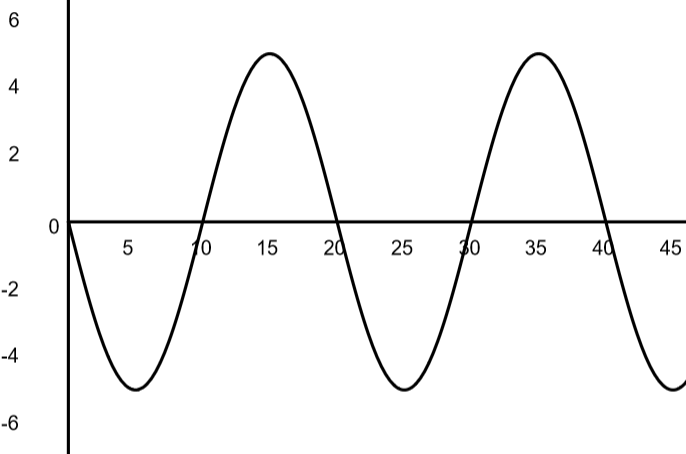
Amplitude = 5
300
A wave has frequency of 5 Hz and a speed of 25 m/s. What is the wavelength of the wave?
5 m
300
Two waves are superimposed. The final wave has a bigger amplitude than the two individual waves. What type of interference is this?
Constructive
300
The distance between the identical point in two waves (like two crests or two troughs).
Wavelength
400
As the frequency increases, the wavelength.....
decreases.
400
What is the amplitude of this wave?

Amplitude = 9
400
A wave has wavelength of 10 m and a speed of 340 m/s. What is the frequency of the wave?
34 Hz
400
Sound waves move through a _________.
Medium
400
The measure of how high or low a wave is
Amplitude
500
As amplitude decreases, the wavelength....
stays the same.
500
What is the wavelength of this wave?

Wavelength = 3
500
How many nodes does a standing wave have if it has 4 antinodes?
5 nodes
500
What is the difference between the period and the frequency?
The period measures how long one wavelength takes to pass an observer. The frequency measures how many wavelengths pass an observer in one second.
500
A wave produced by particles moving parallel to the direction that the wave travels.
Longitudinal wave