Investigations
Definitions
Concepts
Get up and move!
Hmm...think about it
100
During the Warmth of the Sun investigation, was the water in the sun cooler or warmer than the water inside the classroom?
The water in the sun was warmer.
What is warmer?
100
Define the axis of the earth.
The imaginary line on which the Earth is tilted that runs from the North to South pole.
100
Why is the water cycle important to understanding weather and climate?
It shows the movement of water on Earth and in the atmosphere. Water is a crucial part of weather and understanding a region's climate.
100
Go to the globe and touch the equator.
The middle line dividing the Earth into two hemispheres.
100
During the winter solstice in the Northern hemisphere, is it also the winter solstice in the Southern Hemisphere? If not, what is it?
No, it is the summer solstice because the seasons are flipped.
200
What happened to the sunrise and sunset over time when we collected weather data?
The sunrise and sunset showed that the length of the day was shortening.
The sun was rising later and setting earlier.
200
Define the sun according to the water cycle diagram.
The sun is defined as the "source of light and heat".
200
Explain the reason for seasons.
The earth's tilt causes the seasons. Different parts of the earth receive different amounts of direct and indirect sunlight, which impacts seasons in a given place.
200
With your group, get up and demonstrate how you might feel in a polar climate.
Cold!!! Brr.
200
Why do you think it is important to study weather and climate?
Answers will vary.
300
Was the ground temperature usually cooler or warmer than the air temperature?
Usually cooler (look at data for evidence).
300
Name this weather tool: 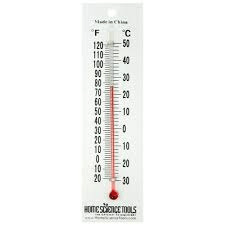
Thermometer.
300
How do we determine a region's climate?
Observing a region's weather over long periods of time will help us understand a region's climate. Different geographical features can contribute to a region's climate.
300
With your group, act out the different parts of the water cycle.
Sun- source of light and heat.
When water cannot be held in a cloud any longer (condensation), water falls from the sky in the form of precipitation (rain, snow, sleet, hail) and runs over earth's surface (runoff). It can be transported back into the atmosphere in the form of evaporation and transpiration (from plants).
300
Which climate zone do we live in? Worldwide and also specific to the US?
Temperate.
Humid continental.