Weather
Mechanics
Hazards
Planning and Resources
ELOs
100
The common altimeter reference point for nearly all types of flight
sea level (MSL)
100
Neutrally stable air is __ with respect to surrounding air temperature
the same temperature
100
Two types of fog
radiation and advection
100
What is a METAR
Aviation Routine Weather Report; communicate the latest observed weather to meteorologists and aircrew
(page 103)
100
A decrease of one inch of mercury in atmospheric pressure would cause a change in an altimeter reading of approximately
(assuming constant elevation and altimeter setting).
plus 1000 feet
200
A condition where the air temperature aloft is higher than that of the lower atmosphere
temperature inversion
200
A trough is
an extension of a low-pressure area (page 100)
200
Icing conditions
Freezing temperatures, visible moisture, and aircraft skin temperature below freezing
(atmosphere must have supercooled visible water droplets... free air temperature and the aircraft’s surface temperature must be below freezing, page 61)
200
A TAF is
Terminal Aerodrome Forecast; surface forecasted weather conditions, usually a 24 hour forecast
(page 116)
200
A squall line is
a line of violent thunderstorms. They are indicated on surface charts by a dashed, double-dotted red line. (page 44)
300
Cold air masses are considered ___ because the air is ___ than the surface.
unstable, colder
300
The four methods of lifting
Convergence; two air masses, or parts of a single air mass, force the air upward because it has nowhere else to go
Frontal; cold fronts, as they move through an area, they will lift the air ahead of the cold air mass
Orographic; the force of the wind against a mountainside pushes the air upward
Thermal; also known as convective lifting, is caused when cool air is over a warm surface, and it is heightened by intense solar heating
300
Thunderstorm hazards (6)
extreme turbulence, hail, microbursts, severe icing, lightning, and tornadoes
(page 75)
300
Categories of weather advisories (3)
Severe Weather Watch Bulletins
SIGMET (convective and non-convective)
AIRMET
(page 142)
300
Frontal discontinuities, particularly ___ (4) are used to locate and classify fronts
temperature, moisture (indicated by the dew point), winds, and pressure
(page 39)
400
The types of altitudes (4)
True altitude (AGL); height above the terrain directly beneath the aircraft.
Mean Sea Level (MSL); correcting calibrated altitude for temperature deviations from the standard atmosphere.
Pressure Altitude (PA); height above the standard datum plane.
Density Altitude (DA); pressure altitude corrected for nonstandard temperature deviations.
400
The four kinds of fronts and their chart symbol
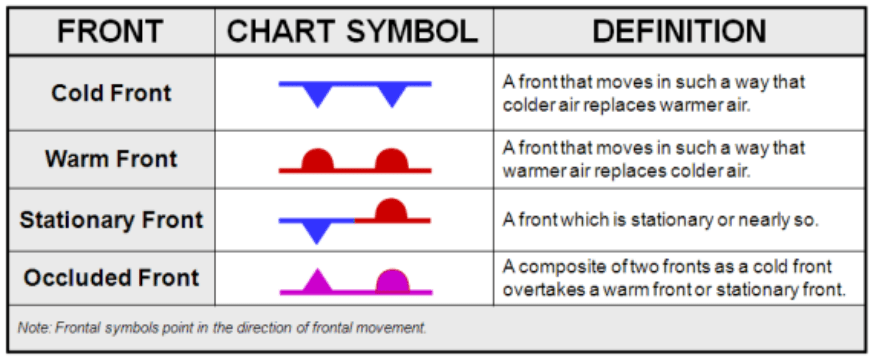
(page 38)
400
Signs of a microburst (5/6)
virga, localized blowing dust (especially in circular or elliptical patterns), rain shafts with rain diverging away from the core of the cell, roll clouds, and, of course, experiencing vivid lightning or tornado-like activity
(page 80)
400
Winds-Aloft are never forecasted for these conditions (3)
Wind information is never forecast for altitudes within 1500 feet of the surface.
Temperature information is never forecast within 2500 feet of the surface.
Temperature information is never forecast for the 3000-foot level.
(page 138)
400
The DD 175-1 is
Flight Weather Briefing, and is prepared and used by the local weather office to brief pilots on weather conditions both locally and along a planned route of flight
(page 140)
500
Standard day conditions of sea level pressure, temperature, pressure lapse rate, and temperature lapse rate
29.92 in-Hg, 15° C, 1 in-Hg / 1000', 2° C/1000'
500
Four cloud groups and their two principal forms
Groups
1. Low clouds, ranging from just above the surface to 6500 feet AGL.
2. Middle clouds with bases between 6500 and 20,000 feet AGL.
3. High clouds found above 20,000 feet AGL.
4. Special clouds with extensive vertical development.
Forms:
1. Cumuliform – A lumpy, billowy cloud with a base showing a definite pattern or structure.
2. Stratiform – A cloud with a uniform base, formed in horizontal, sheet-like layers
(page 29)
500
The recommended techniques for avoiding thunderstorms (4)
1. Fly around (circumnavigate) the storm.
2. Fly over the top of the storm.
3. Fly under the storm.
4. If it is not possible to avoid the storm(s) then, fly through the lower ⅓ of the storm.
(page 83)
500
The METAR format
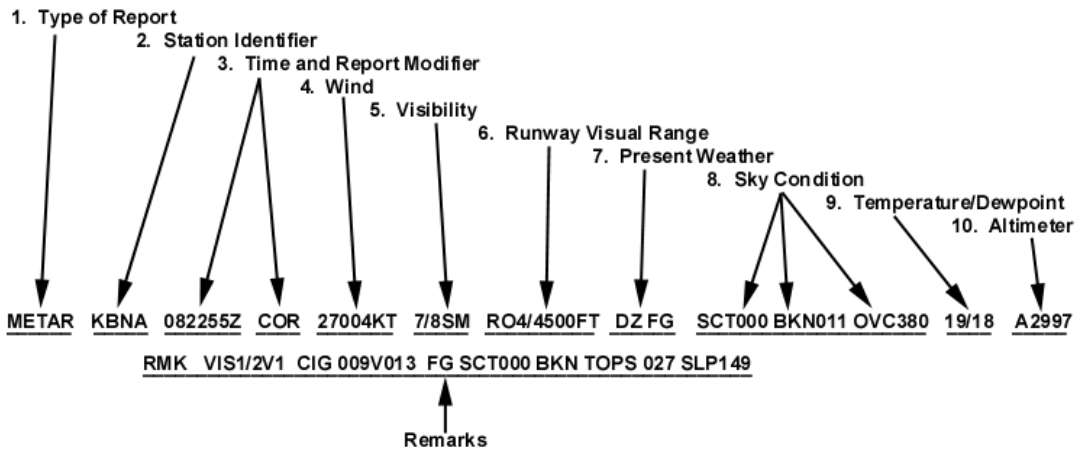
500
Flight techniques for turbulence (4)
1. Establish and maintain thrust settings consistent with turbulent air penetration airspeed and aircraft attitude. Severe turbulence may cause large and rapid variations in indicated airspeed. Don’t chase airspeed.
2. Trim the aircraft for level flight at the recommended turbulent air penetration airspeed. Don’t change trim after the proper attitude has been established.
3. The key to flying through turbulence is proper attitude control. Both pitch and bank should be controlled by reference to the attitude gyro indicator. Extreme gusts may cause large changes in pitch or bank. To avoid overstressing the aircraft, don’t make abrupt control inputs. Use moderate control inputs to reestablish the desired attitude.
4. Severe vertical gusts may cause appreciable altitude deviations. Allow altitude to vary. Sacrifice altitude to maintain desired attitude. Don’t chase the altimeter.
(page 60)