Spooky Scary Skeleton
Glutes Gone Wild
Vibe Check
"Why does this hurt?"
Bad Hip
Electric Boogie - NMES Edition
Grown up Babies
Babies R Walkin
100
This structure is formed by 3 bones: ilium (2/5), ischium (2/5), and pubis (1/5)
Acetabulum
100
This structure is considered the "key" to the gluteal region because structures are either found above or below it
Piriformis
100
Name the muscle length tests that can be conducted in a hip exam (Name at least 2)
Ely Test
Thomas Test
90/90 Test
Ober's Test
Piriformis Length Test
100
What is included in the category "Contractile Tissue"?
Muscles and Tendons
100
Name at least 1 pathology that effects a largely pediatric population?
Apophysitis, Avulsion, Slipped Capital Femoral Epiphysis, Legg Calve Perthes
100
What currents are best for a tetanic contraction? (Name at least 1)
BSPC
Russian
IFC
MFBurstPC
100
Name at least one of the variables that influence growth
Nutrition
Hormones
Drugs
Environment
Mechanical Forces
100
What is most important in the development of gait?
Practice
200
How many degrees of freedom does the hip joint have?
3 (flexion/extension, abduction/adduction, internal/external rotation)
200
What muscle groups belong in each of the three compartments of the thigh?
Anterior: quads (and sartorius)
Posterior: hamstrings
Medial: adductors
200
Which examination tests concern the TFL and ITB?
Ober's Test
Noble's Compression Test
(Technically also Thomas Test)
200
A patient arrives complaining of pain with shoulder flexion as well as shoulder extension, what other Selective Tissue Test might elicit pain?
Resisted Isometric Contractions
200
Name at least 1 pathology that effects a largely older population?
Hip OA
Greater Trochanteric Pain Syndrome
Hip Strain/Tendinopathy
Femoral Stress Fracture
200
For NMES, what frequency range would be best?
50 - 80 pps
200
This term identifies the center of bone growth that is located at the distal ends
Epiphyseal Plate
200
What are some common chief concerns for children in gait development? (Name 2)
In-toeing/Out-toeing
Knock Knees
Flat Feet
Hip Clicks
Toe Walking
Late Walking
300
What comprises the intracapsular structures of the hip joint?
Femoral Head and Neck
300
What is the function of the quadratus femoris?
Hip External Rotation
300
What is the beginning position for the FADDIR test?
Flexion, Abduction, Lateral/External Rotation (then you scoop into adduction and internal rotation)
300
A patient arrives to the clinic complaining of pain with a hamstring stretch as well as pain with knee flexion and hip extension, what tissue type are you most concerned about?
Non-Contractile Tissue
300
What is the capsular pattern for Hip OA?
IR > Hip Flexion > Hip Abduction
300
Name the 3 Theories of Strength Gains?
Type 2 Fiber Activation
Overload Principle
Synchronous Firing of Motor Units
300
Is genu varum or genu valgum expected in the first year of life?
Genu Varum
300
At which age is heel strike consistently seen in gait?
2 years old (24 months)
400
What is the function of the labrum?
Deepens Acetabulum
400
What muscle(s) of the hip and posterior thigh have dual innervation?
Biceps Femoris (tibial nerve and peroneal nerve)
400
Your friend is an aspiring supermodel and shows you her best supermodel runway walk, as you observe you notice that her R hip drops compared to her L hip during R LE swing phase. What does she have?
Positive L Trendelenberg
400
Name at least 2 structures that are included with non-contractile tissues?
Joint Capsules, Ligaments, Cartilage, Nerves, Bursae
400
This pathology refers to a type of labral tear presenting as a non-round femoral head that is unable to rotate smoothly inside the acetabulum; a bump generally forms on the edge of the femoral head that grinds the cartilage inside the acetabulum
Cam Lesion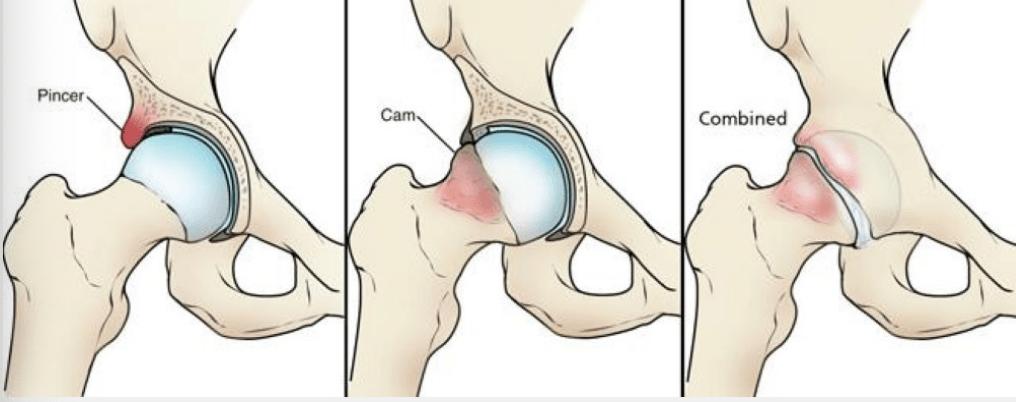
400
Concerning muscle contraction, would increasing or decreasing the current amplitude increase the force of contraction?
Increasing
400
What two forces change and mold skeletal development?
Compression (Weightbearing) and Shear (Muscle Pull Forces)
400
Name one of the three causes of in-toe gait
Persistent Femoral Anteversion
Internal Tibial Torsion
Forefoot Adductus
500
In what position is the hip joint maximally congruent?
Flexion, Abduction, and slight ER (more movement is available in this position --> discuss what the closed packed position is)
500
Identify this muscle
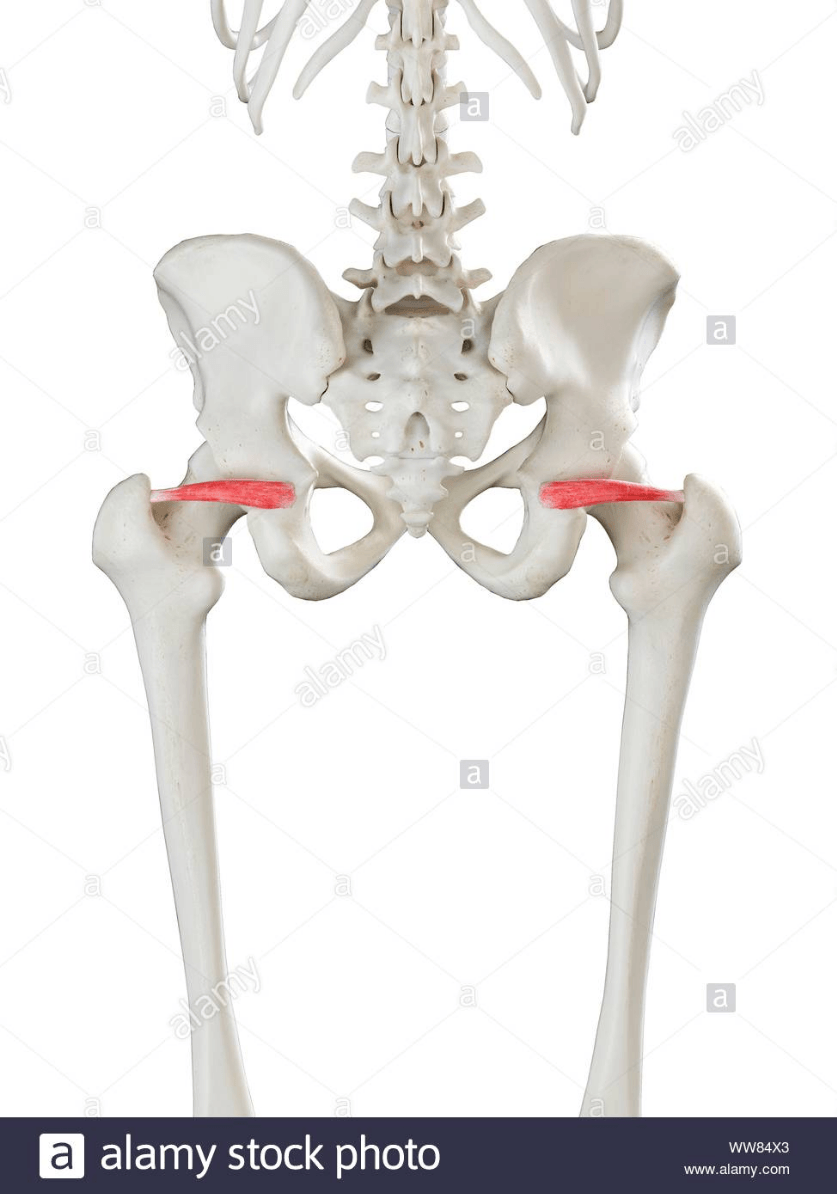
Superior Gemellus
500
What are the tests for intra-articular joint pathology?
Scour Tests
FABER/Patrick's Test
500
In a Passive Movement Exam, if you encounter pain before the motion barrier; is the injury considered acute/subacute/chronic?
Acute
500
Which pathologies effect Contractile Tissues? (Name 2)
Greater Trochanteric Pain Syndrome
Hip Strains/Tendinopathy
Adductor Strain
500
What is the ideal on/off time for NMES?
10/50
500
What does the SALTER acronym stand for and describe?
Straight Across
Above (Growth plate)
Lower/below (Growth plate)
To/Through (Growth plate)
ERasure (of Growth plate)
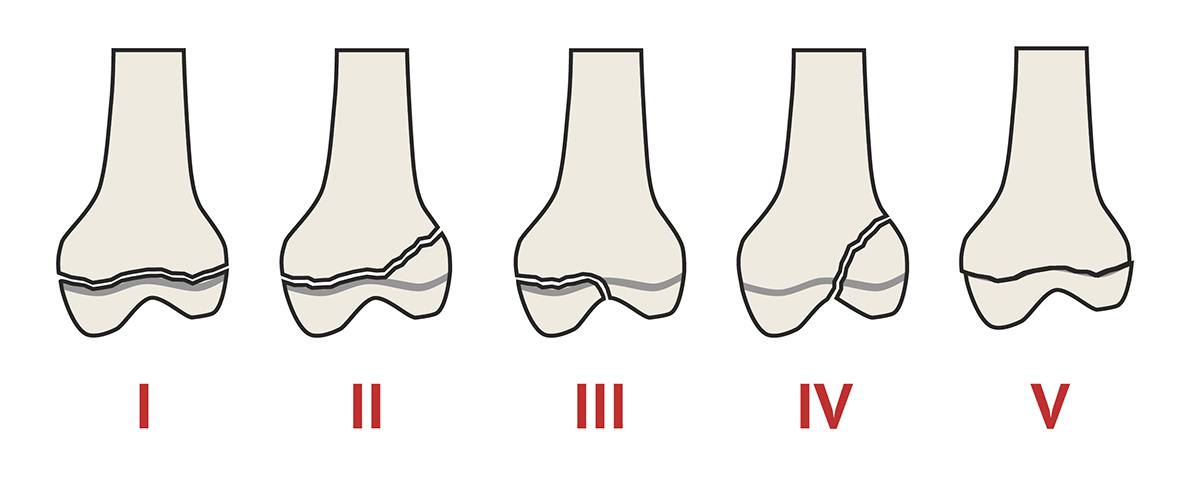
500
At what age range would you expect to see a narrowed BoS?
18 - 24 months
600
This angulation of the femur is measured in the frontal place and has a normal value of 125 degrees
Angle of Inclination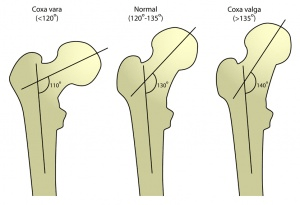
coxa vara = more stable
coxa valga = more mobile600
True or False: All of the gluteus muscles perform a common action of hip external rotation
False
Glute max: hip extension + hip ER
Glute med: hip abd + hip IR + hip ER
Glute min: hip abd + hip IR
600
OMG! Your patient has a Craig's Test result of 25 degrees on their right leg, what does that mean?
Anteversion of the R Hip
600
If a Resisted Isometric Contraction is painful or weak, what tissue type is involved?
Contractile Tissue
600
This pathology refers to the inflammation or occurrence of a stress injury on/around growth plates in children and adolescents
Apophysitis
600
Name the appropriate pulse duration range for motor level reactions
100 - 600 microseconds (or more)
600
At what age range would you expect to see a NORMAL decrease in flexibility?
11 - 14 years old (due to growth spurt and muscle length needing to 'catch up')
600
At what age is knee flexion in mid-stance consistent?
3 - 3.5 years old
700
What ligaments assist at the hip joint?
Iliofemoral: Y-shaped with origin on AIIS and insertion on Greater Trochanter --> limits hip extension
Ischiofemoral: posterior ligament with origin on acetabular labrum and insertion on anterior Greater Trochanter --> limits hip extension)
Pubofemoral: anterior ligament with origin on superior rami and insertion on trochanteric fossa --> limits hip abduction)
700
Name the short external rotator muscles (6)
Piriformis
Obturator Internus
Obturator Externus
Superior Gemelli
Inferior Gemelli
Quadratus Femoris
700
Apparent/Functional Leg Length is measured from what two landmarks?
Umbilicus and Medial Malleolus
700
A patient arrives in the clinic 2 months post knee injury; during the exam, the symptoms are reproduced with active knee extension and during the Thomas Test. You are able to passively move the patient up to their motion barrier but not through it due to pain.
Is this Contractile/Non-Contractile Tissue Injury AND is it acute/subacute/chronic?
Subacute Contractile Tissue Injury
700
What is the CPR for Hip OA?
Hip/Groin Pain (or Paresthesias)
Ipsilateral Anterior Thigh Pain
Passive Knee Flexion < 122 degrees
Passive Hip IR < 17 degrees
Pain with Hip Distraction
700
Name the appropriate range for ramp up/down times
1 - 5 seconds
700
What are the 4 F's of DDH (Developmental Dysplasia of the Hip)?
Female
First Born
Feet First
Family History
700
At what age would a normally developing child have a fully mature gait?
6 - 7 years old
800
What are the normal values for the femoral angle of torsion?
8 - 15 degrees
800
If the innervation of the superior gemellus were interrupted, what other specific muscle would be effected?
Obturator Internus
(superior gemellus + obturator internus = innervated by 'nerve to superior gemellus and obturator internus)
Same goes for inferior gemellus and quadratus femoris
800
Which two pairs of tests have the same starting position?
Anteroposterior impingement test and Anterior Labral Test (flexion + abduction + lateral rotation)
Scour and Posterior Labral Test (flexion + adduction + medial rotation)
800
A patient presents to PT for evaluation; during the exam, the patient has pain and limited range of motion with shoulder abduction. Noticing the limited ROM, you take the patient through passive ROM and are able to exceed the motion barrier before the patient experiences pain. When taking the patient through an MMT screen, they score a 3+/5 with shoulder abduction.
Is this a Contractile/Non-Contractile Tissue injury AND acute/subacute/chronic?
Chronic Contractile Tissue Injury
800
Which pathology (mostly present in a pediatric setting) includes the following 4 stages?
1. Necrosis (portions of bone turn into dead into dead tissue and the femoral head becomes less round)
2. Fragmentation (body 'cleaning up' dead bone and replaces it, allowing the femoral head to begin remodeling)
3. Re-Ossification (femoral head continues to remodel)
4. Remodeling (normal bone cells replace new bone cells to continue remodeling for a few years)
Legg Calve Perthes
800
How long should one treatment session last for NMES?
10 - 20 minutes
800
At what age is the adult coverage of the femoral head reached?
8 years old
800
Name two characteristics of gait seen in a 9 month old
Wide BoS
Hip Abduction
Hip ER
Hip Flexion
Genu Varum
Everted Heel