Chemistry Lingo
Random Acts of Chemistry
Periodic Puzzlers
Degrees of Difficulty
Atmospheric
Bio Throwback
100
The electrons in an atom’s outer shell — their name comes from the Latin word for “power.”
What are valence electrons?
100
In chemistry, it’s made of two or more different elements; in real estate, it’s a property with multiple units.
What is a compound?
100
World Book calls it “a poisonous, yellowish-green gas with a strong, unpleasant odor” — perfect for disinfecting your pool.
What is chlorine?
100
On the Celsius scale, pure water freezes at this temperature.
What is 0 degrees Celsius?
100
Produced by burning fossil fuels, this greenhouse gas helps trap heat in Earth’s atmosphere.
What is carbon dioxide (CO₂)?
100
Photosynthesis converts water and carbon dioxide into sugar and this gas.
What is oxygen?
200
A neutron has nearly the same mass as this other type of subatomic particle.
What is a proton?
200
In carbon dioxide, atoms share two pairs of electrons, forming a double covalent this.
What is a bond?
200
In a flame test, this element — atomic number 11 — burns yellow and gives fireworks their golden glow.
What is sodium?
200
At 100°C, liquid water becomes this phase of matter.
What is gas (or water vapor)?
200
Chemically, it’s the formula for a pure snowflake.
What is H2O?
200
Alcoholic fermentation of sugar produces ethanol and this gas.
What is carbon dioxide?
300
It’s the general term for a chemical process that turns one substance into another; give us your gut...
What is a reaction?
300
This smallest unit of an element retains all the properties of that element.
What is an atom?
300
This precious metal and platinum are among the heaviest minerals, settling easily in stream beds.
What is gold?
300
The lowest possible temperature, –459.67°F, is known as absolute this.
What is zero?
300
Why: Because blue frequencies of light are scattered more in the atmosphere than others.
Why is the sky blue?
300
DNA’s two strands are held together by these weak bonds between nitrogenous bases.
What are hydrogen bonds?
400
The fundamental chemistry unit is 6.02 x 10²³ atoms or molecules — not a garden pest.
What is a mole?
400
Below 32°F, H₂O is considered this type of naturally formed substance.
What is a mineral (ice)?
400
Sodium chloride is the chemical name for this seasoning mineral.
What is (table)salt?
400
If your mom says you have a fever of 39°, she’s using this temperature scale.
What is Celsius?
400
Lightning powers the conversion of nitrogen gas into nitrates in this natural cycle.
What is the nitrogen cycle?
400
Caused by hydrogen bonding, this property of water lets insects skate across its surface.
What is surface tension?
500
When “electro” meets this gloomy outlook, it measures an atom’s pull on shared electrons.
What is electronegativity?
500
Named for a German chemist, this tool seen here really turns up the heat.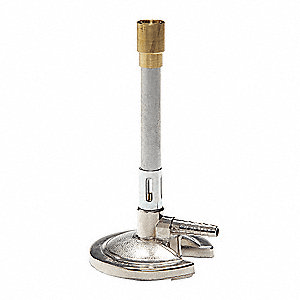
What is a Bunsen burner?
500
The chemical elements are arrayed according to atomic number on this, a name indicating regular intervals.
What is the periodic table?
500
In the 1700s, he created the first practical mercury thermometer and the temperature scale named for him.
Who is Daniel Fahrenheit?
500
Sulfur dioxide emissions can lead to this acidic atmospheric fallout.
What is acid rain?
500
In water molecules, oxygen is slightly negative and hydrogen slightly positive, making water this type of molecule.
What is polar?