PARTICLE DIAGRAMS
PHYSICAL OR CHEMICAL
Mixture/SEPARATION
ENERGY/PHASE CHANGE
Mixture vs Pure Substance
100
Which of these shows a pure substance
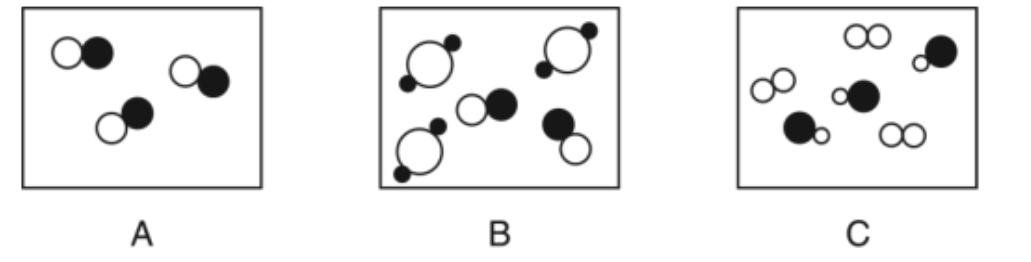
A - compound
100
Type of change that does not alter the identity of matter
Physical change
100
The distribution of particles in a heterogeneous mixture is
uneven, unequal, not uniform throughout
100
What does the Law of Conservation of Energy/Mass tell us?
Energy/mass cannot be created or destroyed - only changed in form
100
Elements A and B combine chemically to make C
C must be a
COMPOUND
200
Which diagram represents a solid
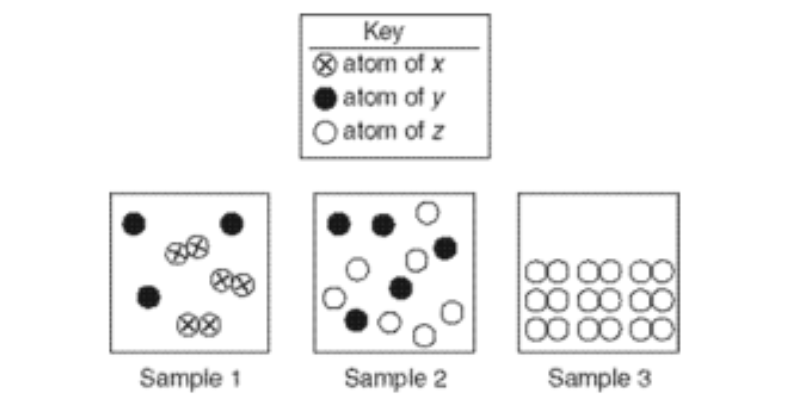
3
200
physical or chemical properties:
See, hear, touch, smell, feel, measure
Physical properties
200
What is a synonym for homogeneous mixtures?
Solutions (bonus points if you remember how we denote/short hand that in a chemical equation)
200
If energy is given off (as heat or light)
Exothermic reaction
200
Which is an example of a compound:
Ca
NH3
Salt Water
U
NH3 - Ammonia!
300
Which diagram shows a mixture of an element and a compound
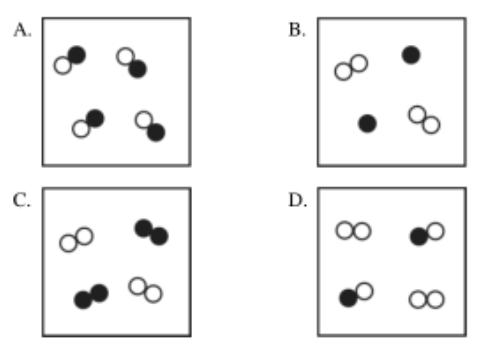
D
300
Physical or chemical change: Dissolving sugar in water
Physical - no NEW substance created
300
Separates liquids from solids in a heterogeneous mixture
Filtration
300
If energy is absorbed/taken in (most commonly as heat)
Endothermic reaction
300
Which type of matter can be broken down chemically?
Compounds
400
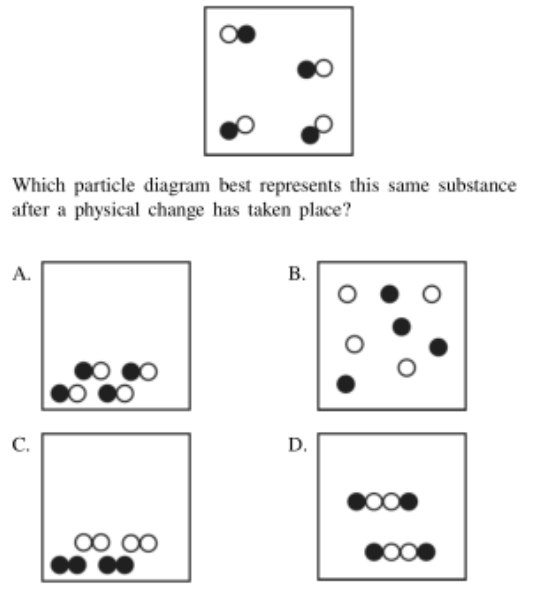
A - solid
400
Give two ways to identify if a chemical change has occurred
Heat, light, sound, bubbles, unexpected color change, formation of new substance, explosion
400
Separates mixtures based on their boiling points when there are large differences with the boiling points
Distillation
400
- Does NOT have a definite shape
- Does NOT have a fixed volume
- Takes the shape of its container AND fills its container
- Can be squashed
Gas
400
Smallest unit of an element or compound
An Atom
500
Does this diagram show a physical or chemical change

Chemical - new substance (compound) formed
500
Mixing vinegar and baking soda
Chemical reaction
500
Homogeneous or Heterogeneous: Oil + Water in a flask
Heterogeneous - you see the layers!
500
Which formula do I use when I change the temperature of a substance?
q = mcdeltaT
Bonus points if you can tell me the two other formulas and when to use them
500
Is air a mixture or a pure substance - give one reason/justification
Mixture of compounds and elements (carbon dioxide, water vapor,,,, oxygen, nitrogen, hydrogen, helium, argon)