Ecology
Cells
Mitosis/Meiosis
Biochemistry
Genetics
100
An animal that eats other organisms
Consumer
100
gelatinous liquid that fills the inside of a cell
cytoplasm
100
This is the stage a body cell spends most of it's life cycle.
interphase
100
Item in a chemical reaction that has the ability to speed up a reaction and also lower the activation energy.
enzyme
100
What does DNA stand for?
deoxyribose nucleic acid
200
the variety of species in an ecosystem
biodiversity
200
movement of particles from high to low
diffusion
200
A type of cell division that results in four daughter cells.
meiosis
200
Molecules that have one end slightly positive and one end slightly negative are called.
polar
200
The four nitrogen bases found in DNA.
adenine, thymine, cytosine, guanine
300
Identify the relationship shown on the graph

predator and prey
300
Simple cells without a nucleus or membrane-bound organelles
prokaryote
300
How many cells are created in mitosis? Are they haploid or diploid cells?
2 diploid cells
300
The three components that make up a nucleotide are.
sugar, phosphate, nitrogen base
300
A homozygous dominant spotted cow has Ss as its genotype. What is the genotype of an unspotted cow?
ss
400
the stable, mature stage of a community
climax community
400
The transportation system of a cell
Endoplasmic Reticulum (ER)
400
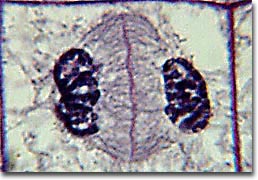
anaphase
400
This molecule encodes genetic information?
nucleic acid
400
This describes two of the same copies of a gene
homologous chromosomes
500
Difference between primary and secondary succession
secondary succession starts with soil
500
This tonicity implies that the solutes across a membrane are in relative equilibrium with one another:
isotonic
500
In humans, how many chromosomes does each gamete contain?
23
500
This polymer is made up of glycerol and fatty acids.
lipids
500
a capital letter represents what type of trait?
dominant