Huffing but for your health
Oh boy time to tell apart different shades of pink
Air goes wooooooshh
Kids, smoking is bad
Dont you dare disappoint Dr Read Pukuli Worley
Are there golden tickets for Passing Step?
100
This drug is commonly used in combination therapy with ICS for the treatment of moderate to sever persistent asthma. Its major warnings is
Prolonged QT interval and sudden cardiac death (salmeterol)
100
All paranasal sinuses drain into the middle meatus except for (2)
Triple Jeopardy: Name where the exceptions drain into
sphenoid sinus-spheno-ethmoidal recess
nasal lacrimal duct-inferior meatus
100
A patient in primary respiratory acidosis would have what ABG values?
double jeopardy: example of a clinical scenario that a patient might present with
pH <7.35, PaCo2>40 mmhg normal or slightly elevated HCO3- (depending on timing if the body has started to compensate)
Clinical examples of Primary Respiratory Acidosis: Severe Asthma/COPD exacerbation, opioid overdose, obesity hypoventilation syndrome, Stroke, etc
100
a 78 y/o male presents to his primary care for increased SOB for the past few years. He has lived next to a factory for his entire life. He endorses nonproductive cough, dyspnea and fatigue. Biopsy of lung shows the following
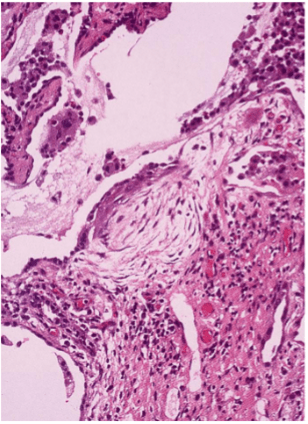
What is the most likely cause of these symptoms?
Double jeopardy: what additional findings would you see on imaging?
Triple Jeopardy: Name one treatment that slows the disease progression
Idiopathic pulmonary fibrosis
decrease in type 1 pneumocytes, increase in type 2 pneumocytes, increase in fibroblasts, honeycombing appearance of lung, peripheral reticular opacities primarily in lower lobes
Treatment: nintedanib
100
The #1 cause for ventilator acquired pneumonia and its treatment
pseudomonas, Piperacillin, tazobactam
100
Greg is a 45 y/o male presenting to his annual check up. He tells you his life has started to fall apart. His wife left him because she couldnt sleep next to the "grizzly bear" in the bedroom. His kids dont talk to him because he almost crashed the car while driving to school. His family thinks he is an alcoholic but he swears he has been sober for 10 years. He states he is constantly tired, falling asleep while driving, while watching tv, literally any time of day. He has gained a significant amout of weight over the last few years and has a BMI of 38. Based on this patient's symptoms what complications is he most likely to develop without treatment?
Pulmonary HTN and right heart failure
also type 2 diabetes, non alcoholic fatty liver disease.
(Pt has sleep apnea)
200
This drug class are the 1 choice in urticaria and second choice in allergic rhinitis for help in relieving sneezing, itching and rhinorrhea These drugs are least sedating in this class and are save to use in patients with CKD
Loratadine, Fexofenadine (also save in liver disease)
200
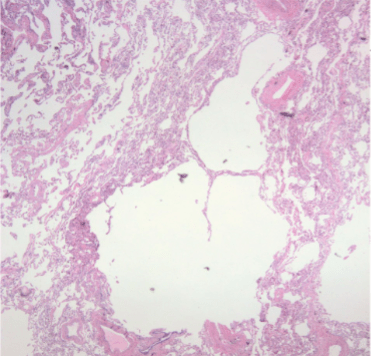
The conditon that presents with the above sample from the terminal bronchials most commonly affects which lobe of the lung.
Double jeopardy: what is most common cause of this.
Upper Lobes, Smoking
Centriacinar emphysema
200
The vital capacity of the lungs is equivalent to the sum of these values:
IRV-inspiratory Reserve volume
Vt-tidal volume
ERV-expiratory reserve volume
200
This is the definitive way to diagnose pulmonary hypertension group 4.
Double jeopardy, what is the treatment?
V/Q scan Group 4- chronic thromboembolic
Indefinite anticoagulation
200
Kyle is a 17 y/o male presenting to the ED with SOB and cough. He is a senior in high school and went to a party a few weeks ago and has been sick ever since. No one else seems to be sick except for the "cool" kids in school. Chest Ct showed the following image. 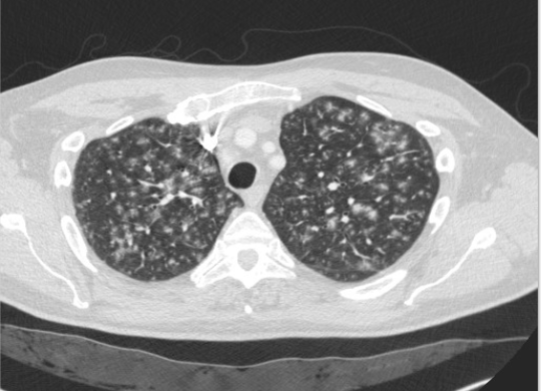
While waiting for results, the nurse says she confiscated a flash drive looking thing from Kyle after seeing him try to impress the nursing assistant from blowing funny shapes of smoke out of his mouth.
What is the most likely etiology of his current symptoms?
Vaping Product associated Lung injury: Vitmain E acetate from E cigarettes
200
This Non small cell lung carcinoma can cause the following symptoms
hoarseness, horner's syndrome, svc syndrome, shoulder pain, sensorimotor deficits, hemidiaphragm paralysis
Pancoast tumor
300
These medications are particularly good for treating aspirin induced and exercised induced asthma. A common side effect is an increase in serum hepatic enzymes, HA and dyspepsia.
What is the main MOA for each drug in this class (2)
Zileuton-5-lipooxygenase inhibitor-decreases leukotrine formation
Zafirlukast/Montelukast-selective LT1 receptor antagonists
Leukotrine modifiers
300
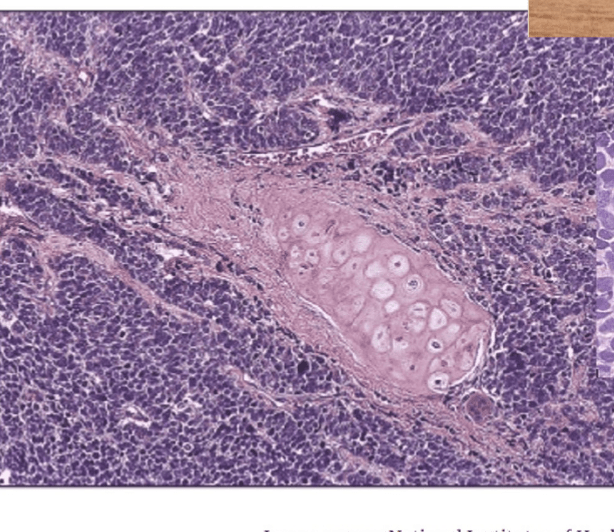 This type of cancer is commonly associated with these conditions
2-normal points
4-double jeopardy
SIADH, Lambert Eaton, Cushing's syndrome, encephalomyelitis
Small cell carcinoma
300
A patient has an increase in cellular respiration and O2 consumption would expect to see what kind of shift on the oxygen dissociation curve?
Right shift (exercise)
(increase cellular respiration leads to increase Co2 production and decrease in pH)
300
You have traveled back in time to March 2020 to complete your ICU rotation. Your first patient is a 19 y/o female intubated after severe respiratory failure following some sort viral infection doctors have yet to identify. The attending explains that her x ray showed bilateral diffuse fluffy infiltrates and ct showed bilateral ground glass opacities. She states they they have tried everything including fluid restriction, corticosteroids, mechanical ventilation and even ecmo but nothing seems to work. You, a med student from the future, went to class and remember what Dr Wong Said about the #1 treatment for ARDS during this difficult time. You suggest it to the attending, and the patient has a miraculous recovery. The attending decides to name this miraculous treatment protocol after you.
What intervention did you suggest to the attending that saved your patient's life?
Proning
Pt has ARDS from covid-19
300
A 60 y/o female presents to free clinic for a work physical. She recently immigrated from india to live with family in worcester. She is going to start working in a day care and needs a clear bill of health to start working. She says she is UTD on all vaccines. She has a positive TST.
How would you determine if her positive TST is latent TB?
Double Jeopardy: What treatment is recommended for latent TB?
Latent TB
Chest xray-usually normal, some evidence of previously healed TB (active-upper lobe cavitation with surrounding air space opacities)
Symptoms: none (reactivation TB would have-cough, fever, night sweats weight loss
Treatment: 3 months-isoniazid+B6+rifampin
4 Months-rifampin
300
A posterior palatal cleft is caused by the failure of what to fuse?
lateral palatine processes fail to fuse with each other and with the nasal septum
400
Doug is a 78 y/o male with a pmh of copd, htn, chronic bronchitis. He has been on tiotropium, salmeterol and fluticasone for a year with no relief in symptoms. He has been to the hospital 3 times with COPD exasperations despite diligently taking his meds (lets be real, his wife is the one that makes sure he takes it every day)
You are considering adding another medication to his regimen. What would you advise Doug about this new medication?
New medication-Roflumilast
Side effects-weight loss, nausea, diarrhea, HA, depression, anxiety, insomnia
Pt also can not take rifampicin or phenytoin while on the medication.
MOA:PD4 inhibitor
400
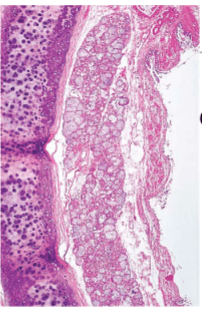
A 65 y/o male with a 45 yr pack hx presents to your clinic for a cough. He states he has had a productive cough with thick mucus on and off for approx 2 years. A bronchoscopy took the following sample from his lungs.
You do PFTs on this patient, what would you expect to see for the following values:
FEV1/FVC, TLC and DLCO
FEV1/FVC decreased (below 0.7)
TLC increased
DLCO normal
400
Whitney is a 26 y/o female presenting to the Er with shortness of breath. She recently came from a hot dog eating contest this morning and won from eating 67 full hot dogs. She denies choking or vomiting any food up (cause that would be cheating and she has a title to defend). She has some slight blue colored lips and pale fingertips. She got a call from one of the other contenders that they are also feeling unwell and there is a question of contamination of the hotdogs they ate.
What would you expect to see for the following values?
Hb concentration, SaO2, PaCo2, Total O2
Double Jeopardy: how do you treat it?
Hb concentration-normal, SaO2-decreased, PaCo2-normal, Total O2 content-decreased, chocolate colored blood
Treated with methylene blue and vitamin C
400
Mary Obrien presents to the ED for SOB. She describes that over the past month, she hasnt been able to talk as fast as she normally does. The other block leaders have had to budget almost an extra hr for her to do her lectures, not the usual 65 slides in 15 minute pace she is used to. PMH includes MI 2 years ago, a stab wound from 6 months ago. Meds include metoprolol, sacubitril/valsartan combo, and spirolactone. A left lateral decubitus x ray shows a white opacity on the lateral wall of the thoracic cavity. Her Blood work is as follows:
Serum LDH: 150 U/l Serum Protein: 7.5 g/dl
Thorocentesis shows: protein 3 g/dl, LDH: 80 U/l
What is the etiology of her current symptoms?
What are other causes of the fluid analysis given?
Transudate Pleural Effusion caused by congestive heart failure
Other causes: hepatic hydrothorax, hypoalbuminemia,
400
Joey is a 35 y/o male presenting to clinic with fever malaise and dyspnea. He stated he was fine two days ago but woke up yesterday morning with a cough with blood streaked sputum, chills. He has no medical hx does not smoke and has had no potential environmental or occupational exposures. Gram stain of his sputum produced gram positive cocci in pairs.
What findings would you expect to see on chest x ray and physical exam?
Double Jeopardy how would you treat him?
PE: egophony and dullness to percussion in unilateral lower lung field
Chest X ray: opacity in lower lobe (consolidation)
Treatment: CAP outpatient-macrolide (also accept ceftriaxone)
400
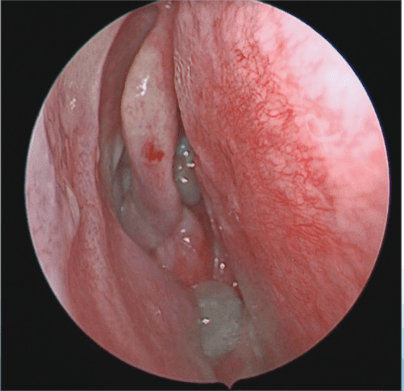
This benign vascular neoplasm primarily presents in adolescent males with unilateral nasal obstruction and epistaxis. Name a possible complication of the treatment of this condition.
dry eye after surgery (possible to sever the nerve of the pterygoid canal/vidian nerve)
Juvenile Nasopharyngeal Angiofibroma
500
Brittany is a 35 y/o female presenting to the clinic with progressive shortness of breath. She stated it started relatively mild but now has progressed that she can barely walk around her house without getting winded. She said she had a wild time in her 20s and was a groupie for Blink 182. She often would take meds out of the giant fish bowl they had on the tour bus. She hasn't seen the doctor in over 2 years since she moved. She said she had some sort of weird test and they stuck a wire in her chest and said her lung had low pressure. She is concerned about taking alot of medications and their side effects.
What treatment regimen would you advise (give example of specific drugs)
ERA-Bosentan (non selective), macitentan (ETA>ETB), ambrisentan-(Selective ETA)
PD5I-sildenafil, tadalafil
possible oral prostacyclin analog-selexipag
Pulmonary Aterial HTN group 1 (class 2/3)
500
Billy is a 4 y/o male who shoved a lego up his nose and his mom takes him to the ED to get it removed. Luckily the piece was very large so it did not get into his nasal conchae. 2 days later Billy's mom brings him back because Billy keeps getting nosebleeds. Billy says he likes eating the boogers because they taste like coins and his mom already yelled at him for trying to eat her money. Billy's nosebleeds are likely caused by repeated damage to what structure?
Double jeopardy, what artery supplies this area?
Kisselbach plexus- sphenopalatine artery and greater palatine artery, anterior ethmoidal, superior labial
Supplied by the maxillary artery
500
Jackie is a 23 y/o female presenting to the ER with sudden shortness of breath, chest pain and dizziness, She also is noted to have a petechial rash. She states she is worried her husband is cheating on her so shes been doing her very best to improve her appearance including liposuction, leg shortening surgery, breast implants. She has no prior med hx and takes an OCP. She has been mostly sedintary since her most recent surgery which was a week ago.
You do blood tests and imaging and recommend leaving her husband and some medications for the next 6 months.
Based on the HPI, what tests did you order and what were the findings?
Hint: (2 blood tests and 1 imaging test for full points)
ABG-respiratory alkalosis, increased A-a gradient
D-Dimer-elevated
Imaging: CT angiogram- shows filling defects
also accept V/Q scan
500
A patient presents with chronic cough with daily copious amounts of purulent sputum production. Imaging shows significant airway dilation and bronchial thickening. The PFts of the patient shouw increased RV,FRC,TLC and decreased FEV1/FVC ratio
Name 2 possible causes of this presentation
Bronchiectasis-consistent inflammation or infection
Many etiologies-most commonly assoc. with cystic fibrosis
also-foreign body aspiration, poor ciliary motility (Kartanger syndrome), allergic bronchopulmonary aspergillosis, TB
500
Sal is a 68 y/o male presenting to clinic with shortness of breath. He recently retired from a great career in the navy. He was primarily stationed in eastern asia but also did a few tours in africa as well. He mostly build ships but also served as a navy medic. He recently retired to a small wheat and peanut farm in western mass. He also raises chickens and owns a very fancy hottub. He presents with cough, a low grade fever and wheezing. His chest ct shows nodular infiltrates. His serum test is positive for the galactomannan antigen. Gram stain shows catalase positive hyphae.
What is the mechanism of action of the best treatment for this patient?
MOA: inhibits ergosterol synthesis (prevents lanosterol from forming to ergosterol by blocking the converting enzyme-disrupts cell wall synthesis)
Voriconazole, Aspergillosis
500
A premature infant born 25 weeks presents with respiratory distress. Pt has cyanosis, grunting and use of intercostal muscles for breathing. Chest xray shows diffuse reticulogranular infiltrate and peripheral airbronchograms. Unfortunately, the hospital was not prepared and the infant passed away. This could have been prevented through detection of what in utero?
a lecithin (phosphatidycholine) : sphingomyelin ratio <1.5 in amniotic fluid