Kinetic Energy
Gravitational Potential Energy
Conservation of Energy
(Must be Done in Order)
(Must be Done in Order)
Work
Energy Transfer
100
Calculate the Kinetic Energy of a 10 kg mass moving with a speed of 12 m/s.
KE = mass/2 x (speed)2
KE = 10kg/2 x (12 m/s)2
KE = 720 J
100
Calculate the Gravitational Potential Energy with a mass of 12 kg dropped from a height of 100 meters. (Use 10 m/s/s for gravity)
GPE = mass x gravity x height
GPE = 12 kg x 10 m/s/s x 100 m
GPE = 12,000 J
100
Calculate the Gravitational PE at point A and the KE if the starting speed is 0 m/s and the mass is 10 kg. (Use 10 m/s/s for g.)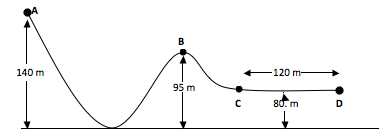
GPE = mass x gravity x height
GPE = 10 kg x 10 m/s/s x 140 m
GPE = 14,000 J
KE = m/2 (speed)2
KE = 10 kg/ 2 (0 m/s)2 = 0 J
Keep the GPE and Mass for this problem on your whiteboards for later.
100
A rollercoaster is being raised to the top (distance) of the first hill by a (Force) the chain. What is happening the the energy of the system?
Increasing or inputting energy into the system.
100
A 0.25 kg bouncy ball is dropped from 1 meter. After striking the floor it rebounds to 0.57 meter. How much energy was transferred to heat and sound.
Work is change in energy.
W = PEf - PEi
W = (0.25kg)(9.8 m/s2)(0.57m) - (0.25kg)(9.8m/s2)(1m)
W = 1.39 J - 2.45 J = - 1.06 J Transferred
BONUS: If the same ball is dropped in vacuum chamber where there is no air, does the ball bounce as high? Why?
200
Calculate the Kinetic Energy of a 50 kg mass moving at 2 m/s.
KE = mass/2 x (speed)2
KE = 50kg/2 x (2 m/s)2
KE = 100 J
200
Calculate the Gravitational Potential Energy with a mass of 1000 kg dropped from a height of 10 meters. (Use 10 m/s/s for gravity)
GPE = mass x gravity x height
GPE = 1000 kg x 10 m/s/s x 10 m
GPE = 100,000 J
BONUS: When a person lifts a weight over their heads, they used this type of energy to do work on the weight to increase the GPE.
200
What is the KE & GPE at the bottom of the first hill between A & B?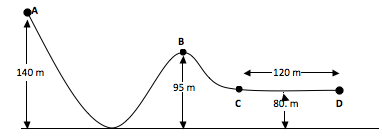
GPE = mass x gravity x height
GPE = 10 kg x 10 m/s/s x 0 m
GPE = 0 J
By Conservation of Energy PEi = KEf
KE = 14,000 J
BONUS: If TME is not conserved, what two energies were produced? Hint: Think friction!
200
A pool player breaks the balls and they come rolling to a stop (distance) by friction (force). Is the energy change negative or positive?
Negative, because energy is transfred to heat, sound, and deformation.
200
A 0.75 kg basketball is dropped downward from a height of 100 meters. The basketball rebounds 25 meters. How much work did the ground do on the basketball?
Work is change in energy.
W = PEf - PEi
W = (0.75kg)(9.8 m/s2)(25m) - (0.75kg)(9.8m/s2)(100m)
W = 183.75 J - 735 J = - 551.25 J Transferred
300
Calculate the Kinetic Energy of a 1000 kg mass moving with a speed of 0 m/s.
KE = mass/2 x (speed)2
KE = 1000kg/2 x (0 m/s)2
KE = 0 J
BONUS: When you add up KE, GPE and EPE in a system it is called this?
300
Calculate the Gravitational Potential Energy with a mass of 75 kg dropped from a height of 150 meters. (Use 10 m/s/s for gravity)
GPE = mass x gravity x height
GPE = 75 kg x 10 m/s/s x 150 m
GPE = 112,500 J
300
What is the KE & GPE at point B?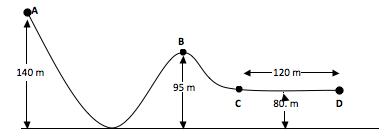
GPE = mass x gravity x height
GPE = 10 kg x 10 m/s/s x 95 m
GPE = 9,500 J
KE = TE - PEi
KE = 14,000 J - 9,500 J = 4,500 J
300
Calculate the work done when a 100 Newton rightward force is applied to an object to move it rightward 20 meters.
Work = force x distance
Work = 100 N x 20 m
Work = 2,000 J
300
A 1200 kg car traveling 35 m/s hits a large puddle of water and slows to 25 m/s. How much work did the puddle do on the car?
Work is change in energy.
W = KEf - KEi
W = (0.5)(1200kg)(25m/s)2 - (0.5)(1200kg)(35m/s)2
W = 375,000 J - 735,000 J = - 360,000 J Transferred
400
Calculate the speed of a 100 kg mass with a Kinetic Energy of 1200 J.
KE = mass/2 x (speed)2
(speed)2 = KE / (mass/2)
(speed)2 = 1200 J / 50 kg
speed = sqrt ((1200J) /(50kg)) = 4.9 m/s
400
Calculate the Gravitational Potential Energy with a mass of 20 kg dropped from a height of 170 meters. (Use 10 m/s/s for gravity)
GPE = mass x gravity x height
GPE = 20 kg x 10 m/s/s x 170 m
GPE = 34,000 J
400
What is the KE & GPE at point C?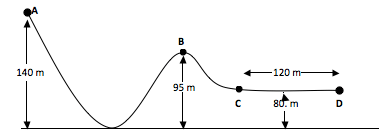
GPE = mass x gravity x height
GPE = 10 kg x 10 m/s/s x 80 m
GPE = 8,000 J
KE = TE - PEi
KE = 14,000 J - 8,000 J = 6,000 J
400
Calculate the force that is applied when 10,000 Joules of work are done upward to lift it 30 meters downward.
Work = force x distance
Force = work / distance
Force = 10,000 J / -30 m
Force = 333.33 N
BONUS: Was this positive or negative work?
400
A 22 kg pendulum swings from a height of 10 meters. It swings back to a height of 8.8 meters. How much work did friction and air resistance do on the pendulum?
Work is change in energy.
W = PEf - PEi
W = (22kg)(9.8 m/s2)(8.8m) - (22kg)(9.8m/s2)(10m)
W = 1,897.28 J - 2156 J = - 258.72 J Transferred
500
A high-speed delivery drone has a total mass of 4 kg. While making a rush delivery, it is clocked traveling at a speed of 72 km/h.
Calculate the kinetic energy of the drone in Joules (J).
If the drone drops its package (reducing its total mass to 3 kg) but maintains the same amount of kinetic energy, what would its new speed be in meters per second (m/s)?
KE = 800 (J)
Velocity = 23.1 (m/s)
500
A construction crane is lifting a crate of bricks to the top of a building that is 25 meters tall. The crate has a mass of 40 kg.
Halfway through the lift, the crane operator pauses to secure the load. At this specific pause point, the crate has exactly 5,880 Joules of Gravitational Potential Energy.
Calculate the height of the crate at the moment the operator paused.
Height = 15 (m)
500
A warehouse worker is pushing a heavy crate weighing 50 kg across a flat, frictionless floor. He applies a constant horizontal force of 120 N. After pushing the crate for 8 meters, he encounters a small ramp and decides to lift the crate vertically onto a shelf that is 1.5 meters high.
A. How much work did the worker perform while pushing the crate across the floor?
B. How much work did the worker perform while lifting the crate onto the shelf?
A. Work = 960 (J)
B. Work = 735 (J)
500
(Before) A 1kg flying squirrel is at the top of a 5m high tree.
(After) falling for a bit, he’s moving at 4m/s at a height of 2m.
Find the Work, (dissipated energy), done by the Air Resistance as it falls
Work = (-) 21. 4 (J)