Middle Ages
Renaissance + Reformation
Exploration
Enlightenment
Random
100
This event is often considered the point in history in which the Middle/Dark Ages begin.
Fall of the Western Roman Empire
100
The period in history of creativity and political, social, economic, and cultural change is referred to as this.
Renaissance
100
The desire for profits in the spice trade, to spread Christianity, and gold and silver are all major contributing factors to the rise of this in the 1400s.
Exploration
100
Increased literacy, eventual revolutions, and questioning religous and monarchial authority are all effects of this time period.
The Enlightenment
100
Boils of blood, necrotizing flesh, and death are all examples of the effects of this disease.
The Black Death (bubonic plague)
200
This event prompted the Crusades.
Muslims gained control of Holy Land (Jerusalem)
200
The wealthy class whom invested in the arts is the primary reason the Renaissance flourished in this country.
Italy
200
The discovery of the Americas improved Europe’s economy as provided a new source of these for European industries.
Raw materials
200
This is a government of the people, for the people, and by the people; the United States is a representative form of it.
Democracy
200
This group were known as fierce warriors who defended the Silk Road during its tenure as a major trade route.
Mongols
300
A European feudal knight is equitable to this Japanese feudal position.
Knight
300
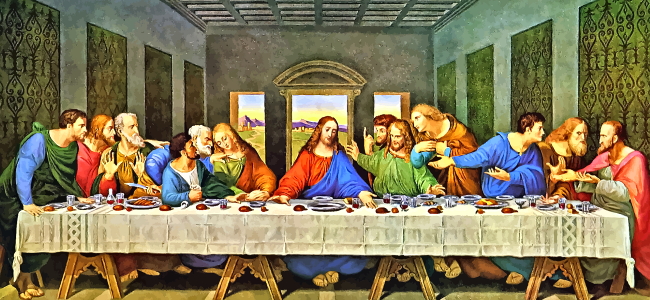
These two techniques were used by Leonardo da Vinci to make The Last Supper appear three dimensional and lighted realisitically.
Perspective and shading (Chiaroscuro)
300
Reducing imports and maximizing exports to build wealth is the primary structure and purpose of this economic system.
Mercantilism
300
This is a government where a small group with a shared characteristic rule; South Africa under apartheid was an example.
Oligarchy
300
These three religions all considered the Middle East to be their Holy Land; Canaan, Judea, Mecca respectively.
Judaism, Christianity, Islam
400
The bubonic plague entered the European continent through this body of water.
Mediterranean Sea
400
This term is used to describe an individual whom is well-versed in many areas of study and practice; da Vinci for example.
Renaissance Man
400
This would be considered the greatest major modern impact of Spanish colonization in Latin America.
Widespread use of the Spanish language
400
This is a government where religion acts as a guiding institution and the religious leaders are often the head of government; the Vatican City is an example of this.
Theocracy
400
This absolute monarch was an avid reforming of many institutions within the Austrian empire including but not limited to medicine and law.
Maria Theresa
500
As a result of the Crusades, there was a major increase in this.
Religious intolerance
500
The Catholic Church did not appreciate the work of Reformation leaders Luther, Calvin, and Henry VIII. In turn, they planned this to fight against the Reformation movement.
Catholic Counter Reformation
500
Passing strict trade laws, forbidding colonists from making their own goods or buying goods from other countries are examples of how European mother countries protected this economic system.
Mercantilism
500
This is a government where a king/queen is in charge and power is inherited typically through blood relation; the United Kingdom has a parliamentary form of this.
Monarchy
500
This Enlightenment philosopher advocated for the rights of women and is known as the first feminist writer for her essay A Vindication of the Rights of Women.
Mary Wollstonecraft
600
Control over this trade route and these two products allowed the Kingdom of Ghana to become a powerhouse in the Middle Ages. Requires all three answers to be correct.
Trans-Saharan; gold and salt
600
These were important to Renaissance artists as they provided a form of income and financial stability.
Wealthy patrons
600
The desire for cheap labor in New World colonies caused this to begin in the 1500s.
Atlantic Slave Trade
600
Centralizing control of the government was the goal of most European this.
Absolute monarchs
600
This explorer was known for completing the first circumnavigation of the world despite not actually doing it himself given he was killed by natives in the Philippines.
Ferdinand Magellan
700
In earlier Crusades, this way of travel proved slower. As a result, later Crusades utilized this way of travel. Requires both answers to be correct.
By land; by water
700
This is the term used to describe the separation of church and state and the overall reduction of religion in daily life.
Secularism
700
Native Americans' were forced to convert to this after the Europeans arrived in the New World.
Christianity
700
Denis Diderot's goal in drafting this was to spread new ideas about government and philosophy to wider society.
Encyclopedia
700
The establishment of this group in the Catholic Counter Reformation was known for being ruthless in their rooting out of heresy/heretics, often using torture and execution.
The Inquisition
800
This empire in Middle Ages China was known for the development of woodblock printing and the invention of gunpowder.
Tang Dynasty
800
In order to address his concerns with the Catholic Church, Martin Luther drafted these and nailed them to the local church door.
95 Theses
800
The Atlantic Slave Trade caused an increase in this in many West African Empires.
Conflict
800
The idea that religion should not play any role in government is often referred to as this phrase.
Separation of Church and State
800
This Enlightenment philosopher will be important in a couple of units as he wrote The Wealth of Nations, his essay arguing for free markets, division of labor, and the internal drive of competition as a market factor.
Adam Smith
900
The bubonic plague, affectionately called the Black Death, was an epidemic caused by this.
Fleas carried on rats
900
The Church supported the geocentric model of the universe. This scientist determined that heliocentrism was reality.
Nicolaus Copernicus
900
This is known as the system of slavery in the New World that used the indigenous population as a source of labor.
Encomienda system
900
This monarch centralized power in France and built the luxurious Palace of Versailles.
Louis XIV
900
A lord in Europe's feudal system is equitable to this Japanese feudal position.
Daimyo
1000
The declaration of faith, prayer five times a day, almsgiving, fasting during Ramadan, and pilgramage to Mecca are all a part of this.
Five Pillars of Islam
1000
Life is good, not just about work, and can be comfortable are all tenets of this perspective.
Humanism
1000
Most enslaved from Western Africa were picked up along this to avoid dealing with inland tribes and kingdoms.
Coast
1000
The Universal Declaration of Human Rights contain ideas from these three Enlightenment thinkers regarding their beliefs about natural rights, freedom of expression, and the social contract respectively.
Locke, Voltaire, Rousseau
1000
This explorer was the first European to interact with the American indigenous, getting as far north as modern-day Kansas.
Francisco Coronado