Module 1
Module 2
Module 3
Module 4
100
Which elements often form allotropes. Name at least two examples.
Carbon, silicon, sulfur, phosphorus.
Carbon= diamond, buckminstrer fullerine, nanotubes, graphine, graphite.
100
What is the empirical formula of this
CH3COOH
What is CH2O
100
What is the oxidation state of Manganese in MnO4-
What is +7
100
Sketch an exothermic energy profile diagram

200
Find the relative atomic mass of the following:
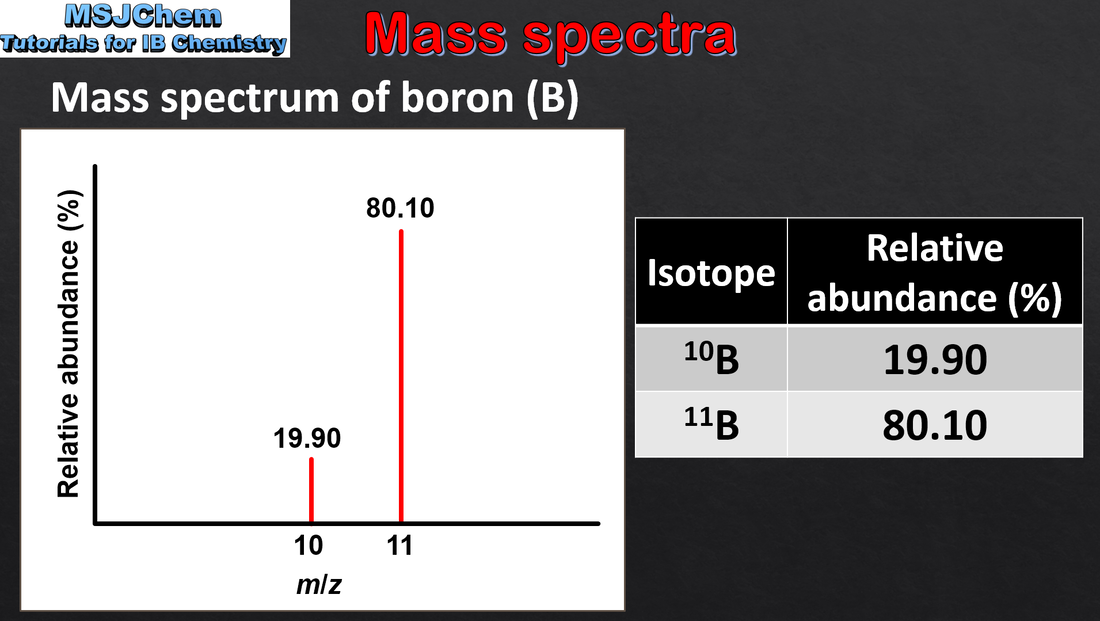
Ar= 10.81
200
What mass in grams is needed to prepare 100.0mL of 0.100 mol/L sodium sulfate.
What is
1.42 g
200
What are the formulas for sulfuric acid, nitric acid and hydrchloric acid?
What is H2SO4 , HNO3, HCl
200
 Identify the Activation Energy and Enthalpy \ for the Reverse Reaction
Ea= 341kJ mol
Delta H reverse= +225kJ mol
300
Rank the following metals in terms of reactivity, why?
Potassium
Barium
Magnesium
- Potassium > Barium > Magnesium
- Potassium is a Group 1 metal with a single valence electron that is far from the nucleus and weakly held. It is very easily removed, making potassium highly reactive.
- Barium and magnesium are both Group 2 metals and must lose two electrons. Barium is more reactive than magnesium because it is lower in the group, so its outer electrons are further from the nucleus and experience less attraction.
- Reactivity of metals generally increases down a group and decreases across a period because outer electrons become easier to remove.
300
What is the percentage mass of nitrogen in ammonium nitride?
Step 1: Calculate molar mass
M((NH4)3N)=(4×14.01)+(12×1.01)M((NH_4)_3N) = (4 \times 14.01) + (12 \times 1.01) =56.04+12.12= 56.04 + 12.12 =68.16 g mol−1= 68.16\ \text{g mol}^{-1}
Step 2: Calculate mass of nitrogen
4×14.01=56.04 g mol−14 \times 14.01 = 56.04\ \text{g mol}^{-1}
Step 3: Percentage by mass of nitrogen
%N=56.0468.16×100\%N = \frac{56.04}{68.16} \times 100 =82.2%
300
Write an equation for the reaction of lead (II) nitrate and potassium hydroxide.
Determine if a precipitate was formed?
Pb(NO3)2(aq)+2KOH(aq)→Pb(OH)2(s)+2KNO3(aq)
Yes, a precipitate is formed. The precipitate is lead(II) hydroxide, Pb(OH)₂(s), which appears as a white solid.
300
Describe 2 errors in this experiment 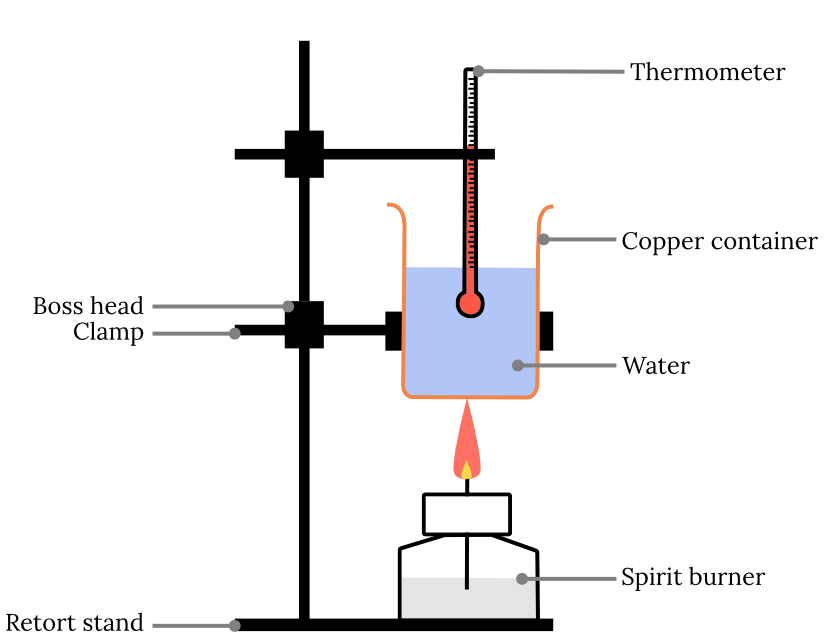
- Significant heat loss to the surroundings
- The flame is exposed to the air.
- Heat escapes around the sides of the can rather than heating the water.
- This causes the calculated enthalpy of combustion to be less exothermic than the accepted value.
- No draught shield
- Air currents can carry heat away from the flame and can.
- Flame stability may vary during the experiment.
- Heat absorbed by the copper can
- Calculations usually assume only the water gains heat.
- Some energy heats the metal can itself, leading to an underestimate of the fuel's energy output.
- No insulation around the calorimeter
- The sides and top of the can are exposed.
- Heat is continually lost to the room.
- Open top
- Heat escapes from the water surface.
- Evaporation may also occur, removing thermal energy.
- Incomplete combustion may occur
- Limited oxygen supply can produce soot.
- Not all chemical energy is released.
- This is often seen as black deposits on the base of the can
400
Design a flowchart to separate a mixture of nickel, potassium chloride, sand and water so that each component (except water) can be collected.
- Magnetic separation removes the nickel because nickel is magnetic.
- Filtration separates the insoluble sand from the potassium chloride solution.
- Evaporation/crystallisation removes the water and leaves potassium chloride crystals behind.
400
8.00g of oxygen is at 25C and 110kPa. Calculate the volume it occupies?
What is V=110(0.250)(8.314)(298) V=619.1110V=\frac{619.1}{110} V=5.63 L
400
Explain with 3 diagrams how a catalyst speeds up a chemical reaction?
Answers will vary-
Energy Profile Diagram
Maxwell Boltzmann Distribution
400

ΔH=(+184)+(−1716)+(+360)
ΔH=−1172 kJ/mol
500
Draw the structure of carbon tetrafluoride and determine if it is polar, the IM forces involved and its shape and bond geometry.
Formula: CF₄
Bond Type:
Shape Tetrahedral
Bond Geometry Angle109.5°
Polarity non-polar
Intermolecular Forces: Dispersion (London) forces only
500
A hydrocarbon contains 85.7% carbon and 14.3% hydrogen by mass. Its molar mass is 42 g mol⁻¹.
Determine its molecular formula.
Discuss whether the molecule formed is polar or non polar.
The molecular formula C₃H₆ could represent several structures, but at the Year 11 level the expected structure is propene.
Propene contains C–C and C–H bonds, which have very small differences in electronegativity. As a result, the molecule does not possess a significant permanent dipole.
Therefore:
Propene is non-polar
Because the molecule is non-polar, the dominant intermolecular force between propene molecules is dispersion forces (London forces).
500
Aluminium reacts with Iron(II) nitrate.
Write a full ionic equation
Net ionic equation and identify the species undergoing oxidation and reduction?
2Al(s) + 3Fe²⁺(aq) + 6NO₃⁻(aq) → 2Al³⁺(aq) + 6NO₃⁻(aq) + 3Fe(s)
Net ionic: 2Al(s) + 3Fe²⁺(aq) → 2Al³⁺(aq) + 3Fe(s)
Aluminium is oxidised and iron(II) ions are reduced.
500
A student dissolves 12.0 g of ammonium nitrate (NH₄NO₃) in 100.0 g of water.
The temperature of the solution decreases from 23.5°C to 15.8°C.
Assume:
- Specific heat capacity of the solution = 4.18 J g⁻¹ °C⁻¹
- Density of the solution = 1.00 g mL⁻¹
Determine the molar enthalpy of dissolution of ammonium nitrate.
=24.1 kJ mol−1