Enzymes and biochemical pathways
Regulation of enzymes
Photosynthesis
Cellular Respiration
Random
100
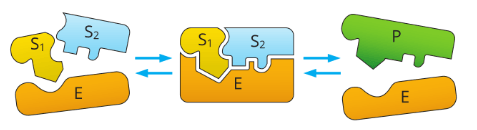
Enzymes are used to catalyse cellular reactions during both photosynthesis and cellular respiration. What enzyme activation model does the diagram above represent?
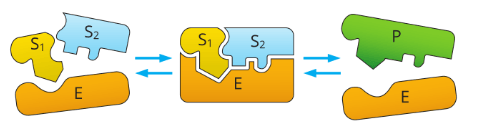
Induced-fit model
100
Study the graph of enzyme activity. Identify the optimum temperature for the enzyme.
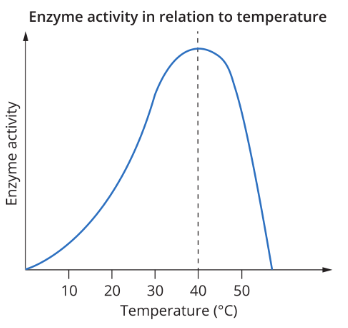
Approximately 40°C
100
This graph shows the rates of photosynthesis and cellular respiration in an indoor plant that receives plenty of natural light through a large window. Propose what change in the plants environment might have caused the rate of photosynthesis shown at times D and E.
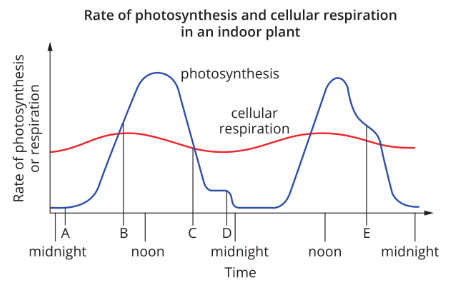
At time D, the rate of photosynthesis has remained slightly higher than normal, despite it being night time. This might happen if a light is left on, either inside the room or outside the window. At time E, the rate of photosynthesis is less than normal, despite it being day time. This might happen if the sky becomes cloudy or a blind or curtain reduces the amount of light.
100
The graph shows the contributions of the two energy-producing pathways (aerobic cellular respiration and anaerobic fermentation) to physical activity. Why do cells need ATP?
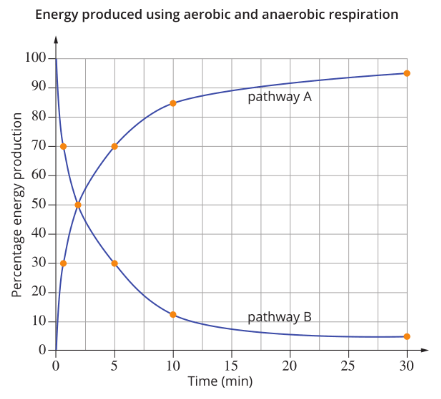
Cells need ATP to perform growth and metabolic functions.
100
What molecule acts as an energy carrier in glycolysis?
NAD+
200
A transmission electron micrograph of structure Z is shown. Identify structure Z.
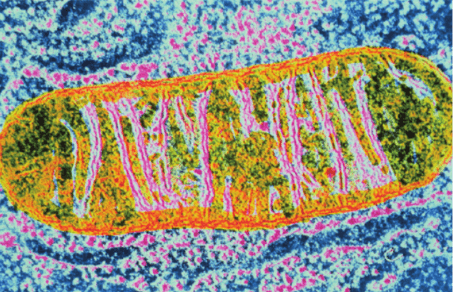
Mitochondrion
200
Study the graph of enzyme activity. Name the other factors that affect enzyme activity.
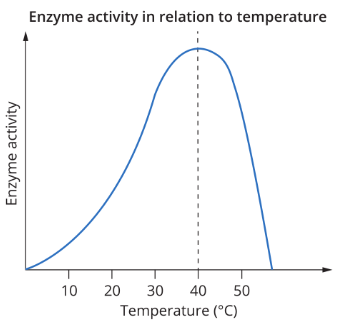
pH, concentration of reactants and enzyme inhibitors
200
This graph shows the rates of photosynthesis and cellular respiration in an indoor plant that receives plenty of natural light through a large window. Deduce whether there is an net oxygen uptake or output at each of these times: A, B, C, D OR E
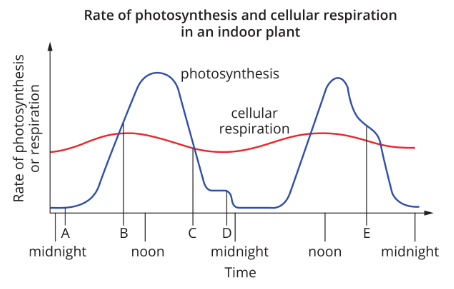
There is a net oxygen uptake by the plant when the rate of cellular respiration is greater than the rate of photosynthesis, because cellular respiration uses oxygen while photosynthesis produces it. Thus, there is a net oxygen uptake at times A and D. There is a net oxygen output at times B and E. At time C, there is no net uptake or output, because the rates are the same
200
The graph shows the contributions of the two energy-producing pathways (aerobic cellular respiration and anaerobic fermentation) to physical activity. What is the name of the process that produces ATP during anaerobic fermentation?
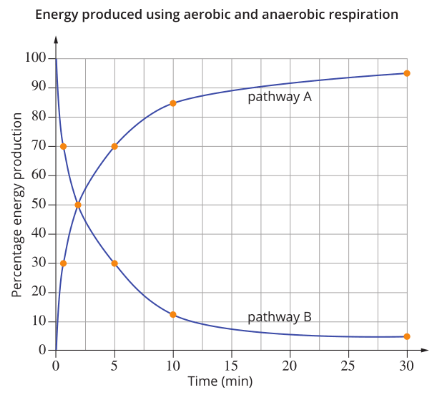
Glycolysis is the process that produces ATP.
200
Identify the reactants and products of glycolysis.
Glucose + 2ADP + 2Pi + 2NAD+ → 2 pyruvate + 2ATP + 2NADH
300
Enzymes are used to catalyse cellular reactions during both photosynthesis and cellular respiration. If heated above its critical temperature, an enzyme denatures. Describe what happens to an enzyme's structure when it denatures.
An enzyme is denatured when the tertiary structure has been permanently changed.
300
The graph shows the activity of human isocitrate dehydrogenase, which is an enzyme used in cellular respiration. What is the optimum temperature of isocitrate dehydrogenase likely to be? Give a reason for your answer.
The optimum temperature of human isocitrate dehydrogenase is likely to be close to normal human body temperature, around 37°C, or slightly higher. If the optimum temperature of the enzyme was much higher than 37°C, the enzyme would not function efficiently in the body. If the optimum temperature was lower than 37°C, it would be denatured in the body.
300
Scientists investigated the effect of temperature on the rate of photosynthesis on two different plants: Plant A and Plant B. The graph shows the results of the experiment. Compare the general effect of temperature on the rate of photosynthesis in plant A and Plant B.
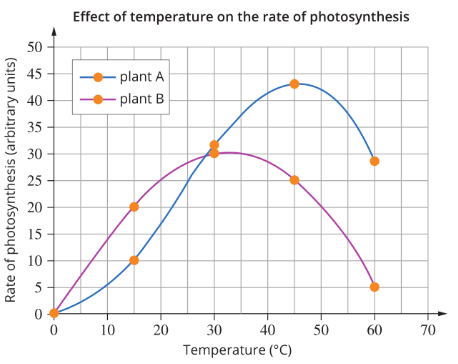
For both plants, as the temperature increased, the rate of photosynthesis also increased. However, beyond their optimum temperature (plant A: 45°C and plant B: 32°C), the rate of photosynthesis decreased for both plants.
300
The graph shows the contributions of the two energy-producing pathways (aerobic cellular respiration and anaerobic fermentation) to physical activity. Explain which pathway (A or B) is most likely to represent ATP production by a sprinter.
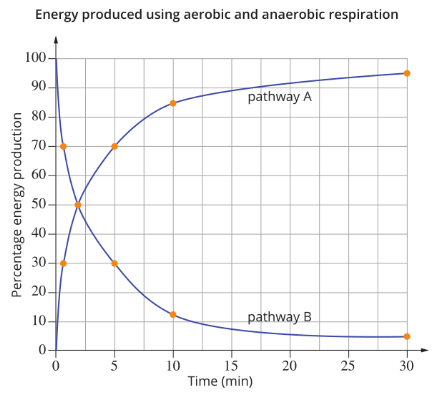
Pathway B is likely to represent ATP production in a sprinter, as it shows a decreasing contribution of that pathway.
300
What is the major benefit to cells in using cellular respiration rather than anaerobic fermentation?
Cellular respiration produces 36–38 molecules of ATP for energy supply, whereas anaerobic fermentation produces only two molecules of ATP.
400
Enzymes are used to catalyse cellular reactions during both photosynthesis and cellular respiration. Why does denaturation affect the enzyme's activity during these processes?
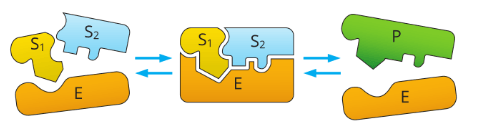
An enzyme that has a permanently changed shape will have an active site that no longer fits its substrates, so the enzyme’s activity has been permanently lost.
400
Study the graph of enzyme activity. Explain what happens to the enzyme above 40C?
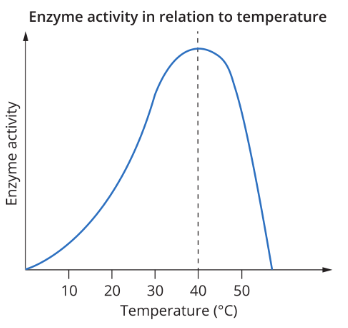
At temperatures greater than 40°C, the enzyme begins to denature as the temperature rises, until it becomes completely denatured and inactive at around 60°C.
400
Scientists investigated the effect of temperature on the rate of photosynthesis on two different plants: Plant A and Plant B. The graph shows the results of the experiment. Explain why the rate of photosynthesis falls at temperature higher than 50oC.
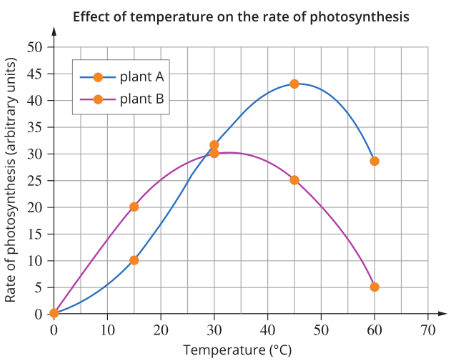
50°C is above the optimum temperature for both plants. As a result, the enzymes involved in photosynthesis start to denature and the plants are unable to carry out photosynthesis at the same rate. The rate of photosynthesis decreases as the enzymes denature.
400
The graph shows the contributions of the two energy-producing pathways (aerobic cellular respiration and anaerobic fermentation) to physical activity. Why cant anaerobic fermentation supply the energy needs of athletes in events requiring energy over a sustained period of time?
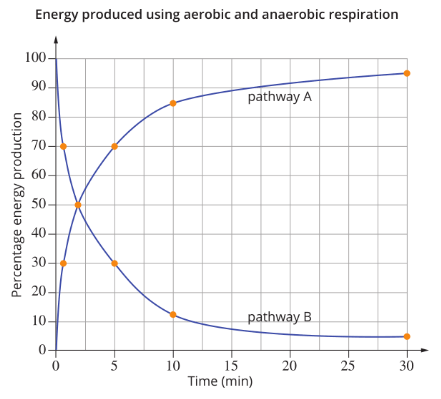
Anaerobic fermentation supplies only a fraction of the energy of the aerobic pathway (cellular respiration), so over a long period of energy demand it will not supply enough energy to meet the needs of the muscles.
400
Why would a prokaryotic organism use anaerobic fermentation rather than cellular respiration?
Organisms may undergo anaerobic fermentation rather than cellular respiration due to lack of oxygen in the environment or if the organism lacks the genes to produce the proteins involved in the Krebs cycle and the electron transport chain.
500
A transmission electron micrograph of structure Z is shown. State the overall chemical equation for the reaction that involves this structure, providing total inputs and outputs.
C6H12O6 + 6O2 → 6CO2 + 6H2O (with the production of 36–38 ATP)
500
Study the graph of enzyme activity. Outline what happens to enzyme activity as the temperature increases from 0C to 40C.
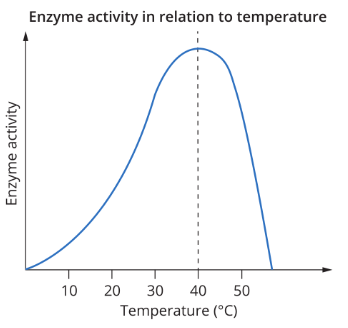
Enzyme activity increases as temperature increases. For every 10°C increase in temperature, enzyme activity doubles, until the optimum temperature (40°C) is reached.
500
Scientists investigated the effect of temperature on the rate of photosynthesis on two different plants: Plant A and Plant B. The graph shows the results of the experiment. Which plant is most likley to be a CAM plant? Justify your answer.
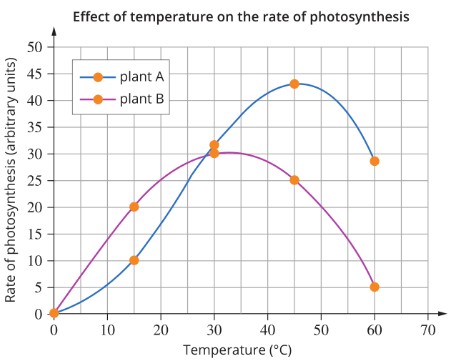
Plant A. Plant A has a higher optimum temperature, which suggests that it will be able to adapt to the hot temperatures in the desert and would most likely be the CAM plant. Plant B has a lower optimum temperature and may not be able to carry out photosynthesis in the hot desert temperatures.
500
Animals make lactic acid during anaerobic fermentation, but yeast and plants produce ethanol and carbon dioxide. Suggest a reason why the products are different in animals and plants.
Animals and plants make different products during anaerobic fermentation because they use different enzymes in the chemical reactions.
500
Briefly describe what happens to pyruvate in the two biochemical pathways that can occur after glycolysis when oxygen is absent (in anaerobic organisms)
When oxygen is absent in anaerobic organisms, anaerobic fermentation takes place. Pyruvate is fermented in the cytosol into lactic acid or alcohol and carbon dioxide with limited further release of energy of two ATP