Minerals
Rock Types
Rock Cycle
Earth's Layers
Plate Tectonics
Volcanoes & Earthquakes
Fossils
Sonar & Evidence
100
Most rocks are made up of a mixture of what?
Most rocks are mixtures of minerals.
100
Which rock group forms when magma or lava cools and solidifies?
Igneous rocks form when magma or lava cools and solidifies.
100
What are loose rock particles such as sand and gravel called?
Loose particles such as sand and gravel are called sediments.
100
What is Earth’s outermost rocky layer?
The crust is Earth’s outermost rocky layer.
100
Which theory explains how Earth’s rigid outer layer is divided into moving plates?
The theory of plate tectonics explains the movement of Earth’s plates.
100
What do we call the shaking that happens when rocks suddenly slip along a fault?
The shaking is an earthquake.
100
In which rock group are fossils most commonly found?
Fossils are most commonly found in sedimentary rock.
100
What kind of wave does sonar send through water?
Sonar sends sound waves through water.
200
Which is a mineral, quartz or granite?
Quartz is a mineral. Granite is a rock made up of several minerals.
200
Which type of igneous rock forms from magma below Earth’s surface?
Intrusive igneous rock forms from magma that solidifies underground.
200
What process breaks rock down in place?
Weathering breaks rock down in place.
200
Which of Earth’s four main layers is thickest?
The mantle is Earth’s thickest layer.
200
What type of boundary forms where two plates slide past each other?
At a transform boundary, two plates slide past each other.
200
What is molten rock called below Earth’s surface and after it erupts onto the surface?
Molten rock is called magma underground and lava once it erupts at the surface.
200
What is a fossil?
A fossil is a preserved remain or trace of an organism that lived long ago.
200
What is a sound pulse called when it bounces off the seafloor and returns to the boat?
The returning sound pulse is an echo.
300
Which mineral property are you testing when you try to scratch a sample with a reference material?
A scratch test measures Hardness.
300
Which of these rocks is metamorphic: basalt, sandstone or marble?
Marble is a metamorphic rock.
300
How does erosion differ from weathering?
Weathering breaks down rock. Erosion moves the resulting material.
300
Which layer is made mostly of liquid iron and nickel?
The outer core is made mostly of liquid iron and nickel.
300
What type of boundary forms where two plates move apart?
At a divergent boundary, two plates move apart.
300
A volcano is erupting now. How would you classify it?
A volcano that is erupting now is active.
300
A fossil bone and a fossil footprint are found. Which is a body fossil and which is a trace fossil?
The bone is a body fossil. The footprint is a trace fossil.
300
What name did Alfred Wegener give the ancient supercontinent?
Supercontinent Pangaea (255 million years ago)
400
What is the term for how a mineral’s surface reflects light?
Lustre (or shine) describes how a mineral’s surface reflects light.
400
A rock forms when grains of sand are pressed together and bonded by minerals. Which rock group does it belong to?
The rock is Sedimentary because it forms from sand grains that are compacted and cemented together.
400
What process turns solid igneous or metamorphic rock into magma?
Melting turns solid rock into magma.
400
Which layer is hottest and made mostly of solid iron?
The inner core is the hottest layer and is made mostly of solid iron.
400
What type of boundary forms where two plates move towards each other?
At a convergent boundary, two plates move towards each other.
400
A volcano is quiet now but could erupt again. How would you classify it?
A dormant volcano is quiet now but could erupt again.
400
Why are muscles and organs less likely to fossilise than bones or shells?
Soft tissues usually decay more quickly than bones or shells, giving them less time to be preserved.
400
What does sonar measure to work out the depth of the seafloor?
*Think of sonar Prac
Sonar measures how long a sound pulse takes to reach the seafloor and return.
500
What scale ranks minerals by their resistance to scratching?
The Mohs scale ranks minerals by scratch hardness.
500
What are the three main groups of sedimentary rocks?
The three groups are clastic, chemical and biological sedimentary rocks.
500
A river slows down and drops its load of sand. What process has occurred?
Deposition occurs when the river drops the sediment it was carrying.
500
What are Earth’s four main layers in order from the surface to the centre?
From the surface to the centre, the layers are the crust, mantle, outer core and inner core.
500
Which two plates are colliding to form the Himalayas, and how does their movement build mountains?
The Indian and Eurasian plates converge. The collision thickens and lifts the crust.
500
What are the three volcano shapes covered in the revision slides?
The three shapes are shield volcanoes, stratovolcanoes and cinder cones.
500
How can an index fossil help scientists compare rock layers?
Matching index fossils can help scientists identify rock layers that formed during the same interval of geologic time
500
Give two observations Wegener used as evidence for continental drift.
Two examples are matching fossils on continents separated by oceans and the fit of the continents’ edges.
600
What is the name for the colour of a mineral’s powder on an unglazed porcelain plate?
Streak is the colour of a mineral’s powder.
600
Chalk forms from the remains of microscopic organisms. Which sedimentary group does it belong to, and why?
Chalk is a biological sedimentary rock because it forms from the remains of organisms.
600
What two processes turn loose sediment into sedimentary rock, and what does each do?
Compaction squeezes sediment particles together. Cementation binds them with minerals.
600
Describe the physical state of the crust, mantle, outer core and inner core.
The crust and inner core are solid, the outer core is liquid, and the mantle is mostly solid rock that flows slowly over geologic time.
600
Oceanic and continental crust meet at a convergent boundary. Which plate sinks, why does it sink, and what is the process called?
The oceanic plate sinks beneath the continental plate because it is denser. This process is called subduction
600
A volcano’s magma supply has cut off, and scientists consider another eruption very unlikely. How would you classify it?
A volcano considered very unlikely to erupt again is classified as extinct.
600
How might an animal’s shell become fossilised after the animal dies?
Rapid burial can protect the shell. Over time, minerals may replace the shell and preserve its shape as a fossil.
600
A sonar echo takes longer to return at site B than at site A. If sound travels at the same speed at both sites, which site is deeper and why?
Site B is deeper because the sound travels farther before the echo returns.
700
A student says charcoal must be a mineral because it is solid. What about charcoal’s origin explains why it is classed as a non-mineral?
Charcoal forms from once-living material, so it is classed as an organic non-mineral.
700
One rock contains pebbles cemented together. Another forms as dissolved minerals crystallise when water evaporates. Identify the sedimentary group of each.
The rock with cemented pebbles is clastic. The rock formed from crystallising minerals is chemical sedimentary rock.
700
A buried sedimentary rock is heated and squeezed without melting. What rock group can form, and what drives the change?
Metamorphic rock can form as heat and pressure change the buried rock while it stays solid.
700
How does continental crust compare with oceanic crust in thickness and density?
Continental crust is generally thicker and less dense than oceanic crust.
700
Describe how warm and cool material move in a mantle convection current. Include density in your explanation.
Warmer, less dense material rises. Cooler, denser material sinks, creating a circulating flow.
700
The San Andreas Fault is a transform boundary. How can sideways plate movement there cause an earthquake?
Parts of the fault can lock while the plates keep moving. Stress builds until the rocks slip suddenly and release energy as an earthquake.
700
In undisturbed layers, fossil A is at the top, B is in the middle and C is at the bottom. Which fossil is oldest, and how do you know?
Fossil C is oldest because it is in the bottom layer, which was deposited first.
700
How can a survey boat use repeated sonar measurements to map a shallow ridge and a deep valley?
The crew calculates depth from each echo’s travel time and plots the depths by location. Shorter return times show the shallower ridge, and longer times show the deeper valley.
800
An unknown mineral scratches a glass plate and leaves a white powder on unglazed porcelain. What two properties did you test, and what does each result show?
The scratch tests hardness and shows that the mineral is harder than the glass. The powder tests streak and shows a white streak.
800
Granite has large crystals, while basalt usually has very small crystals. Explain how cooling location and cooling rate produced this difference.
Granite cools slowly underground, giving its crystals time to grow. Basalt cools quickly at or near the surface, so its crystals stay small.
800
Trace a path from magma to igneous rock, then to sedimentary rock and finally to metamorphic rock. Name the processes along the way. (Hint - Describe the rock cycle process)
Magma cools and solidifies into igneous rock. Weathering, erosion and deposition produce and accumulate sediment. Compaction and cementation form sedimentary rock. Heat and pressure can then change it into metamorphic rock. 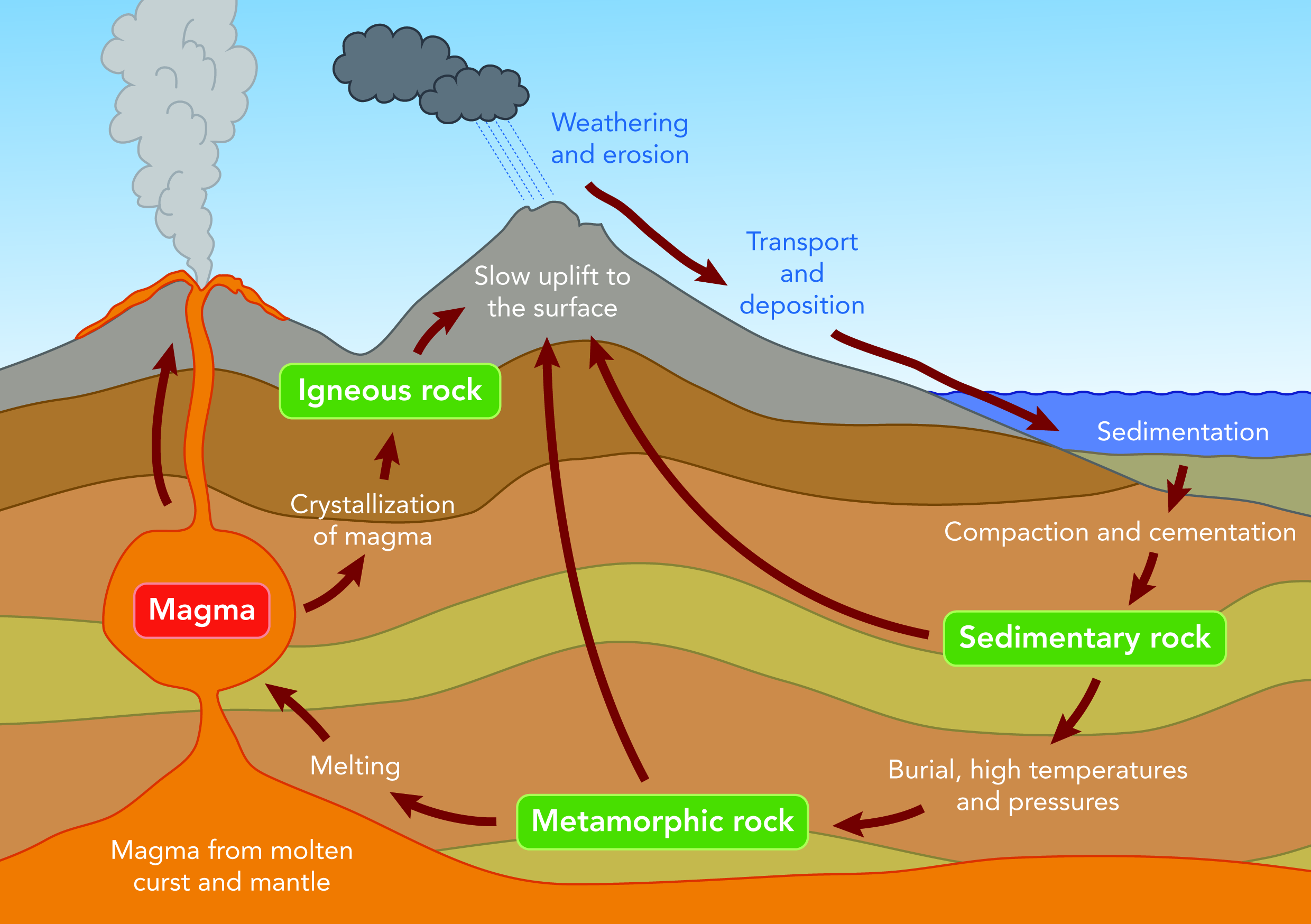
800
Why is the inner core solid even though it is hotter than the liquid outer core?
Extreme pressure at Earth’s centre keeps the inner core solid despite the high temperature. Pressure is lower in the liquid outer core.
800
How can mantle convection and gravity help move tectonic plates? Include ridge push and slab pull.
Mantle convection involves warmer material rising and cooler material sinking. In ridge push, gravity helps move plates away from elevated ridges. In slab pull, a dense sinking slab pulls the rest of its plate along.
800
Why can a subduction zone produce both earthquakes and volcanoes, while a transform boundary mainly produces earthquakes?
At a subduction zone, plate movement causes earthquakes and the sinking slab can lead to magma formation. At a transform boundary, sideways slip mainly produces shallow earthquakes.
800
A student says a fossil must be exactly 100 million years old because it is below another fossil. What can the layer positions establish, and what further evidence would be needed?
In undisturbed layers, the lower fossil is older. A numerical age requires separate dating evidence, such as radiometric dating of a suitable rock layer.
800
Marie Tharp’s maps showed a rift valley along the centre of a mid-ocean ridge. How does this feature support the idea that plates move and new seafloor forms?
The rift valley supports the idea that plates move apart at the ridge. Molten rock rises and cools there, forming new oceanic crust through seafloor spreading.