Nervous System
Reproduction
Nerve Cells
Endocrine System
Trivia
100
What are the two main parts of the nervous system?
Central Nervous System (CNS) and Peripheral Nervous System (PNS)
100
Identify two differences between K and r strategests
responses may vary
100
What are nerve cells called?
Neurons
100
What does the endocrine system involve?
Hormones
100
Who was the first woman to win the Nobel Prize in 1903?
Marie Curie!
200
Explain the function of a neuron
To transmit via electrical signal information from receptors to control centre and back to effectors
200
What are the two stages of fertilisation in flowers
Pollination and fertilisation
200
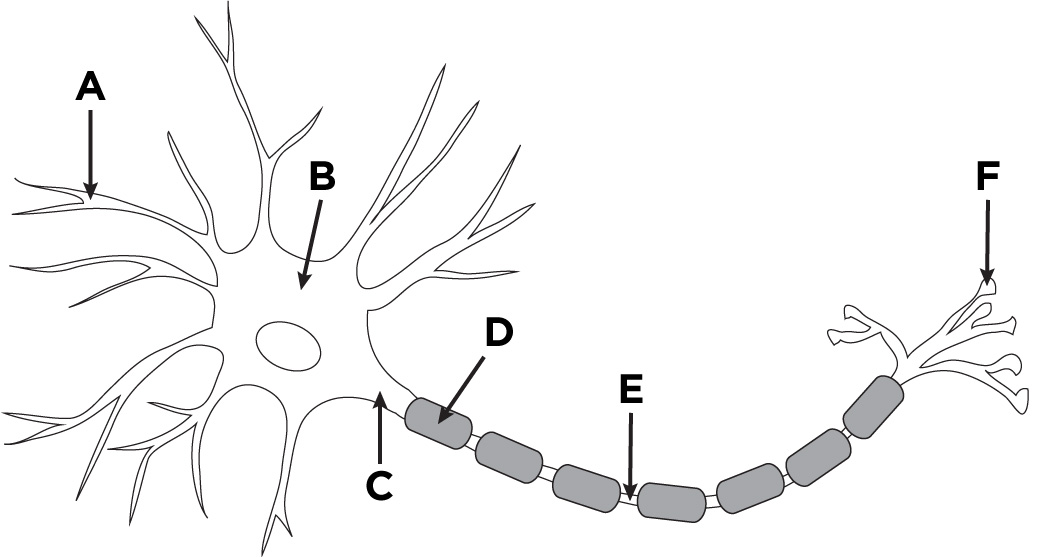
Name A, B, C, D and F
A Dendrite
B Cell body
C Axon
D Myelin sheath
F synaptic terminal
200
Where are hormones released from?
Glands
200
In which year did World War I begin?
1914
300
You accidentally touch the metal part of a seatbelt on a 40 degree day. As a reflex, you pull your hand away. What is the stimulus?
The heat from the metal part of the seatbelt
300
What are two differences between self-pollination and cross pollination
Self-pollination is when pollen is transferred between different parts of the same plant. Less genetic diversity than cross-pollination.
Cross-pollination is when pollen is transferred between different plants. More genetic diversity due to two parents
300
What does a sensory neuron do?
Transmits impulses from receptors in sense organs (sight, smell, touch, taste, sound) to the CNS
300
How does the body make sure the right hormone binds the right receptor? (e.g. hormone binding heart muscle cells)
Complementary shapes (like a jigsaw puzzle) between hormones and receptor
300
What is the chemical symbol for gold?
Au
400
You accidentally touch the metal part of a seatbelt on a 40 degree day. As a reflex, you pull your hand away. What is the response?
Pulling your hand away from the source of heat
400
compare asexual and sexual reproduction
answers may vary - must have similarities and differences
400
What does a motor neuron do?
Transmits impulses from the CNS to muscles or glands (effectors) to cause them to respond
400
What is homeostasis?
The process of maintaining a constant internal environment in the body to keep everything at a healthy level
400
What is the only continent where coffee grows naturally?
Africa
500
Which division of the autonomic (involuntary) nervous system is activated in situations of fear or stress? (200 points) And which division opposes this and calms the body back down?
Sympathetic nervous system (fight or flight) and parasympathetic nervous system (rest and digest)
500
Explain why K strategists are better suited to stable environments
They are better suited to stable environments because:
- They invest heavily in each offspring: In stable environments, offspring have a higher chance of surviving, so investing more resources in each one is worthwhile.
- Competition is more important than rapid reproduction
- When resources are consistently available but limited, success depends on competing effectively rather than reproducing quickly.
- K-strategists often have traits such as larger body size, longer lifespans, and efficient resource use that help them compete.
- Population growth is slow and steady - Stable environments do not usually create sudden opportunities for explosive population growth.
- They are less adapted to frequent disturbances
- Because they reproduce slowly, K-strategists recover more slowly after disasters or major environmental changes.
- In stable environments, this disadvantage is minimized because large disturbances are relatively uncommon.
500
Describe what happens in a knee-jerk reflex (hammer tap on the knee, and the leg swings forward)
Include: stimulus, receptor, sensory neuron, motor neuron, effectors, response
Stimulus: hammer tap
Receptor: receptor in knee detects hammer tap
Sensory neuron: sends impulse to brain and spinal cord
Motor neuron: transmits impulse from brain to muscles
Effectors: muscles contract and move leg
Response: lower leg swings forward
500
Use the idea of a negative feedback loop to explain what happens when either water levels, or blood glucose becomes too high.
Blood glucose becomes too high
- After eating, blood glucose levels rise above the normal range.
- The pancreas detects the increase and releases the hormone insulin.
- Insulin causes body cells to take up more glucose from the blood and stimulates the liver and muscles to store glucose as glycogen.
- As glucose is removed from the bloodstream, blood glucose levels fall back toward normal.
- When the normal level is restored, insulin release decreases.
This is a negative feedback loop because the response (insulin release) counteracts the original change (high blood glucose), reducing the stimulus and restoring balance.
Water levels become too high
- The body detects that there is too much water in the blood, causing the blood to become more dilute than normal.
- The hypothalamus in the brain detects this change and signals the pituitary gland to release less antidiuretic hormone (ADH).
- With less ADH present, the kidneys reabsorb less water back into the bloodstream.
- More water is excreted in the urine, which becomes larger in volume and more dilute.
- As excess water leaves the body, water levels return to normal.
- Once the normal level is restored, ADH secretion returns to its usual level.
This is a negative feedback loop because the response (reduced ADH and increased water loss) opposes the original change (water levels being too high), bringing the body's water balance back to normal.
500
What is the largest desert in the world?
The Antarctic Desert