Presidents
Expansion
Governmental Actions
Political Parties
Misc
100
Which President was known for the quote "A House Divided Against Cannot Stand"
Abraham Lincoln
100
The 19th-century belief that the United States was divinely destined to expand westward across North America.
Manifest Destiny
100
After the Civil War, this period was led by Congress and focused on reorganizing Southern governments and securing civil rights for formerly enslaved people.
Reconstruction
100
This political party emerged from the collapse of the Whigs, opposed the expansion of slavery, and rose to national power with Abraham Lincoln’s election in 1860.
The Republican Party
100
In what years was the Civil War fought?
1861-1865
200
In what year was Abraham Lincoln elected?
1860
200
This agreement admitted California as a free state and included a stronger Fugitive Slave Law.
The Compromise of 1850
200
In this 1857 Supreme Court case, the Court ruled that African Americans were not citizens and that Congress had no power to prohibit slavery in U.S. territories.
Dred Scott v. Sandford
200
This political party's main platform was anti-immigration.
The Know-Nothing Party
200
This former slave became a leading abolitionist and founded the anti-slavery newspaper The North Star to advocate for freedom and equality.
Frederick Douglas
300
What document did President Lincoln issue that freed slaves in the red states?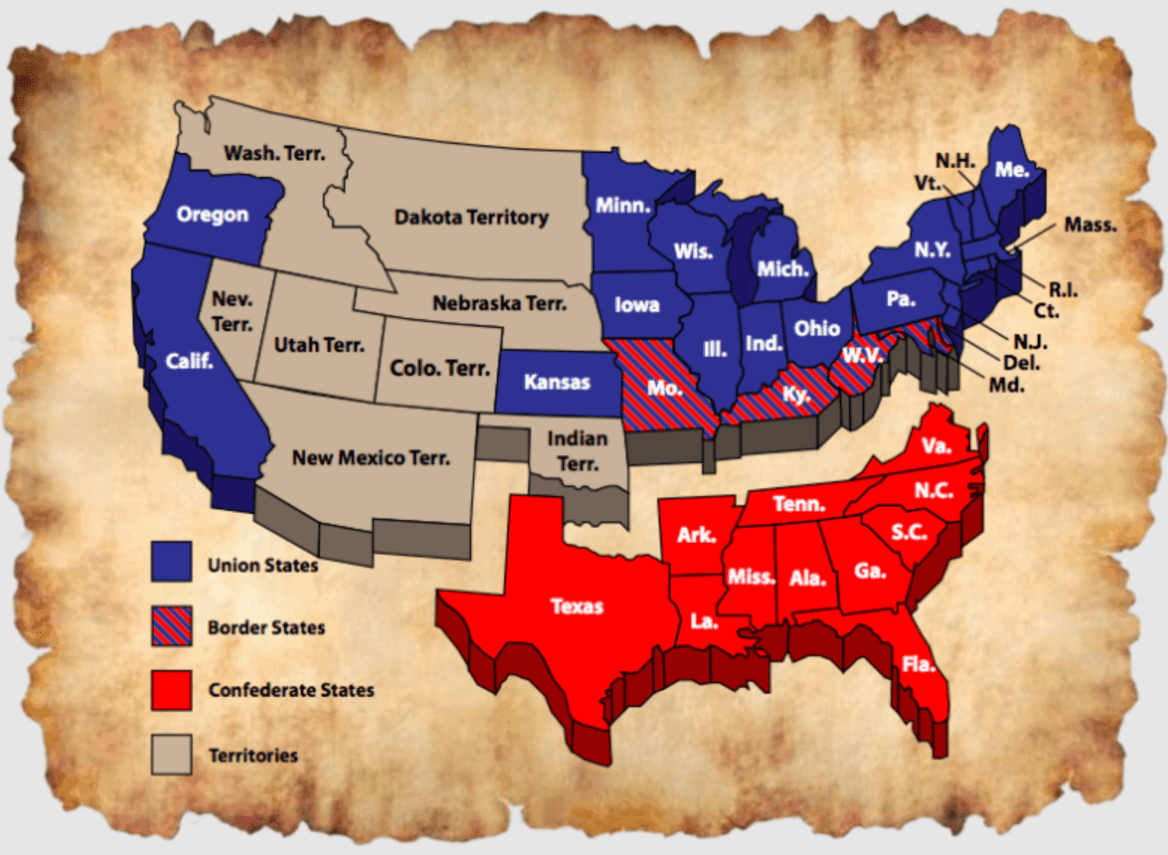
Emancipation Proclamation
300
This war was fought to help fulfill Manifest Destiny.
Mexican-American War
300
Passed in 1862, this law gave 160 acres of public land to settlers who agreed to farm it for at least five years, encouraging westward expansion.
Homestead Act
300
Which political party's primary platform was to prevent slavery from expanding into the Western Territories?
The Free Soil Party
300
This speech, delivered by Abraham Lincoln during the Civil War, began with the words “Four score and seven years ago” and honored the fallen soldiers at a famous Pennsylvania battlefield.
The Gettysburg Address
400
Which President declared war on Mexico to help achieve Manifest Destiny?
President James K. Polk
400
This 1854 law allowed new territories to decide for themselves whether to allow slavery, effectively repealing the Missouri Compromise and leading to violent sectional conflict.
The Kansas-Nebraska Act
400
This agreement resolved a disputed presidential election, gave Rutherford B. Hayes the presidency, and ended federal military presence in the South, effectively ending Reconstruction.
The Compromise of 1877
400
This political party collapsed before the Civil War after splitting over the issue of slavery, especially following the Kansas–Nebraska Act.
The Whigs
400
Name one way in which Southern States prevented African Americans from voting after Reconstruction ended?
Grandfather Clause, Literacy Tests and Poll Tax
500
Why was President Andrew Johnson impeached?
For violating the Tenure of Office Act
The Tenure of Office Act required the President to get Senate approval before removing certain officials
500
This violent conflict in the mid-1850s erupted as pro-slavery and anti-slavery settlers fought over whether a western territory would allow slavery.
Bleeding Kansas
500
These three Amendments are known as the Reconstruction Amendments. They
1. Ended Slavery
2. Granted former slaves citizenship
3. Gave African Americans the right to vote
1- 13th Amendment
2- 14th Amendment
3- 15th Amendment
500
This political party faction in Congress pushed for harsh Reconstruction policies and full civil and political rights for formerly enslaved people.
Radical Republicans
500
This farming system kept many African Americans and poor Southern whites in debt and tied to the land after the Civil War.
Sharecropping