TERMINOLOGY
SAMPLE SPACES
THEORETICAL PROBABILITY
EXPERIMENTAL PROBABILITY
VENN DIAGRAMS & CONDITIONAL PROBABILITY
100
The type of letter used to denote a set.
What is a Capital letter?
100
The list of all possible outcomes in a probability event is called this.
What is the sample space?
100
Probability is calculated as favourable outcomes divided by this.
What are the total possible outcomes?
100
The type of probability calculated using results from an experiment.
What is experimental probability?
100
The part of a Venn diagram showing elements in both sets.
What is the intersection? (⋂)
200
The type of brackets used for a set of elements in probability topic
What is Curly? {}
200
Rolling a fair twenty-sided die produces this many possible outcomes.
What is 20?
200
The probability of rolling an even number on a fair, six- sided die.
What is 3/6 (or 1/2)?
200
If a coin lands tails 63 times in 100 flips, this is the experimental probability.
What is 63/100?
200
The region showing elements in set A or set B.
What is the union? (⋃)
300
This symbol (∈) is used to describe it
What is 'Is an element of'?
300
The sample space when flipping two coins.
What is {HH, HT, TH, TT}?
300
The probability of drawing a heart from a standard deck of cards.
What is 13/52 (or 1/4)?
300
The number of times an outcome occurs in an experiment is called this.
What is frequency?
300
The probability of event A occurring given event B has occurred is written using this notation.
What is P(A | B)?
400
These symbols (Ø and {}) are used to describe it
What is an empty set or null set
400
The number of outcomes when selecting a card from a standard deck.
What is 52?
400
The probability of drawing a prime number from a die numbered 1–6.
What is 3/6?{2, 3, 5}
400
The probability obtained after many trials that approaches the theoretical probability.
What is the long run proportion?
400
Two sets that have no elements in common are called this.
What are mutually exclusive events?
500
Symbol | |, used to describe this question:
|Prime numbers|
What are the 'Number of elements'?
500
The sample space when rolling a fair ten-sided die numbered 0 to 9.
What is {0, 1, 2, 3, 4, 5, 6, 7, 8, 9}?
500
The probability of getting at least one tail when flipping two coins.
What is 3/4? {HT, TH, TT}
500
In 100 coin flips, tails appears 40 times. The experimental probability of heads.
What is 60/100?
500
If P(A) = 0.4 and P(B) = 0.5 and they are mutually exclusive, the value of P(A ∪ B).
What is 0.9? (I.e. 0.4 + 0.5)
600
The set containing all possible outcomes in a probability experiment.
What is the universal set?
600
The sample space for rolling a die and flipping a coin.
{H1,H2,H3,H4,H5,H6,T1,T2,T3,T4,T5,T6}?
600
The probability of rolling a number greater than 4 on a fair, six-sided die.
What is 2/6?
600
A die is rolled 120 times and a 6 appears 19 times. The experimental probability of rolling a 6.
What is 19/120?
600
P(A)=6/10, P(A∩B)=2/10, find P(A|B) if P(B)= 5/10. 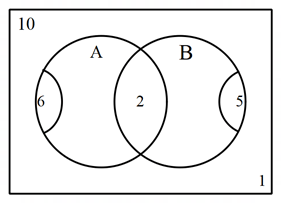
What is 2/5?
800
This notation A ∩ B′ describes the set of elements that are in A but not in B.
What is A only (or A and not B)?
800
The number of possible outcomes when rolling three four-sided dice.
What is 64?
800
A fair coin is flipped three times. This is the probability of getting at least one tail.
What is 7/8?
800
A coin is flipped 200 times and lands heads 99 times. The experimental probability of tails.
What is 101/200?
800
In a class, 18 like soccer, 12 like basketball and 5 like both. The number who like soccer or basketball.
What is 25?