Nature and Practice
Working Scientifically
Space
Solutions and mixtures
Solutions and Mixtures
100
What are the four main branches of Science?
biology, chemistry, geology and physics
100
A student was testing if different coloured cans (black, white or red) would absorb different amounts of heat. State a suitable hypothesis.
The black can will absorb more heat than the red and white can.
100
What is the name of the current model of the solar system?
Heliocentric
100
What are the three states of matter
solids, liquids and gases
100
Identify the solute and solvent when sugar dissolves in water.
Sugar is the solute, and water is the solvent.
100
What is the difference between a quantitative and qualitative measurement?
Qualitative measurements describe the qualities or characteristics of an object or substance using words. Quantitative measurements describe the properties of an object or substance using numerical values.
100
Identify the most accurate piece of equipment from under laboratory benches that can measure 5mL of water.
10mL Measuring Cylinder
100
During which type of eclipse does Earth move between the Sun and the Moon, causing Earth's shadow to fall on the Moon?
Lunar Eclipse
100
What change of state occurs when water vapour cools and becomes liquid water?
Condensation
100
Why can a gas be compressed more easily than a liquid?
Gas particles are much further apart, with large spaces between them that can be reduced when compressed.
200
A scientist investigates how a volcanic eruption affects the surrounding environment. They study the movement of molten rock, analyse the chemical composition of volcanic gases, and examine how heat energy is transferred during the eruption. Identify the branches of science involved and what each investigates.
Geology: investigates the volcano, molten rock and processes occurring within the Earth.
Chemistry: analyses the chemical composition of volcanic gases.
Physics: investigates heat energy and its transfer during the eruption.
200
Identify the key components of a risk assessment and price an example for using a Bunsen burner.
Risk + Harm + Prevention
The Bunsen burner can hair to catch on fire and cause severe burns to scalp. To prevent this, tie your hair up.
200
Explain why the Moon appears to change shape throughout the month.
As the Moon orbits Earth, we see different portions of its sunlit side, creating the phases of the Moon.
200
What is the difference between cohesion and adhesion in water?
Cohesion is the attraction between water molecules, while adhesion is the attraction between water molecules and other surfaces.
200
Define density and write its formula.
Density is how closely packed particles are in a substance. Density = mass ÷ volume
250
'A student observes that the sky is dark, the wind is increasing and she can hear thunder in the distance.'
Explain the difference between an observations and inferences with reference to the statement above.
An observation is information gathered directly using the senses such as the sky is dark. An inference is an explanation or prediction based on observations such as a storm is approaching.
250
What is the difference between the flame produced by a closed collar and an open collar on a Bunsen burner?
A closed collar produces a yellow safety flame, while an open collar produces a blue flame that is hotter and suitable for heating.
250
Explain why Australia experiences summer when the Northern Hemisphere experiences winter.
Earth's tilted axis and its revolution around the Sun, causing the hemispheres to receive different angles and durations of sunlight at the same time. When Australia experiences summer, the southern hemisphere is tilted more towards the sun causing rays to land more directly and therefore temperatures are hotter.
250

Identify what is occurring from A-E
A- Solid
B- Melting
C- Liquid
D- Boiling
E- Gas
250
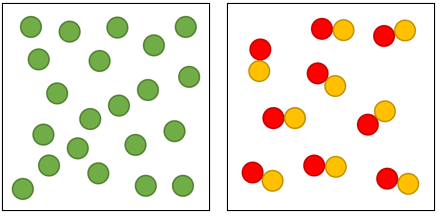
Compare and contrast the two substances.
Both are pure substances. The first substance contains elements while the second contains compounds.
300
Explain the difference between a scientific theory and a scientific law.
A scientific theory explains how or why a natural phenomenon occurs, while a scientific law describes an observed pattern or relationship in nature.
300
A student repeatedly measures an object and obtains 8.2 cm, 8.2 cm and 8.3 cm. The accepted value is 10.0 cm. Evaluate the accuracy and reliability of the measurements
The measurements have high reliability because they are very similar, but low accuracy because they are far from the accepted value.
300
Explain whether spring tides or neap tides would create higher tides.
Spring tides create higher high tides than neap tides. During a spring tide, the Sun, Earth and Moon are aligned, so the gravitational effects of the Sun and Moon combine to produce a greater tidal range.
300
A student mixes sand, salt and water in a beaker. Explain the classification of this substance.
It is a heterogenous mixture , because the sand does not dissolve and the different components are not uniformly distributed.
300
Compare and contrast homogenous and heterogenous mixtures.
Both contain different particles in the substance.
Homogenous has evenly distributed particles so the substance looks uniform while heterogenous mixtures contain particles that are not uniformly distributed so it can loop clumpy.