Define the Concept
Gothic Europe
Crisis of the 14th & 15 Century
Miscellaneous
100
Define: Hundred Years' War
(Question from page 73)
The longest war between England and France which lasted from 1337 - 1453. It was caused by territorial conflicts, succession conflicts, and comercial rivalry.
100
The rise of the monarchies was due to:
(Question from page 72)
(page 62)
- Support of the rich and powerful Bourgeoisie
- Economic prosperity (which allowed kings to levy taxes and pay armies & officials)
- Expansion of the size of their domains
100
What caused hunger and demographic decline to occur in the 14th century?
(Question from page 72)
(pages 64-65)
- Bad harvests (resulting in famine)
- Decrease in production
- The Black Death (Bubonic plague)
100
Study the picture and answer the questions:
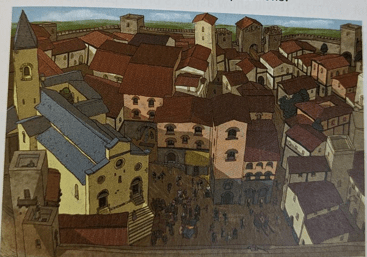
A. How and why did cities grow?
Who lived there and what work did they do?
(Question from page 73)
- Improvements in agriculture led to an increase in food production which led to a rise in the population.
- Bourgeoisie, servants, labourers, craftsmen, beggers, and fugitive serfs lived in the city. These people included maids, unskilled labourers, and apprentices in craft workshops.
- Many cities had a Jewish population who lived in neighbourhoods known as Jewish quarters. There were also Moorish quarters, areas where Muslims lived.
(page 59)
200
Define: Guild
(Question from page 73)
An association of craftsmen working in the same profession. Guilds regulated the working life of their members, and had a monopoly on their trade, and set the price of products.
200
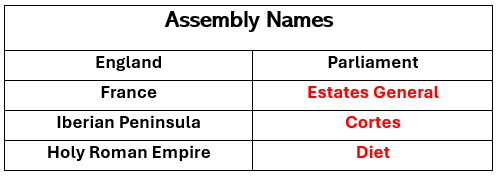
Assemblies or parliments had different names depending on the country.
Identify the names of the missing assemblies: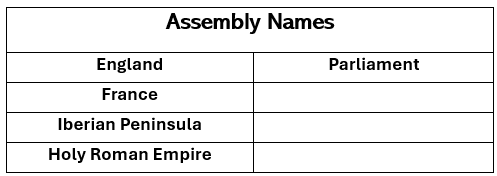
(Question from page 73)
(page 62)
200
The Hundred Years' War was fought between what two countries?
(Question from page 72)
England and France
(page 66)
200
Study the picture and answer the questions:
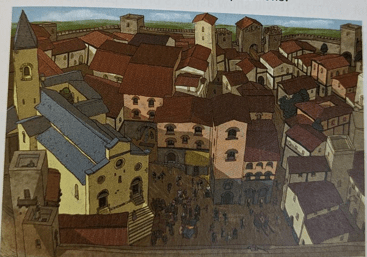
Why did the inhabitants of cities feel free in comparison to people from the country?
(Question from page 73)
City inhabitants had a status as free people, on the other hand, peasants were subject to the power of a feudal lord.
(page 59)
300
Define: Bourgeoisie
(Question from page 73)
(page 59) A social group that was "free" unlike peasants. Growth in commercial activity made many of the bourgeoisie rich thereby increasing their power.
300
What were the duties (functions) of the parliaments?
(Question from page 72)
(page 62)
- To swear loyalty to the King or his successor
- To approve new taxes
- To finance the monarchy
- To support the king in foreign policy
300
Read this text on the Battle of Agincourt and answer the questions:
On the 20th the French lords heard that the English were marching through Picardy and the Lord of Charalois was attacking them so successfully that they could not advance any further. Then all the leaders of France, except for six or seven of them, pursued them and reached them in a place called Agincourt... That was where the battle took place on Saint Crispin's Day. The French were defeated and killed.
A. In which war did this battle take place?
B. Who was the war between? How did it end?
(Question from page 73)
A. The Hundred Years War
B. The war was between the French and English.
The English won the battle of Agincourt, but the French eventually won the war.
300
What connection does the free status of those living in cities in the middleages have with the use of the term "citizen" today?
(Question from page 73)
The main characteristic feature of city inhabitants was their status as free people.
If a serf or inhabitant of the country escaped the lord and took refuge in a city, after a year and a day had passed without them being claimed by their lord, they would become a free citizen.
Over time the term "citizen" and inhabitant of a city who enjoyed rights and freedoms contrasted with the term "subject" which indicated that the person was under the control of a lord.
As a legacy of this medieval principle, in democratic countries today, we use the term "citizen" to refer to inhabitants.
400
Define: Holy Roman Empire
(Question from page 73)
The union of all Christians under a single supreme sovereign. (page 63)
(A dominion for Christendom characterized by strong papal authority.)
400
Identify 3 characteristics of assemblies/parliaments
(Question from page 72)
(page 62)
- They represented all inhabitants of the kingdom, but only the most powerful attended.
- They were advisory
- They only met when convened by the king.
400
Explain what the Investiture Controversy was. What powers came into conflict and who were the key figures?
(Question from page 73)
(Page 63)
Political and religous powers came into conflict.
Emperor Henry IV considered himself the successor to the ancient Roman emperors He wanted to confirm or remove the pope and the bishops in the empire.
Pope Gregory VII was considered the highest spiritual power. He believed that he should choose the bishops and demanded that the emperor meet his approval to rule.
400
Study the picture and answer the questions
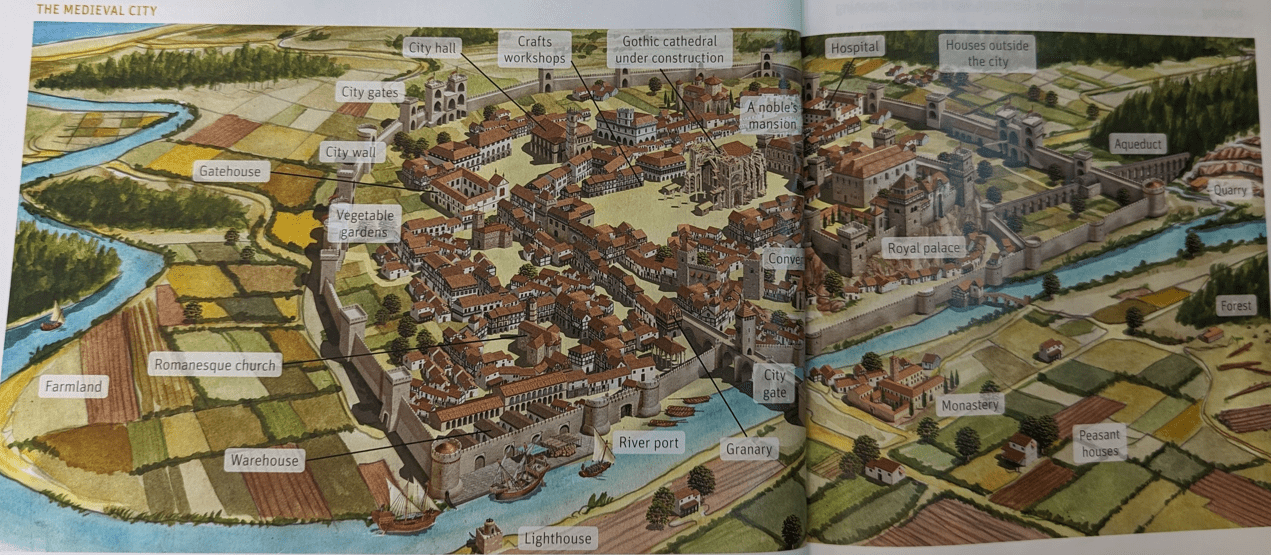
Describe the elements of a medieval city.
What were the main buildings?
Where was the market held?
What traces can be found in today's cities?
(Question from page 73)
Monasteries and convents, city hall, hospitals, granaries, churches and/or cathedrals, crafts workshops,
The market was held in the square.
(page 58)
500
Define: Western Schism
(Question from page 73)
When Christendom was divided for almost forty years.
There was the Pope of Rome (recognised by Germany, England, Portugal and part of Italy),
the Pope of Avignon (recognised by France, Castilla, /aragon and Naples)
and a third pope elected in Pisa.
500
During the "Urban Expansion" what new social group emerged?
(Question from page 72)
(page 59) The Bourgeoise.
500
What were the consequences of the Investiture Controversy?
(Question from page 73)
(page 63)
- The power of the empire and the papacy was weakened
- New political entities emerged (some cities in Italy were governed as republics and in northern Germany a federation of trading cities known as the Hanseatic League emerged)