Algebra
Asymptotes
Limits
Derivatives
Surprise
100
Factor (4x4-9).
Difference of Two Squares
= (2x-3)(2x+3)
100
What indicates that a function has a vertical asymptote? (Hint: What is the denominator equal to?)
Values that make the denominator equal to zero once its completely factored are vertical asymptotes.
100
What is limx ->4 f(x), given that f(x) = x2
16
100
What does the derivative calculate?
The slope of the tangent line at a given point.
100
What is the period of sinx and cosx?
2pi
200
What is the conjugate of x1/2 - 3?
x1/2 + 3
200
Find all holes and asymptotes of the following:
(x-4)2/ [(x+2)(x-5)]
Hole at x=-2, Vertical asymptote at x=5
200
What are some strategies for evaluating limits when direct substitution fails?
Factoring, Conjugate, Cancelling terms, Make a table of values
200
What is the formula for the derivative? (Hint: uses limits)
f′(x)=limh→0 [f(x+h)−f(x)]÷h
200
Explain the Intermediate Value Theorem and its requirements.
When:
- The curve is the function y = f(x),
- which is continuous on the interval [a, b],
- and w is a number between f(a) and f(b),
Then ...
... there must be at least one value c within [a, b] such that f(c) = w
300
Simplify: (x7y) ÷ (x-1y3)
x8/y2
300
Find the horizontal asymptote of the following function: (2x2+5)/(3x2+2)
2/3
300
When is a function f(x) continuous at some value x=a?
Continuous when (1) f(a)=n (where n is some real number); (2) limx ->a+ f(x)=n, and (3) limx ->a- f(x)=n
300
Find f'(x) given that f(x)=2x2−16x+35 using limits.
4x-16
300
What is ln(e)?
1
400
What does it mean for a function to be one-to-one?
This means that the function and its inverse are functions. Graphically, it passes the horizontal and vertical line tests.
400
Does f(x)=x3/x have any asymptotes? Explain.
No, becuase f(x) can be simplified to f(x)=x2, which does not contain any form of asymptotes.
400
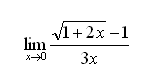
1/3
400
Find the equation to the tangent line at x=2 give that f(x)=5x−x3
y= -7x+11
400
Factor: (2x2-2x-12)
(2x+4)(x-3)
500
Tell whether each function is one-to-one or not:
1) f(x)=ex 2) f(x)=sinx 3) f(x)=x3-5x2 2) f(x)=ln(x)
1) and 4) are one-to-one (notice that they are each other's inverses)
2) and 3) are not becuase they fail the horizontal line test.
500
How do you find the horizontal asymptotes of a function that has the same degree in the numerator and denominator?
Look at the highest degrees of the numerator (n)/denominator (d). Since n=d, then the asymptote is the coefficient of the highest term in the numerator divided over the coefficient of the highest term in the denominator.
500
What is the squeeze theorem?
If two functions squeeze together at a particular point, then any function trapped between them will get squeezed to that same point.
(This deals with limits rather than function values)
500
Find the derivative of W(t)=1÷√t using the limit definition.
(-1/2)*t(-3/2)
500
What is [1÷(x-1)] + [2÷(x+3)]?
(3x+2)÷[(x-1)(x+3)]