Anatomy
Flavors
Systemic associations
Cataract surgery
And complications
100
What is the anteroposterior length of a natural lens at birth and in adulthood?
A. 4 mm, 6 mm
B. 3.5 mm, 5 mm
C. 5 mm, 9 mm
D. 2.5 mm, 6 mm
B. 3.5 mm, 5 mm
Adult AP length 5 mm, equatorial length 9-10 mm
"Cataract surgery is a 9-5 job"
100
The following condition can be seen with all of the following, except:
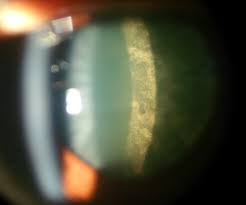
A. Wilson disease
B. Topical steroid use
C. Brachytherapy
D. NF type 2
A. Wilson disease
Wilson disease (auto recessive): commonly associated with sunflower cataract (reddish pigment, curpous oxide, deposits in anterior lens capsule & subcapsular cortex)
100
What type of cataract is most commonly seen with atopic dermatitis?
A. Spokelike central
B. Anterior supcapsular
C. Cerulean
D. Nuclear sclerotic
B. Anterior supcapsular
25% of patients with atopic dermatitis develop shield-like anterior subcapsular cataracts. Onset usually 2nd or 3rd decade.
Can also develop PSC less commonly.
100
Which of the following is a dispersive OVD?
A. Healon
B. Viscoat
C. Provisc
D. Amvisc
B. Viscoat
Cohesive OVDs (Healon, Amvisc, Provisc): long-chain, high MW, high viscosity; good at maintaining space and easy to remove from eye
Dispersive OVDs (Viscoat, Healon endocoat, OcuCoat): short-chain, low MW, low viscosity; great coating & protection, difficult to remove
100
All of the following contribute to PCO formation, except:
A. younger age
B. square edge optics
C. larger capsulorrhexis
D. poor cortical clean up
B. square edge optics
Additional risk factors:
-H/o intraocular inflammation
-Exfoliation syndrome
-Lens material: PMMA > silicone > acrylic
200
From what germ layer is the lens derived?
A. Mesoderm
B. Endoderm
C. Ectoderm
D. Neuroectoderm
C. Ectoderm
200
The following condition is characterized by all of the following, except:
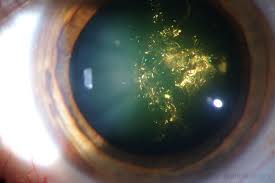
A. difficulty releasing door knobs
B. eyelid retraction
C. cardiac conduction delays
D. early balding and infertility issues in males
B. eyelid retraction
Myotonic dystrophy (auto dominant): delayed relaxation of contracted muscles, ptosis, weakness of facial muscles, cardiac conduction defect, frontal balding
Associated with Christmas tree cataracts: polychromatic iridescent crystals in lens cortex with PSC formation
200
Which of the following complications is most likely during cataract extraction in a young patient with inferonasally displaced lens?
A. malignant hyperthermia
B. renal failure
C. liver failure
D. pulmonary embolism
D. pulmonary embolism
Homocystinuria (auto recessive): error of methionine metabolism; usually tall, light colored hair, thromboembolic episodes, seizures, osteoporosis, cognitive impairment
Ocular s/s: lens dislocation (80% by age 15) inferonasally, abnormal zonular development (has cysteine)
200
Which of the following phaco tips will provide the most holding force?
A. 0 degree tip
B. 15 degree tip
C. 30 degree tip
D. 45 degree tip
D. 45 degree tip
Angled tips provide an oval mouth piece. The greater the degree of angulation, the larger of the surface area
Force = pressure*area
200
After completing the rhexis, you suddenly loose the red reflex and the lens moves forward. What should you do next?
A. Increase bottle height
B. Finish nuclear removal as quickly as possible
C. Close wound with a suture
D. Perform posterior sclerotomies
C. Close wound with a suture
Patient is having a suprachoroidal hemorrhage. Goal is to close the eye as quickly as possible to prevent expulsion of any intraocular content.
300
Which of the following describes appropriate ion composition of a normal lens compared to surrounding aqueous?
A. High [Na] & [K]
B. High [Na], low [K]
C. Low [Na], high [K]
D. Low [Na] & [K]
C. Low [Na], high [K]
Na/K pump located on anterior lens epithelium & oriented to pump K into cell, Na out of cell.
- Anterior lens: higher [K], lower [Na] due to pump
- Posterior lens: lower [K], higher [Na] due to diffusion
- Difference in relative concentrations creates anteroposterior gradient
300
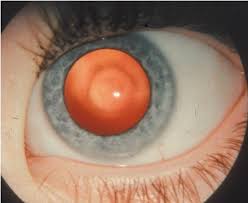
A consult in the newborn nursery has the following findings. Which consult should you recommend?
A. Cardiology
B. Hematology
C. Nephrology
D. Nutrition
D. Nutrition
Galactosemia (auto recessive): defect in galactose conversion to glucose. Most common enzyme deficiency Gal-1-UPT deficiency.
- S/s: malnutrition, hepatomegaly, jaundice, intellectual deficiency
- Dx: galactose in urine
- Rx: elimination of milk
300
Which of the following is most commonly seen when the lens vesicle fails to separate from the surface ectoderm?
A. Avascular corneal haze
B. Congenital cataract
C. Elevated IOP
D. Posterior corneal indentation centrally
A. Avascular corneal haze
Peters (type II) caused by failure of lens vesicle to separate from surface ectoderm, leading to corneolenticular adhesions and corneal opacities.
300
Which setting on a peristaltic phacoemulsification machine controls the speed of rise of vacuum?
A. Aspiration flow rate
B. Surge
C. Vacuum level
D. Bottle height
A. Aspiration flow rate
Peristaltic phaco machines: generates vacuum through series of rollers with fixed tubing. As rollers compress and pass across tubing, vacuum is created.
Surge: when tip is occluded & vacuum has been built up and then occlusion suddenly breaks, causes fluid to rush into phaco tip
Bottle height: controls infusion rate and IOP
300
How long after complicated cataract surgery with dropped nucleus into the vitreous can you wait to remove the pieces without increased risk of CME?
A. 3 days
B. 7-10 days
C. 3 weeks
D. 3 months
C. 3 weeks
Small amounts of retained cortical material can be absorbed by the body; can remain in the eye as long as IOP and inflammation under control.
Nuclear fragments are usually not absorbed and should be removed within 3 weeks.
400
You are signing up a patient for cataract surgery with an axial length of 22 and keratometry of 42/44 x133 degrees. What IOL power should you select? Assume A constant of 118.4
A. 19 D
B. 21 D
C. 22 D
D. 25 D
D. 25 D
Based on SRK formula,
P = A - 0.9(K) - 2.5(AL)
= 118.4 - 0.9(43) - 2.5(22)
= 24.7 D
400
What layer of the lens does the following cataract form within?
A. Posterior subcapsular
B. Anterior cortex
C. Nucleus
D. Anterior capsule
D. Anterior capsule
Phenothiazine causes pigment deposition in the anterior lens epithelium or capsule. Dependent on dosage and length of treatment. Higher risk with chlorpromazine & thioridazine. Usually visually insignificant.
400
Which of the following treatments is most likely associated with a myopic shift?
A. Steroid use
B. Radiation treatment
C. Hyperbaric oxygen treatment
D. Antibiotic use
C. Hyperbaric oxygen treatment
Chronic hyperbaric oxygen treatment (1 year with >150 treatments) can lead to NSC formation. NSC is more commonly associated with lenticular myopia.
400
Which of the following refers to the percentage of the length that the phaco tip moves relative to the maximal possible length?
A. Load
B. Power
C. Duty cycle
D. Cavitation
B. Power
Load: amount of nucleus in contact with phaco tip
Power: ability for phaco needle to vibrate
Duty cycle: proportion of time phaco energy is applied during a set period of time
Cavitation: formation of bubbles at phaco tip & ability to emulsify lens material
400
A patient with past history of CE/IOL presents with acute vision changes after bumping his head on the roof of his car. Which of the following syndromes is most likely associated with the exam findings below?

A. High hyperopia
B. Previous strabismus surgery
C. Usher syndrome
D. Posterior polymorphous corneal dystrophy
C. Usher syndrome
Patient presents with dislocated IOL with minimal trauma, typically seen with zonular weakness.
Conditions with weakened zonules: pseudoexfoliation, prior PPV, past trauma, myopia, CTD, uveitis, RP (Usher)
Usher = RP + congenital, sensorineural hearing loss
500
Where in the lens are the cells with the highest metabolic activity found?
A. Anterior lens capsule
B. Lens epithelium
C. Nucleus
D. Zonular fibers
B. Lens epithelium
Lens epithelium single layer of cells found under anterior lens capsule. Contain germinative zone where most mitosis and metabolic activity occurs.
Glc absorbed from aqueous and phosphorylated into G6P. Enters 1 of 2 pathways predominately: anaerobic glycolysis or hexose monophosphate (HMP) shunt
500
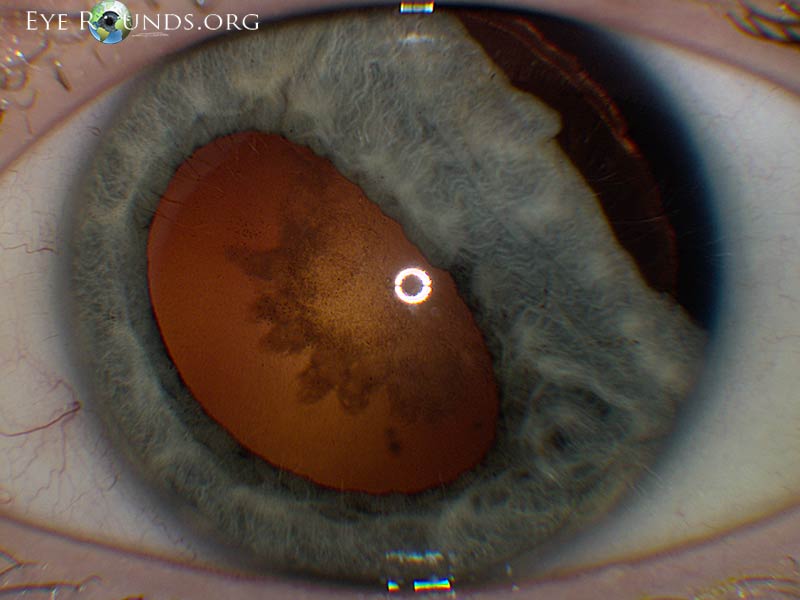
In what pattern does the cataract below begin to form?
A. Anterior star-like
B. Anterior circular
C. Posterior star-like
D. Posterior circular
C. Posterior star-like
Traumatic cataract: usually starts as sellate or rosette cataract involving posterior lens capsule
500
A patient with short stature and the following findings presents with IOP of 45. Which of the following is the best initial treatment?
A. Brimonidine
B. Pilocarpine
C. Cyclopentolate
D. Pred forte
C. Cyclopentolate
Weill-Marchesani (auto recessive): short stature, short & stubby fingers, broad hands, reduced joint mobility
-Associated microspherophakia which can cause pupillary block. Cycloplegics push lens/iris diaphragm back & break block
500
All of the following are associated with a higher incidence of anterior capsule phimosis, except:
A. Small rhexis
B. Marfan syndrome
C. Pseudoexfoliation syndrome
D. 3 piece IOL
D. 3 piece IOL
Capsular phimosis occurs when anterior capsule contracts post-op. Can lead to decreased vision or IOL displacement
RF: pseudoexfoliation, loose zonules, small rhexis, silicone lens, plate haptic IOLs
Rx: Nd:YAG laser, requires higher E
500
A patient with history of remote cataract extraction and aphakia presents with the findings below. Which of the following is true of the condition?
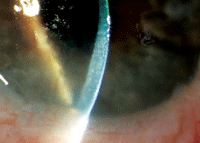
A. Edema initially begins 3-6 months after surgery
B. Can be caused by mutation in ZEB1
C. There is usually NV adjacent to corneal edema
D. Edema starts inferiorly and progresses peripherally
D. Edema starts inferiorly and progresses peripherally
Brown McLean syndrome: unknown etiology, peripheral K edema after CE/IOL with clear central cornea
- Edema starts inferiorly and spans 360, leaves central 5-7 mm zone clear usually
- Associated with remote CE/IOL history, aphakia