Kinematics
Forces
Rotation/Gravitation
Oscillations
Momentum
100
The time it takes an object to fall off the empire state building (187 m)
~13.5 seconds
100
An object of mass 2 kg is acted upon by three external forces, each of magnitude 4 N. Which of the following could NOT be the resulting acceleration of the object?
- A. 0 m/s2
- B. 2 m/s2
- C. 4 m/s2
- D. 6 m/s2
- E. 8 m/s2
8m/s2
The maximum net force on the object occurs when all three forces act in the same direction, giving Fnet = 3F = 3(4 N) = 12 N, and a resulting acceleration of a = Fnet/m = (12 N)/(2 kg) = 6 m/s2. These three forces could not give the object an acceleration greater than this.
100
A disk of radius 0.1 m initially at rest undergoes an angular acceleration of 2.0 rad/s2. If the disk only rotates, find the total distance traveled by a point on the rim of the disk in 4.0 s.
1.6 m
100
A spring mass system is vibrating along a frictionless, horizontal floor. The spring constant is 8 N/m, the amplitude is 5 cm and the period is 4 seconds.
In kg, the mass of the system is

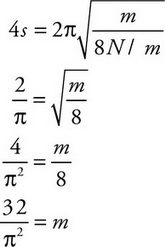
The period for a spring-mass system is given by the equation  . Use that equation to solve for the mass, as shown below.
100
A lightweight toy car crashes head-on into a heavier toy truck. Which of the following statements is true as a result of the collision?
I. The car will experience a greater impulse than the truck.
II. The car will experience a greater change in momentum than the truck.
III. The magnitude of the acceleration experienced by the car will be greater than that experienced by the truck.
III.
By Newton's Third Law, both vehicles experience the same magnitude of force and, therefore, the same impulse; so Statement I is false. Invoking Newton's Second Law, in the form impulse = change in momentum, we see that Statement II is therefore also false. However, since the car has a smaller mass than the truck, its acceleration will be greater in magnitude than that of the truck, so Statement III is true
200
An object initially at rest experiences a time-varying acceleration given by a = 2t for t ≥ 0. How far does the object travel in the first 3 seconds?
9m
200
A box of mass m slides on a horizontal surface with initial speed v0. It feels no forces other than gravity and the force from the surface. If the coefficient of kinetic friction between the box and the surface is μ, how far does the box slide before coming to rest?
Vo2/(2μg)
200
An astronaut lands on a planet whose mass and radius are each twice that of Earth. If the astronaut weighs 800 N on Earth, how much will he weigh on this planet?
400 N
200
A simple pendulum of length l and mass M is oscillating with a period t with very small amplitude. Now the amplitude is halved. The new period is most nearly?
t
For small amplitude oscillations, the period of a pendulum is given by the equation,  . This indicates the period is independent of the amplitude, so the new period will equal the previous period.
200
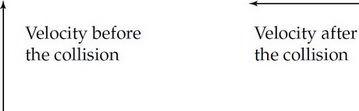
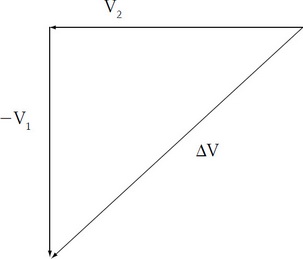
The velocity of an object before a collision is directed straight north and the velocity after the collision is directed straight west, as shown above. Which of the following vectors represents the change in momentum of the object?
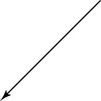
D The direction of the change in momentum of an object will be the direction of  V. The resultant of V2 – V1 is shown below.
300
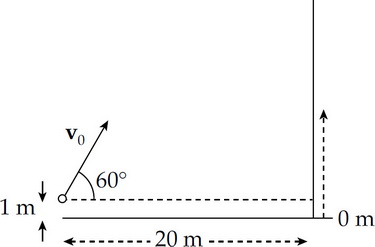
A ball is projected with an initial velocity of magnitude v0 = 40 m/s toward a vertical wall as shown in the figure above. How long does the ball take to reach the wall?
1.0 s
The projectile's horizontal speed is v0 cos 60° = v0 = 20 m/s, so it reaches the wall in 1.0 s.
300

Three blocks of masses 3m, 2m, and m are connected to strings A, B, and C as shown above. The blocks are pulled along a frictionless, horizontal floor with a force, F. Determine the acceleration of the 2m block.

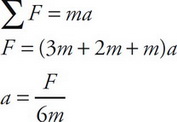
The acceleration of the 2m mass is the same as the acceleration of the m and 3m mass because they are connected to each other. Use Newton's Second Law for the entire system to solve for the acceleration.
300
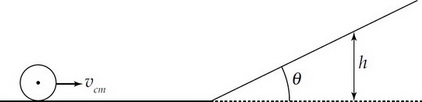
The center of mass of a cylinder of mass m, radius r, and rotational inertia  has a velocity of vcm as it rolls without slipping along a horizontal surface. It then encounters a ramp of angle θ, and continues to roll up the ramp without slipping.
Now the cylinder is replaced with a hoop that has the same mass and radius. The hoop's rotational inertia is mr2. The center of mass of the hoop has the same velocity as the cylinder when it is rolling along the horizontal surface and the hoop also rolls up the ramp without slipping. How would the maximum height of the hoop compare to the maximum height of the cylinder?
A. The hoop would reach a greater maximum height than the cylinder.
B. The hoop and cylinder would reach the same maximum height.
C. The cylinder would reach a greater maximum height than the hoop.
D. The cylinder would reach less than half the height of the hoop.
E. None of the above.
The hoop would reach a greater maximum height than the cylinder.
use the Law of Conservation of Energy. The easiest way to determine which object will reach a greater height is to determine which object has more kinetic energy as it rolls along the horizontal surface. If both the cylinder and the hoop have the same velocity then the hoop will have more total kinetic energy because it has a greater rotational inertia. The calculation below shows the calculation for the height which also shows that the hoop reaches a greater height.

While both (A) and (D) indicate that the hoop reaches a greater maximum height than the cylinder, (D) is incorrect as the cylinder reaches 3/4 the height of the hoop.
300
A spring mass system is vibrating along a frictionless, horizontal floor. The spring constant is 8 N/m, the amplitude is 5 cm and the period is 4 seconds.
Which of the following equations could represent the position of the mass from equilibrium x as a function of time t, where x is in meters and t is in seconds.
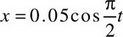
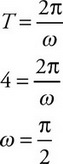
The equation for an object undergoing simple harmonic motion will be of the form x = A cos(ωt + f), where A is the amplitude, ω is the angular frequency and f is the phase constant. None of the solutions involve the phase constant, so we will ignore that part of the equation. The amplitude of the oscillation is 5 cm, which is 0.05 m. This eliminates (D). The angular frequency can be calculated by using the fact that the period is 2π divided by the angular frequency.
300
Two ice skaters are moving on frictionless ice and are about to collide. The 50-kg skater is moving directly west at 4 m/s. The 75-kg skater is moving directly north at 2 m/s. After the collision they stick together.
What is the magnitude of the momentum of the two-skater system after the collision?
250 kg•m/s
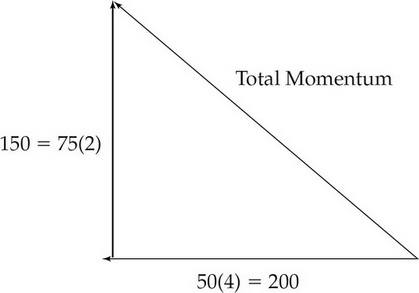
Applying the Law of Conservation of Linear Momentum tells us that the total momentum of the system after the collision is equal to the total momentum of the system before the collision. Momentum can be calculated by multiplying the mass times the velocity for each skater and adding the vectors as shown below. You can use the Pythagorean theorem to solve for the total momentum, or realize this is a 3-4-5 right triangle, so the total momentum is equal to 250 kg⋅m/s.
400
Physics students are checking the constant acceleration equations of kinematics by measuring the velocity of a tennis ball that is dropped and falls 6 meters and then passes through a photogate. The predicted velocity is 20% above the velocity measured by the photogate. Which of the following best describes the cause of the large percent difference?
A. The ball changes its shape while falling.
B. The acceleration of gravity varies as the ball is falling.
C. Air resistance increases the acceleration of the ball.
D. The acceleration of the balls varies with the velocity.
E. The acceleration of gravity changes due to air resistance.
The acceleration of the balls varies with the velocity.
The constant kinematics equations ignore the air resistance that decreases the total mechanical energy of the ball as it falls. The force due to air resistance also increases the faster the ball is going, so the force is increasing with time. This would make the acceleration of the ball begin at 9.8 m/s2 and then decrease as the ball falls. This eliminates (C). The ball is rigid so it will not change shape when falling, which eliminates (A). The acceleration of gravity will be constant over the 6 meters that the ball falls, so this eliminates (B) and (E). Therefore (D) is left and is correct because the fall is speeding up at a decreasing rate of acceleration.
400
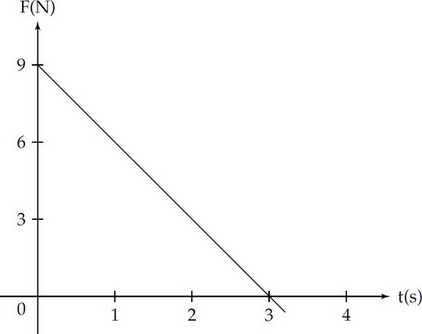
A block of mass 2 kg, initially at rest, is pulled along a frictionless, horizontal surface with a force shown as a function of time by the graph above.
The acceleration of the block at t = 2 s is
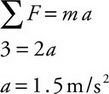
1.5m/s^2
Read the force directly off the graph. At t = 2 s the force is 3 N. Use Newton's Second Law to solve for the acceleration.
400
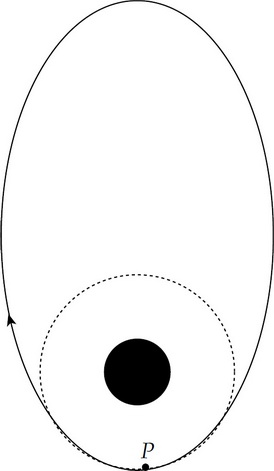
A spaceship orbits Earth in a clockwise, elliptical orbit as shown above. The spaceship needs to change to a circular orbit. When the spaceship passes point P, a short burst of the ship's engine will change its orbit. What direction should the engine burst be directed?

To reduce this elliptical orbit to circular the spaceship must slow down. To accomplish this, the engine burst must be in the same direction of the velocity which will cause the spaceship to accelerate in the opposite direction as per Newton's Third Law of Motion (action/reaction). This will cause the spaceship to slow down. The velocity at point P is directed to the left, so the engine burst must be to the left.
400
10. 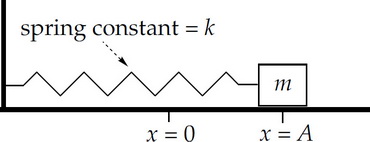
In the figure shown, the block (mass = m) is at rest at x = A. As it moves back toward the wall due to the force exerted by the stretched spring, it is also acted upon by a frictional force whose strength is given by the expression bx, where b is a positive constant. What is the block's speed when it first passes through the equilibrium position (x = 0)?
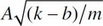
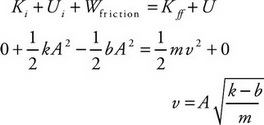
The work done by the friction force as the block slides from x = A to x = 0 is

Now use Conservation of Energy, using U(x) =  kx2:
kx2:
400
2. 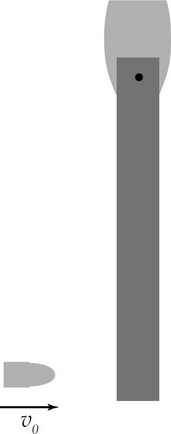
A bullet is moving with a velocity v0 when it collides with and becomes embedded in a wooden bar that is hinged at one end, as shown above. Consider the bullet and the wooden bar to be the system. For this scenario, which of the following is true?
A. The linear momentum of the system is conserved because the net force on the system is zero.
B. The angular momentum of the system is conserved because the net torque on the system is zero.
C. The kinetic energy of the system is conserved because it is an inelastic collision.
D. The kinetic energy of the system is conserved because it is an elastic collision.
E. Linear momentum and angular momentum are both conserved.
The angular momentum of the system is conserved because the net torque on the system is zero.
When objects stick together, a perfectly inelastic collision has occurred. For this situation kinetic energy is not conserved. This eliminates (C) and (D). Linear momentum is conserved when the net force on the system is zero. In this situation the hinge in the bar is exerting a force on it prohibiting it from translating to the right. Therefore linear momentum is not conserved. This eliminates (A) and (E). Angular momentum is conserved when the net torque on a system is zero. The force exerted by the hinge provides no torque because the lever arm is zero. Therefore (B) is correct.
500
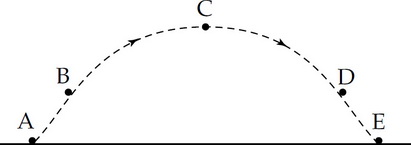
An object is launched and follows the dashed path shown above. If air resistance is considered, when is the velocity of the object the greatest and the acceleration of the object the greatest?
The acceleration of the object will be due to gravity and air resistance. Air resistance is proportional to the velocity of the object. Since air resistance decreases the total mechanical energy of the object, the greatest velocity will occur at the point closest to the initial launch, point A. The greatest acceleration will occur when the air resistance and gravity are in the same direction and when the object is traveling the fastest. This is also at point A. Therefore (A) is correct.
500
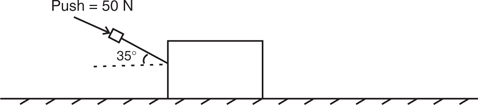
A student pushes a big 16-kg box across the floor at constant speed. He pushes with a force of 50 N angled 35° from the horizontal, as shown in the diagram above. If the student pulls rather than pushes the box at the same angle, while maintaining a constant speed, what will happen to the force of friction?
A. It must increase.
B. It must decrease.
C. It must remain the same.
D. It will increase only if the speed is greater than 3.1 m/s.
E. It will increase only if the speed is less than 3.1 m/s.
It must Decrease
The friction force is equal to the coefficient of friction times the normal force. The coefficient of friction is a property of the surfaces in contact, and thus will not change here. However, the normal force decreases when the cart is pulled rather than pushed—the surface must apply more force to the box when there is a downward component to the applied force than when there is an upward component. Speed is irrelevant because equilibrium in the vertical direction is maintained regardless.
500
The radius of a collapsing spinning star (assumed to be a uniform sphere) decreases to  its initial value. What is the ratio of the final rotational kinetic energy to the initial rotational kinetic energy?
162
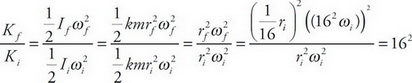
Since no external torques act on the star as it collapses (just like a skater when she pulls in her arms), angular momentum, Iw, is conserved, and the star's rotational speed increases. The moment of inertia of a sphere of mass m and radius r is given by the equation I = kmr2 (with k =  , but the actual value is irrelevant), so we have:

Therefore,
500
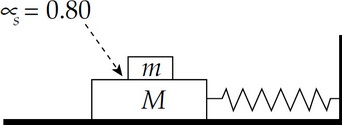
In the figure above, the coefficient of static friction between the two blocks is 0.80. If the blocks oscillate with a frequency of 2.0 Hz, what is the maximum amplitude of the oscillations if the small block is not to slip on the large block?
0.05m
The horizontal position of the blocks can be given by the equation
x = A sin(wt + ϕ0)
where A is the amplitude, w is the angular frequency, and ϕ0 is the initial phase. Differentiating this twice gives the acceleration:

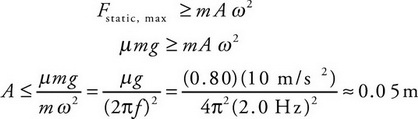
This means that the maximum force on block m is Fmax = mamax = mAw2. The static friction force must be able to provide this much force; otherwise, the block will slip. Therefore,
500
5. 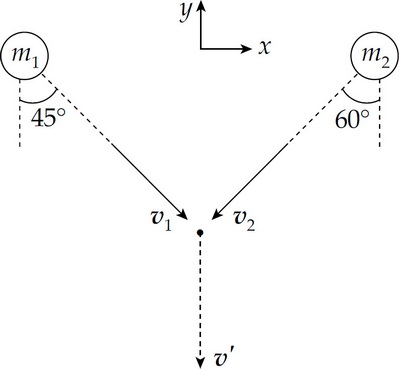
The figure shown is a view from above of two clay balls moving toward each other on a frictionless surface. They collide perfectly inelastically at the indicated point and are observed to then move in the direction indicated by the post-collision velocity vector, v'. If m1 = 2m2 what is v2?
v1(2 sin 45°)/(sin 60°)
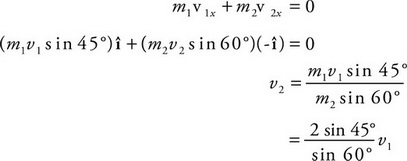
The diagram given with the question shows that after the clay balls collide, they move in the –y direction, which means that the horizontal components of their linear momenta canceled. In other words, p1x + p2x = 0: