Mitosis
Meiosis
Cell Cycle Control
Cancer
Terminology
100
Binary fission in prokaryotes does not require
(A) Replication of DNA
(B) Elongation of Cell
(C) Separation of daughter cell by a septum formation
(D) Assembly of nuclear envelope
(D) Assembly of nuclear envelope
100
In fruit flies, somatic cells contain eight chromosomes. Which of the following correctly describes the number of chromosomes in gametes of fruit flies?
a. 8
b. 4
c. 2
d. 16
b. 4
100
A cyclin-dependent kinase is regulated by
(A) The periodic destruction of cyclins
(B) Bipolar attachment of chromosomes to the spindle
(C) DNA Synthesis
(D) Both A and B are correct
(A) The periodic destruction of cyclins
100
Cancer is a disease of
(A) Cell cycle
(B) Mitochondria
(C) Bacteria
(D) HIV
(A) Cell cycle
100
Structure in a chromosome that holds together the two chromatids.
(A) Centromere
(B) Centrosome
(C) Chromatin
(D) Centriole
(A) Centromere
200
A mouse skin cell containing 404040 chromosomes undergoes mitosis. This process results in the formation of
(A) Four daughter nuclei, each with 40 chromosomes
(B) two daughter nuclei, each with 20 chromosomes
(C) four daughter nuclei, each with 20 chromosomes
(D) two daughter nuclei, each with 40 chromosomes
(D) two daughter nuclei, each with 40 chromosomes
200
Which of the following correctly describes meiosis?
a. Meiosis begins with a haploid parent cell and ends with two haploid daughter cells.
b. Meiosis begins with a diploid parent cell and ends with two diploid daughter cells.
c. Meiosis begins with a haploid parent cell and ends with four haploid daughter cells.
d. Meiosis begins with a diploid parent cell and ends with four haploid daughter cells.
d. Meiosis begins with a diploid parent cell and ends with four haploid daughter cells.
200
What steps in the cell cycle represents irreversible commitment?
(A) The S/G2 checkpoint
(B) The G1/S checkpoint
(C) The spindle checkpoint
(D) Both B and C are correct
(D) Both B and C are correct
200
Human papillomavirus (HPV) is a viral infection that is transmitted mainly through skin-to-skin contact. Following transmission, HPV enters host cells and integrates into the host genome, eventually causing the cells to synthesize the viral protein E6. In turn, E6 inactivates the host protein p53, a tumor suppressor that arrests the cell cycle or induces apoptosis when DNA damage is detected.
(A) HPV causes uncontrolled division in the infected cell.
(B) HPV increases the likelihood of apoptosis in infected cells.
(C) HPV causes infected cells to exit the cell cycle and enter G0
(D) HPV increases the synthesis of tumor suppressor proteins in infected cells.
(A) HPV causes uncontrolled division in the infected cell.
200
A complex of macromolecules found in cells, consisting of DNA, protein, and RNA.
(A) Chromosome
(B) Chromatid
(C) Chromatin
(D) Centriole
(C) Chromatin
300
A student is examining a whitefish blastula cell under a microscope. Based on his observations, the student proposes that the whitefish blastula cell is in interphase.
(A) The genetic content of the cell exists as dispersed chromatin.
(B) A cleavage furrow has formed on the cell’s surface.
(C) The mitotic spindle is fully assembled, with its poles at opposite ends of the cell.
(D) Sister chromatids have separated and are moving toward opposite poles of the cell.
(A) The genetic content of the cell exists as dispersed chromatin.
300
The formation of ova, or female reproductive cells, occurs when diploid germ cells undergo meiosis. In female swamp wallabies (Wallabia bicolor), diploid germ cells contain 10 chromosomes. At the beginning of meiosis I, a female wallaby germ cells contains
a. 5 homologous pairs of chromosomes comprising a total of 10 chromatids
b. 10 homologous pairs of chromosomes comprising a total of 20 chromatids
c. 10 homologous pairs of chromosomes comprising a total of 10 chromatids
d 5 homologous pairs of chromosomes comprising a total of 20 chromatid
d. 5 homologous pairs of chromosomes comprising a total of 20 chromatid
300
DNA damaging agents results in the arrest of cell division at this checkpoint
(A) G1/S checkpoint
(B) G2/M checkpoint
(C) Spindle checkpoint
(D) Both A and B are correct
(D) Both A and B are correct
300
When mutations occur in protooncogenes, they become cancer-causing agents called ______.
(A) Tumor suppressor gene
(B) Malignant tumor
(C) Stem cells
(D) Oncogene
(D) Oncogene
300
Paired cylindrical organelles found in the centrosome of an animal cell.
(A) Centrosome
(B) Centriole
(C) Centromere
(D) Chromatid
(B) Centriole
400
A student is examining an onion root tip cell under a microscope. Based on her observations, the student proposes that the onion root tip cell has completed interphase and is now in the first phase of mitosis.
Which of the following pieces of evidence would best support the student’s claim?
(A) Separated sister chromatids are being pulled towards opposite ends of the cell.
(B) The cell’s chromosomes are aligned across the metaphase plate.
(C) The cell’s DNA is dispersed within the nucleus as chromatin.
(D) Discrete chromosomes are scattered throughout the cell’s nucleus.
(D) Discrete chromosomes are scattered throughout the cell’s nucleus.
400
During anaphase I
a. Sister chromatids separate and move to the poles
b. homologous chromosomes move to the opposite poles
c. homologous chromosomes align at the middle of the cell
d. all the chromosomes align independently in the middle of the cell.
b. homologous chromosomes move to the opposite poles
400
Which of the following statements about cyclin-dependent kinases (Cdks) or cyclin is false?
A.Different Cdks act at different points in the cell cycle.
B.A Cdk can catalyze the phosphorylation of other proteins.
C.Cdks use ATP as a substrate.
D.Cyclin is made continuously during the cell cycle.
D.Cyclin is made continuously during the cell cycle.
400
An example of a proto-oncogene is
(A) Ras
(B) p53
(C) RB
(D) All of the above
(A) Ras
400
An organelle that is the main place where cell microtubules are organized.
(A) Centriole
(B) Centrosome
(C) Centromere
(D) Chromosome
(B) Centrosome
500
The following graph shows how cellular DNA content changes over the course of a typical mitotic cell cycle in rapidly proliferating human cells. 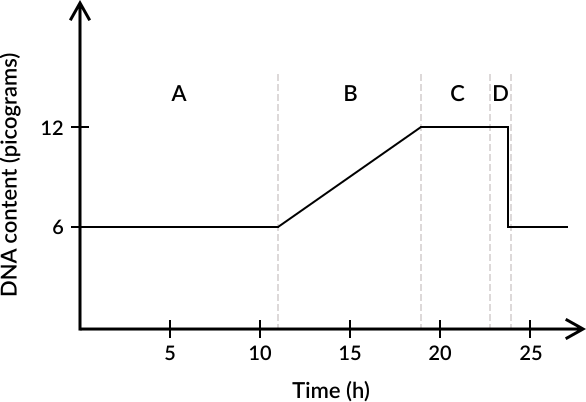
Based on the graph, which of the following labeled phases corresponds to S phase of the cell cycle?
(A) Phase A, because it is the longest phase of the cell cycle.
(B) Phase B, because the amount of cellular DNA is doubled during this phase.
(C) Phase C, because it occurs immediately after the amount of cellular DNA is doubled.
(D) Phase D, because the amount of cellular DNA is halved during this phase.
(B) Phase B, because the amount of cellular DNA is doubled during this phase.
500
Name the event wherein the paternal and maternal chromosomes change their material with each other in cell division
(a) Crossing over
(b) Synapsis
(c) Formation of the synaptonemal complex
(d) Bivalent forming
(a) Crossing over
500
The metaphase to anaphase transition involves
(A) the new force being generated to pull the chromatids apart.
(B) An increase in force on the sister chromatids to pull them apart
(C) completing DNA replication of centromeres allowing chromosomes to be pulled apart
(D) loss of cohesion between sister chromatids
(D) loss of cohesion between sister chromatids
500
Genetically, proto-oncogenes act in a dominant fashion. This is because
(A) There is only one copy of each proto-oncogene in the genome.
(B) They act in a gain-of-function fashion to turn on the cell cycle.
(C) They act in a loss-of-function to turn off the cell cycle.
(D) They require that both genomic copies are altered to affect function.
(B) They act in a gain-of-function fashion to turn on the cell cycle.
500
Thread-like structures located inside the nucleus of animal and plant cells. Made of protein and a single molecule of deoxyribonucleic acid (DNA).
(A) Chromosome
(B) Chromatin
(C) Chromatid
(D) Centromere
(A) Chromosome