General Macroeconomics
General Macroeconomics
GDP
Economics and the government
General Macroeconomics
100
What is opportunity cost?
the loss of potential gain from other alternatives when one alternative is chosen.
100
What does CPI stand for?
consumer price index
100
What does GDP Stand for?
Gross domestic product
100
Describe the two principles of taxation
(1) the belief that taxes should be based on the individual's ability to pay, known as the ability-to-pay principle, and
(2) the benefit principle, the idea that there should be some equivalence between what the individual pays and the benefits he subsequently receives from governmental activities.
100
What is inflation?
In economics, inflation is a general rise in the price level in an economy over a period of time.
200
What is the law of demand?
The law of demand states that quantity purchased varies inversely with price.
200
What type of unemployment will not be present at full employment?
cyclical unemployment
200
What is the formula for GDP?
GDP = C + I + G + NX or GDP = C + I + G +(X-M)
200
What are transfer payments?
a payment made or income received in which no goods or services are being paid for, such as a benefit payment or subsidy.
200
What is the difference between deflation and disinflation?
As we know, inflation refers to the rise in price levels in an economy, and deflation is the opposite, a fall in price levels. Disinflation, on the other hand, refers to a slower rate of inflation.
300
What is the law of supply?
The law of supply says that as the price of an item goes up, suppliers will attempt to maximize their profits by increasing the quantity offered for sale.
300
What is a positive economic statement?
Positive economics is objective and fact-based where the statements are precise, descriptive, and clearly measurable.
300
Goods that are produced and consumed in an economy counted in a GDP calculation are separated into what two categories?
Durable and non-durable goods
300
What term is used to describe the economy during the great depression?
Stagflation
300
What is the formula for CPI?
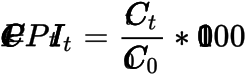
400
What are the labels for the two axes on a supply-demand graph?
Price and Quantity
400
What are the sectors of a circular flow model chart?
Factor Market, Product Market, Businesses, Households
400
Why are sales of intermediate goods and services are not included in GDP?
The reason why these goods are not part of the calculation is that they would be counted twice.
400
What is the difference between the federal deficit and federal debt?
The difference between the deficit and the debt lies in the time frame. The federal deficit (or surplus) refers to what happens with the federal government budget each year. The public (or Federal government) debt is accumulated over time; it is the sum of all past deficits and surpluses.
400
How do you calculate the labor force participation rate?
(Labor Force ÷ Civilian Noninstitutional Population) x 100.
500
What is the difference between a surplus and a shortage?
A shortage occurs when the quantity demanded is greater than the quantity supplied. A surplus occurs when the quantity supplied is greater than the quantity demanded.
500
Why does full employment not mean 0 unemployment?
Full employment does not mean zero unemployment, it means cyclical unemployment rate is zero. At this rate, job seekers are equal to job openings. This is also called the natural rate of unemployment (Un) where real GDP is at its potential GDP.
500
If you want to be able to compare GDP numbers from year to year in a way that makes an apple to apple comparison you take into account what?
Inflation
500
What are the 7 roles of government in a mixed economy?
1.Establishing and enforcing rules of exchange
2.Promoting competition/prevent anticompetitive practices
3.Regulating natural monopolies
4.Provide public goods
5. Dealing with externalities
6.Redistribute income
7. Promote macroeconomic goals of Full employment, Price stability, Economic growth
500
Explain why people dislike inflation.
People dislike inflation because of money illusion. They mistake their nominal incomes for real incomes, and mistake consumer prices for the real cost of living. ... People who suffer from money illusion will tend to be upset when consumer prices rise, but happy when their nominal wages rise.