Matter Matters
Water, water everywhere
Scientific Reasoning
Energy
Experimental Design
100
To compare how objects are similar:
A. Compare
B. Solid
C. Temperature
D. Liquid
A. Compare
100
A state of matter that keeps its shape:
A. Liquid
B. Solid
C. Gas
D. Plasma
B. Solid
100
Doing which of the following would provide evidence that weathered rock is part of soil?
A. Breaking rocks into small pieces with a hammer
B. Observing several soil samples with a hand lens
C. Planting grass seeds in different types of soil
D. Sorting rocks into different groups by color
B. Observing several soil samples with a hand lens
100
Helps us stay warm in the winter
Helps us see where we are going
Helps pedal a bike
Helps us communicate or talk
A. Light energy
B. Sound energy
C. Mechanical energy
D. Thermal energy
D Helps us stay warm in the winter A. Light energy
A Helps us see where we are going B. Sound energy
C Helps pedal a bike C. Mechanical energy
B Helps us communicate or talk D. Thermal energy
100
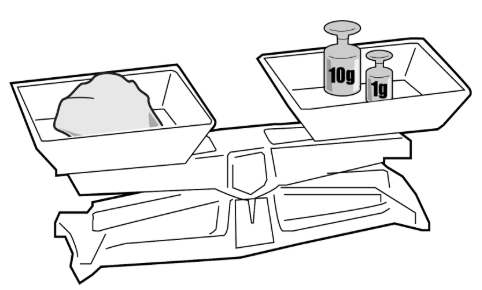
What is the mass of the rock on this pan balance?
A. 1 gram
B. 9 grams
C. 10 grams
D. 11 grams
D. 11 grams
200
A substance that has a definite shape:
A. Compare
B. Solid
C. Temperature
D. Liquid
B. Solid
200
Anything that takes up space and has mass:
A. Solid
B. Matter
C. Liquid
D. Gas
B. Matter
200
Four students were given pieces of clay that were exactly the same size. When they put the pieces of clay in water, two of the pieces floated and two of them sank. What might explain these results?
A. Some students changed the shape of the clay pieces.
B. The students had water at different temperatures.
C. A few of the pieces were heavier than the others.
D. Clay pieces only float in large bowls of water.
C. A few of the pieces were heavier than the others.
200
List two things you might do in a day that use sound energy.
Answers will vary.
200
Some students were investigating how a push or pull changes the position of an object. Which of the following will increase the reliability of their results?
A. Repeat the experiment to see if the results are the same.
B. Use a meter stick to measure how far the object moves.
C. Create a graph showing the results of the investigation.
D. Draw conclusions based on the data they collected.
A. Repeat the experiment to see if the results are the same.
300
A measure of how hot or cold a substance is.
temperature
300
What are the two scales on a thermometer?
A. Temperature
B. Celsius
C. Grams
D. Fahrenheit
B. Celsius
D. Fahrenheit
300
A scientist wants to find out how different soils support plant growth. How could the scientist collect data about the ability of the soils to grow plants?
A. Count the number of leaves on the plants that grow in the best soil
B. Measure the height of the plants grown in the different soils
C. Use a hand lens to study how the roots take up water in the soils
D. Carefully measure the amount of water given to the plants in each soil
B. Measure the height of the plants grown in the different soils
300
List two things you might do in a day that might involve light energy.
Answers will vary.
300
A group of science students observed and recorded the growth of two plants for four weeks. The table shows their data.
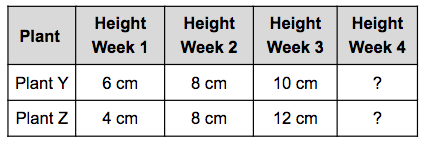
If the plants continue to grow at the same rates, what is the best prediction for the heights of the plants in Week 4?
A. Plant Y will be taller than Plant Z.
B. Plant Z will be about 40 cm tall.
C. Plant Y will be about 8 cm tall.
D. Plant Z will be taller than Plant Y.
D. Plant Z will be taller than Plant Y.
400
A substance that takes the shape of its container.
liquid
400
What is the state of matter that expands and fills its container?
gas
400
This advertisement is for a new e-reader.

Which of the following would a way to verify one of the claims made in the advertisement?
A. Research the weight of the e-reader on the Internet
B. Try to put the e-reader in a pocket to see if it fits
C. Read all the books pre-loaded on the e-reader
D. Purchase a different e-reader for comparison
B. Try to put the e-reader in a pocket to see if it fits
400
List two things you might do in a day that might use thermal energy.
Answers will vary.
400

A student placed a glass beaker containing water on a hot plate and heated it until the water began to boil. What question was he most likely trying to answer?
A. How much water does it take to fill a beaker?
B. How does heating water affect its state?
C. What is the mass of a full beaker of water?
D. What is the difference between liquid water and ice?
B. How does heating water affect its state?
500
The amount of matter in an object.
A. Mass
B. Volume
C. Solid
D. Liquid
A. Mass
500
What is the state of matter that takes the shape of its container?
liquid
500
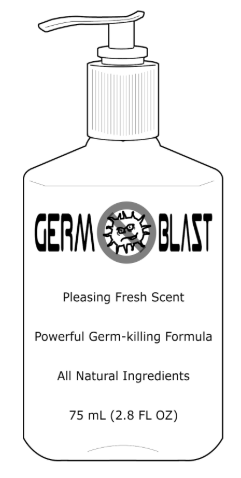 Which statement about the product can be proved by direct measurement?
A. The hand sanitizer has a pleasing scent.
B. The germ-killing formula is powerful.
C. The ingredients are all natural.
D. The bottle contains 75 mL of product.
D. The bottle contains 75 mL of product.
500
List two things you may do in a day that might involve mechanical energy.
Answers will vary.
500
The students in a science class recorded daily temperatures for one week.

What is the difference between the high and the low temperatures on Sunday?
13 degrees Celsius