9.1 Elephants and Ducks
9.2 Real Cool
9.3 Heating Up!
9.4 Chaos
Anything and Everything
100
Temperature is a measure of a system’s
A)Average kinetic energy
B)Heat of fusion
C)Melting Point
D)Total heat energy
A)Average kinetic energy
100
Which letter(s) represents when water is a liquid only?
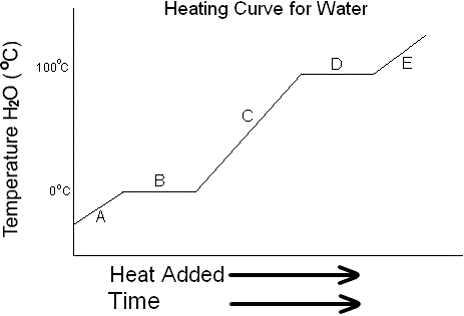
C
100
Which of the following is the most accurate?
A)Heat flows from areas of low kinetic energy to areas of high kinetic energy
B)Heat flows from areas of low potential energy to areas of high potential energy
C)Heat flows from hotter areas to colder areas
D)Heat always flows into a system from its surroundings
C)Heat flows from hotter areas to colder areas
100
Entropy is a measure of
A) accuracy
B) precision
C) the disorder of a system
D) the attraction of a nucleus for an electron
C) the disorder of a system
100
How many neutrons are in an atom of U-235?
Mass number = protons + neutrons
Uranium has 92 protons
143 neutrons
200
In a potential energy diagram, the difference between the potential energy of the products and the potential energy of the reaction is equal to the
A) heat of reaction
B) entropy of the reaction
C) activation energy of the forward reaction
D) activation energy of the reverse reaction
A) heat of reaction
200
Which letter(s) represents a phase change?

B and D
200
What is the heat of fusion for water?
A)334 J/g
B)2260 J/g
C)4.18 J/goC
D)It depends on ΔT
A)334J/g (Located on Table B)
200
The entropy of a sample of CO2 increases as the CO 2 changes from
A) gas to liquid
B) gas to solid
C) liquid to solid
D) solid to gas
D) solid to gas
200
What is the correct formula for magnesium chloride?
A) MgCl
B) MgCl2
C) Mg2Cl
D) MgCl3
B) MgCl2
Mg ionic charge +2
Cl ionic charge -1
Ratio of elements must make a neutral compound
300
Which information about a chemical reaction is provided by a potential energy diagram?
A) the oxidation states of the reactants and products
B) the average kinetic energy of the reactants and products
C) the change in solubility of the reacting substances
D) the energy released or absorbed during the reaction
D) the energy released or absorbed during the reaction
300
Which letter(s) represents a change in kinetic energy?
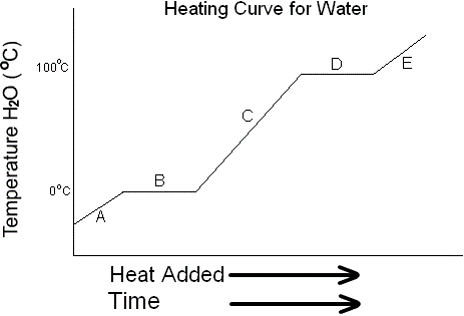
A, C, and E
300
Which equation would you use for this problem?
Find the specific heat of an unknown if 80 g loses 6512 J as temperature drops from 68°C to 46°C.
A)q=mCΔT
B)q=mΔHf
C)q=mΔHv
D)K = C + 273
A)q=mC ΔT (Temperature is changing)
300
Given the balanced equation representing a reaction:
2H2O (l) +571.6 kJ --> 2H2 (g) + O2 (g)
What occurred as a result of this reaction?
A) Energy was absorbed, and entropy increased.
B) Energy was absorbed, and entropy decreased.
C) Energy was released, and entropy increased.
D) Energy was released, and entropy decreased.
A) Energy was absorbed, and entropy increased.
300
Draw a molecule of hexane
6 carbons, single bonds, and saturated with hydrogens
400
The energy absorbed and the energy released during a chemical reaction are best represented by a
A) cooling curve
B) heating curve
C) kinetic energy diagram
D) potential energy diagram
D) potential energy diagram
400
What is the melting point of this substance?
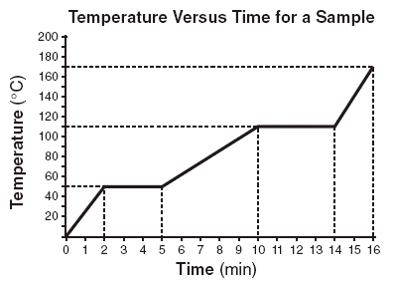
50 C
400
How would you define the following system?
H2 + Cl2 --> 2HCl + 350J
A)Endothermic
B)Exothermic
C)Combustion
D)The system is absorbing energy
B)Exothermic (Heat is a product)
400
Which change in a sample of water is accompanied by the greatest increase in entropy?
A) H2O(l) at 100ºC is changed to H2O(g) at 200ºC. B) H2O(g) at 100ºC is changed to H2O(g) at 200ºC. C) H2O(s) at -100ºC is changed to H2O(s) at 0ºC. D) H2O(s) at -100ºC is changed to H2O(l) at 0ºC.
A) H2O(l) at 100ºC is changed to H2O(g) at 200ºC.
400
What is the %O in Na2O?
25.8%O
500
Based on Reference Table I, when 2.00 moles of NaOH(s) dissolves in water
A) 44.5 kJ of energy is released and the temperature of the water increases
B) 44.5 kJ of energy is absorbed and the temperature of the water decreases
C) 89 kJ of energy is released and the temperature of the water increases
D) 89 kJ of energy is absorbed and the temperature of the water decreases
C) 89 kJ of energy is released and the temperature of the water increases
500
How many minutes does it take this substance to boil?
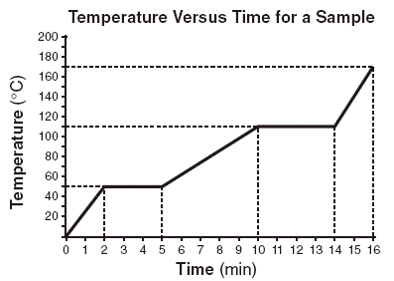
4 minutes
500
Find the specific heat of an unknown if 80 g loses 6512 J as temperature drops from 68°C to 46°C.
q=mCΔT
Solve for C
3.7J/g
500
Chemical systems in nature tend to undergo changes toward
A) lower energy and lower entropy
B) lower energy and higher entropy
C) higher energy and lower entropy
D) higher energy and higher entropy
B) lower energy and higher entropy
500
What is the coefficient of O2 when the follow equation is balanced.
__C4H10 + __O2 --> __CO2 + __H2O
13