General
Regions of the Brain
Autonomic Nervous System and MORE Regions of the Brain
Neuroglia and Nerve Diagram
Action Potentials
Cranial Nerves and Neuropathology
100
These two structures make up the central nervous system.
Brain, Spinal Cord
100
This part of the brain is responsible for integrating information related to sound.
Temporal Lobe
100
This branch of the autonomic nervous system increases activity in the digestive tract, decreases metabolic rate, and decreases heart rate.
Parasympathetic Nervous System
100
This CNS neuroglial cell is responsible for connecting neurons to their blood supply
Astrocytes
100
This is the resting membrane potential of a neuron.
-70 mV
100
The vestibulocochlear nerve is responsible for these two functions.
Hearing and Balance
200
The shallow ridges that cover the brain are called.
Gyri
200
Name the four ventricles of the brain
Lateral (2), third, and fourth.
200
This branch of the autonomic nervous system increases heart rate, dilates bronchioles, and increases blood flow to the skeletal muscles.
Sympathetic Nervous System
200
This PNS neuroglial cell is responsible for making myelin.
Schwann Cell
200
This ion is more abundant outside the cell at resting conditions
Sodium
200
Excessive production of cerebrospinal fluid can lead to this condition.
Hydrocephalus
300
This layer of the meninges directly touches the skull.
Dura mater
300
Body temperature, water balance, and metabolism are regulated by this part of the brain.
Hypothalamus
300
This part of the brain is responsible for vital, primitive functions. It is comprised of the midbrain, pons, and the medulla oblongata.
Brain stem
300
This CNS neuroglia is responsible for make myelin.
Oligodendrocyte
300
These ions are exiting the cell at point 4.
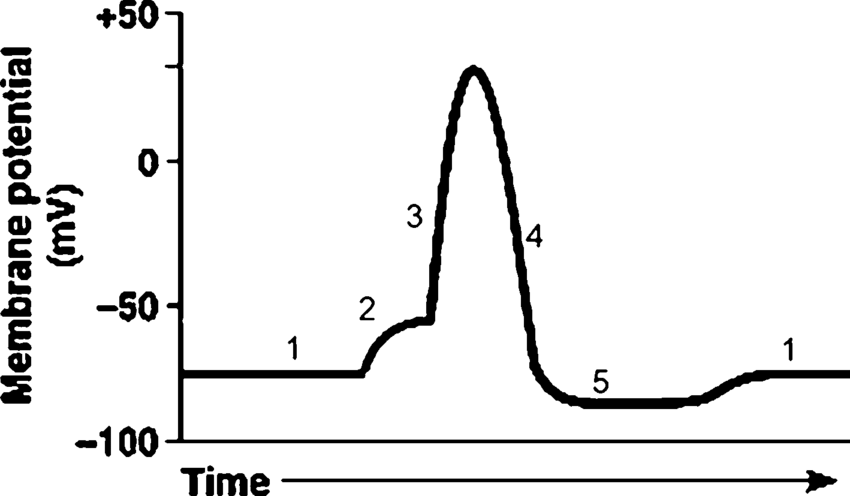
Potassium
300
Inability to lift your arm and move your leg combined with with a drooping face and impaired speech is associated with this pathology.
Stroke
400
The subdural space lies between these two layers of the meninges.
Dura mater and arachnoid mater
400
This lobe of the brain is responsible for vision
Occipital Lobe
400
This lobe of the brain is responsible for smell.
Temporal Lobe
400
This structure surrounds multiple fascicles of nerve bundles
Epineurium
400
What charge will the inside of the membrane become when the potassium channels open and ions diffuse across the cell membrane?
More negative
400
A patient comes stumbling into the clinic unable to walk a straight line. This part of the brain is most likely affected.
Cerebellum
500
Loss of this region of the brain causes a person's words to be nonsensical (word salad).
Wernike's Area
500
This area of the brain is responsible for primitive activities such as heart rate, breathing, blood pressure, swallowing, and vomiting.
Medulla Oblongata
500
This area is responsible for sensing temperature, pain, pressure, and touch.
Primary Sensory Area
500
The tissue layer that surrounds a single nerve bundle or fascicle is called this.
Perineurium
500
This is the ratio of Sodium to Potassium ions pumped via the Na/K pump.
3/2
500
Phineas Gage received a metal rod through his skull in a work accident. The metal rod went through his frontal lobe. What did Gage's friends notice about his personality after the accident?
Mean and irritable