Proteins
Chemical Reactions
Enzymes
Macromolecules
Digestion
100
What elements make up proteins
CHONS
100
What occurs during a chemical reaction?
During a chemical reaction, elements and compounds react with one another to form new elements and compounds.
100
All enzymes are _______.
All enzymes are proteins.
100
Identify the 4 macromolecules that make up living things and give examples types of foods where each is found.
Carbohydrates - bread, pasta, candy
Lipids - lard, oil, nuts, meat, fried food, eggs
Proteins - steak, chicken, pork, fish, cheese, eggs
Nucleic acids - found in all food
100
What occurs during the process of digestion?
BIO IT UP!
Digestion is a process in which macromolecules are broken down into small molecules called monomers that can easily be absorbed into the blood/lymph.
200
What are the monomers that make up proteins?
Amino acids
200
Describe the difference between a reactant and a product.
Reactants enter into the reaction and are shown on the left side of a chemical equation.
Products are what is a produced as a result of the chemical reaction and are shown on the right side of the chemical equation.
200
Describe the role of enzymes.
Enzymes are biological catalysts that speed up chemical reactions by lowering the activation energy needed for the reaction to occur.
200
The building block of enzymes are _____.
Amino acids
200
Give two examples of mechanical digestion.
Teeth/Peristalsis/Churning of stomach
300
Identify 3 functions of proteins and give examples of each type of protein.
Make up structures - collagen, keratin
Transport materials - hemoglobin, transport channel
Produce Movement - muscle contraction (actin/myosin)
Fight infections - antibodies
Speed up chemical reactions - enzymes (lipase, ATP synthase, helicase)
300
During a chemical reaction, when a bond is broken energy is _________.
Released
300
Describe what occurs when enzymes become denatured and give an example of one way this occurs.
Enzymes become denatured when they lose their shape as the results of high temperatures or a change in pH or salinity.
300
Identify the building blocks or monomers for each type of macromolecule.
Carbohydrates - Monosaccharide
Lipids - Glycerol and fatty acids
Proteins - Amino acids
Nucleic acids - Nucleotides
300
Identify where the digestion of carbs, proteins, and lipids first begins within the digestive tract.
Carbs - mouth
Proteins - stomach
Lipids - Small intestine
400
Give two examples of proteins that are involved in transport of materials.
Hemoglobin is a protein found in RBCs that transports oxygen and carbon dioxide.
Transport carrier and channel proteins found in the cell membrane help transport materials across the membrane.
400
What type of reaction is shown in the Figure below?
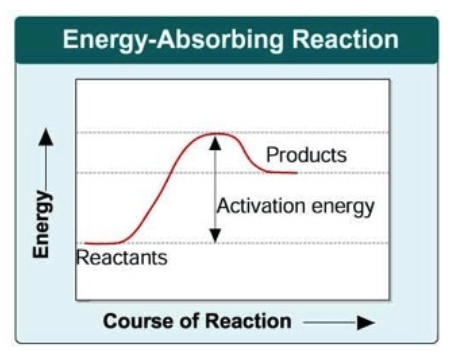
Endothermic Reaction
400
This graph represents the effect of _______ on enzyme activity.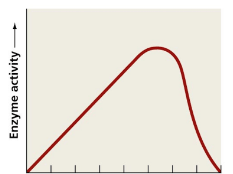
Temperature, salinity or pH.
400
Identify the primary function of each type of macromolecule.
Carbohydrates - short-term energy
Lipids - long-term energy
Nucleic acids - store genetic info for making proteins
Proteins - transport, movement, reactions, infections
400
Identify two chemicals produced by the stomach.
Pepsin - enzyme
Hydrocholoric acid - acid
500
What is the name of the bond that exists between two amino acids?
Peptide bond
500
Describe why activation energy is needed to get a chemical reaction started.
Molecules have kinetic energy and are randomly moving and hitting each other. However, elements, molecules and compounds won't react unless they enough energy so that when they hit each other the bonds between them break and new bonds form that create new elements, molecules, and compounds.
500
What is the substrate of lactase?
Lactose
500
Identify each of the following molecules:
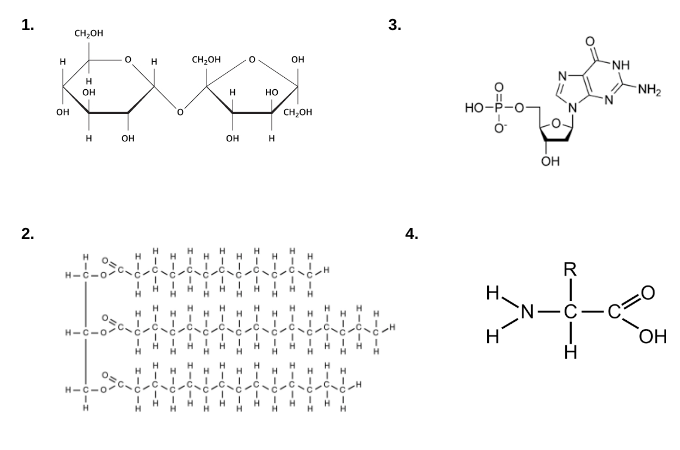
1. Disaccharride
2. Triglyceride
3. Nucleotide
4. Amino acid
500
Identify the organ or gland that produces trypsin, lipase and amylase and identify what each one breaks down.
Pancreas
Trypsin - protein
Lipase - lipids
Amylase - carbs
600
Describe the basic structure of an amino acid.
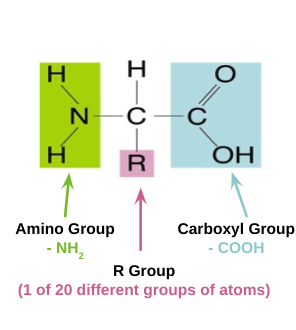
600
Give an example of a chemical reaction and identify the reactants and products.
Photosynthesis -
Reactants = carbon dioxide and water
Products = glucose and oxygen
600
Describe how enzymes work using the following terms:(enzyme, substrate, active site, enzyme-substrate complex, reactant, product, activation energy)
Enzymes are proteins that have an active site with a very specific shape that is specific for a substrate. The substrate is also know as a reactant and binds to the active site found on the enzyme forming the enzyme-substrate complex. The binding of the substrate to the enzyme ensures that the reactants are in the correct orientation to react which lowers the activation energy needed for the reaction. Once the reaction occurs the product is released from the active site on the enzyme and the enzyme can be used again.
600
Trace the path carbohydrates take from the time a carbohydrate enters the digestive tract to the time the monomer reaches its destination in a cell.
Carbs - amylase breaks down starch into disaccharides in the mouth, digestion continues in the small intestine when pancreatic amylase and lactose, maltose, and sucrase that are released by the lining of the small intestine break down the disaccharides into monosaccharides (glucose, fructose, galactose) that diffuse out of finger-like projections called villi that line the small intestine into the blood. The monosaccharides then travel throughout the body and go into the cells via facilitated diffusion. Once inside the cell monosaccharides like glucose enter the mitochondria and are used as a reactant in cellular respiration to produce ATP.
600
Describe the primary function of the liver, small intestine and large intestine.
Liver produces bile that aides in the breakdown of lipids.
Small intestine finishes the break down of macromolecules and finger-like projections called villi absorb the nutrients.
Large intestine absorbs excess water and takes up some vitamins.