Graphing radicals
Key Features
Key Features
The endpoint of
y=3√(x+2) -4
What is (-2,4)
The transformations of
y= √x + 4
What is a vertical translation up 4 units.
Simplify ∛(-343)
What is -7
Solve 3=√(x-2)
What is x=11
Simplify √250
What is 5√10
The domain of
y= √(x+2) -7
What is (-2, ∞)
The transformation for
y= √(x-3) +4
What is a horizontal shift of 3 right and a vertical shift of 4 up
Simplify
2√3 -5√3
What is -3√3
Solve
√(x+8)=2√(x-1)
What is x=4
Simplify
3√8 - 4√32
What is -10√2
The range of
y= ∛(x+2) -8
What is (-∞,∞)
The transformations for
y= -√(x+3) -5
What is a reflection, horizontal shift left 3 and vertical shift down 5
Simplify
3∛16 + 2∛2
What is 8∛2
Solve
∛(x+5) + 4 =7
What is x = 22
Simplify
(5∛15) (3∛9)
What is
45∛5
The maximum point of
y= -√(x-3) +5
What is (3, 5)
Name the transformations
y=-2∛(x-5)
What is a reflection, vertical stretch, and horizontal shift of 5 right.
Simplify
(3√6) (4√3)
What is 36√2
Solve √3x=√(x-6)
What is an extraneous solution of x=-3
Simplify
(15√72) / (3√2)
What is 30
The equation for the graph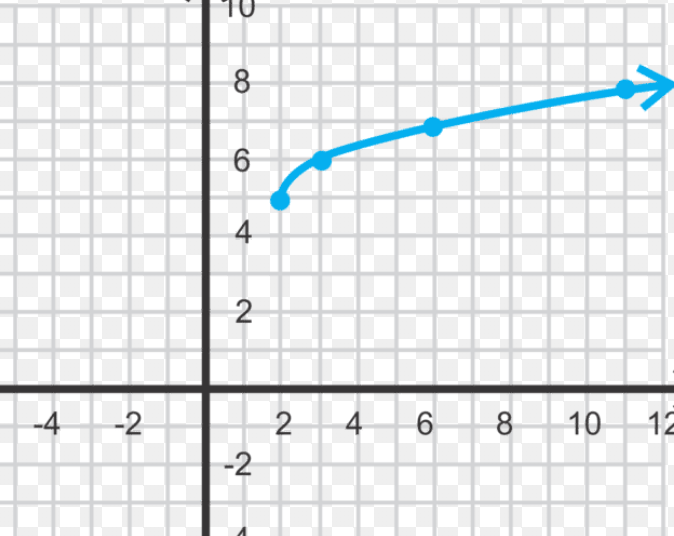
What is
y=√(x-2) +5
The zeros for
f(x) = ∛(x-3) + 1
What is x = 2
Simplify
(3 +√5 )(2 -√3)
What is
6 + 2√5 - 3√3 - √15
Solve x+3 = √(2x+6)
What is x=-1, -3
Simplify
3√(15) / 2√(2)
What is 3√(30) /4