A
B
C
D
E
100
Many birds sing songs. These songs help birds recognize members of their own species. In order for songs to help birds find members of their own species, what characteristic must the songs have?
A Each species must have a special song
B The songs must be very loud
C Birds must change songs often
D Other birds must not hear the song
A Each species must have a special song
100
A seal stores the food it eats as fat. How does this most likely help the seal survive in the climate of Antarctica?
A Fat gives the seal a source of moisture during hibernation.
B Storing food allows the seal to stop eating during the winter.
C Layers of insulation keep the seal warm and provide nutrients.
D Large stores of fat allow the seal to have flexible movement and speed.
C Layers of insulation keep the seal warm and provide nutrients.
100
Sometimes a cat will arch its back and its fur will stand up. This makes the cat look bigger. How might this help the cat?
A It could help the cat locate small animals
B It could help the cat move around at night
C It could frighten an animal that attacks it
D It could make it easier for the cat to hide
C It could frighten an animal that attacks it
100
Which behavior will most likely help an animal survive during a season of hot weather?
A a lizard finding shade under a plant
B a bear hibernating in a den
C a squirrel storing extra food
D a bird migrating to warmer areas
A a lizard finding shade under a plant
100
When a rabbit is surprised by a noise, it may stay very still for a long time. How does staying still help a rabbit survive?
A It helps the rabbit find shelter.
B It helps the rabbit attract a mate.
C It helps the rabbit find more food.
D It helps the rabbit avoid predators.
D It helps the rabbit avoid predators.
200
Which adaptation would be most useful to a black bear living in a forest?
A heavier fur coat
B smaller eyes
C longer claws
D wider arms
C longer claws
200
Some insects, like crickets, make chirping sounds. These sounds help insects recognize members of their own species. In order for these to help insects find members of their own species, what characteristic must the sounds have?
A Other insects must not hear the sound.
B The sound must be very loud.
C Insects must change sounds often.
D Each species must have a unique sound.
D Each species must have a unique sound.
200
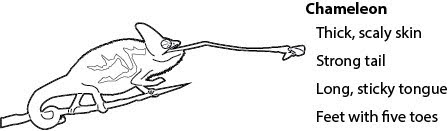
Chameleons are lizards with thick, scaly skin that move in trees with their strong tail and five-toed feet. They eat insects that they catch with a long, sticky tongue. Which difference would most help some chameleons get more food?
A Thicker skin
B Stronger tail
C Longer tongue
D More toes
C Longer tongue
200
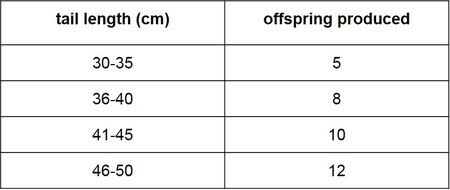
Male widowbirds have long tails that attract females. Not all of their tails are the same length. The data recorded here shows how many offspring were produced by males with different tail lengths. What do these observations show?
A It is not possible for males to have very long tails
B All males have tails of exactly the same length
C Males with shorter tails don’t produce any offspring
D Males with longer tails produce more offspring
D Males with longer tails produce more offspring
200
Geologists discovered a layer of rock formed millions of years in the past. Which of the following would provide the best evidence of what the environment was like when the rock formed?
A The time when the rock appears to have formed
B The sediments from which the rock is made
C The fossil plants and animals found in the rock
D The kinds of rocks above and below the rock layer
C The fossil plants and animals found in the rock
300
Which of these describes how fossilized dinosaur footprints were made?
A A dinosaur walked in fresh cement, and the footprints hardened permanently under the Sun.
B A dinosaur was buried in mud, and the footprints are the indentations the dinosaur left when it was dug up.
C A dinosaur walked in muddy or soft ground, and the footprints were buried after they hardened.
D A dinosaur died in a hot, dry area, and the heat turned the dinosaur's feet into rock.
C A dinosaur walked in muddy or soft ground, and the footprints were buried after they hardened.
300
Scientists use fossils to study plants and animals that lived long ago. What is true about organisms living today?
A Some animals will become fossils, but no plants will.
B Any organism could become a fossil under the right conditions.
C Organisms living today are not old enough to become fossils.
D Some plants will become fossils, but no animals will.
B Any organism could become a fossil under the right conditions.
300
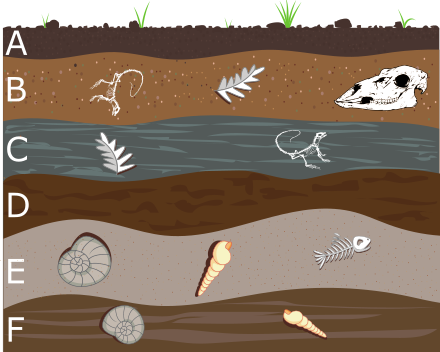
Scientists look at layers of the Earth to learn more about early environments. Based on the diagram of Earth's layers, which of the following is true about the two fossils found in layer C?
A The plant and animal lived in different environments.
B The plant was alive long before the animal.
C The plant and animal were alive at the same time.
D The animal was alive long before the plant.
C The plant and animal were alive at the same time.
300
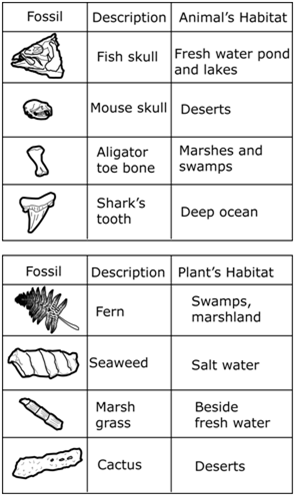
The tables here give information on animal and plant fossils. Based on the information in the tables, which two fossils would most likely be found together in the same rock?
A Fish skull and cactus
B Mouse skull and seaweed
C Alligator toe bone and fern
D Shark’s tooth and marsh grass
C Alligator toe bone and fern
300
Which type of earth would most likely have preserved the footprints of an ancient duck?
A volcanic ash
B mud that dried
C topsoil and sand
D broken rock fragments
B mud that dried
400
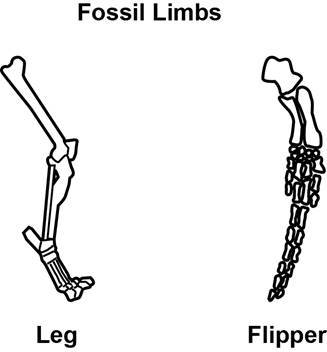
The illustration shows the fossil limbs of two animals. Observing and comparing these fossils would be most useful in determining what about the animals they represent?
A Whether they live in groups or alone
B If one of the animals eats the other
C Whether the animals lay eggs or give live birth
D How the animals move around
D How the animals move around
400
Which of the following could be evidence that a forest was covered by water millions of years ago?
A An increase in rainfall in the forest over time
B Presence of plants in the forest that need water to live
C Fossils of fish discovered in rocks below the forest
D Insects living in the forest that lay their eggs in water
C Fossils of fish discovered in rocks below the forest
400
Fossil ferns, like the ferns found in modern swamps, were discovered in a layer of rock. In a rock layer below were found the fossils of cactus, like those that live in hot, arid deserts today. Based on this evidence, we could conclude that the area where the fossils were discovered had what sequence of climates in the past?
A Forest, followed by deep ocean
B Cold climate that got warmer over time
C Rushing river, then a dark cave
D Very dry and then, much more damp
D Very dry and then, much more damp
400
A scientist discovered fossils of water creatures with bones and teeth. What might these findings suggest?
A eating habits of these creatures
B predators of these creatures
C strength of these creatures
D color of these creatures
A eating habits of these creatures
400
Fossil trees were discovered in a sedimentary rock layer. In the rock layer below are fossils of clams, similar to clams that are currently found on the shores of the Atlantic Ocean. Based on this evidence, we could conclude that the area where the fossils were discovered had what sequence of climates in the past?
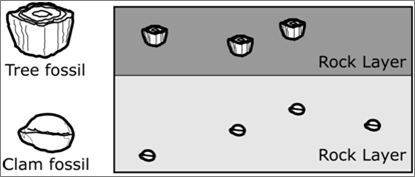
A Beach, followed by a forest
B Rocky and dry, then very moist
C Forest, and later a mountain
D Very cold area, then much warmer
A Beach, followed by a forest
500
Sometimes porcupines will raise their quills. This makes the porcupines look bigger. What are two ways quills may help the porcupine?
A Raising quills could help the porcupines locate plant bark
B Quills could make it easier for the porcupines to hide
C Quills can protect the porcupine by poking the predator when they attack
D Raising quills and appearing bigger could frighten an animal that wants to attack the porcupine
C Quills can protect the porcupine by poking the predator when they attack
D Raising quills and appearing bigger could frighten an animal that wants to attack the porcupine
500
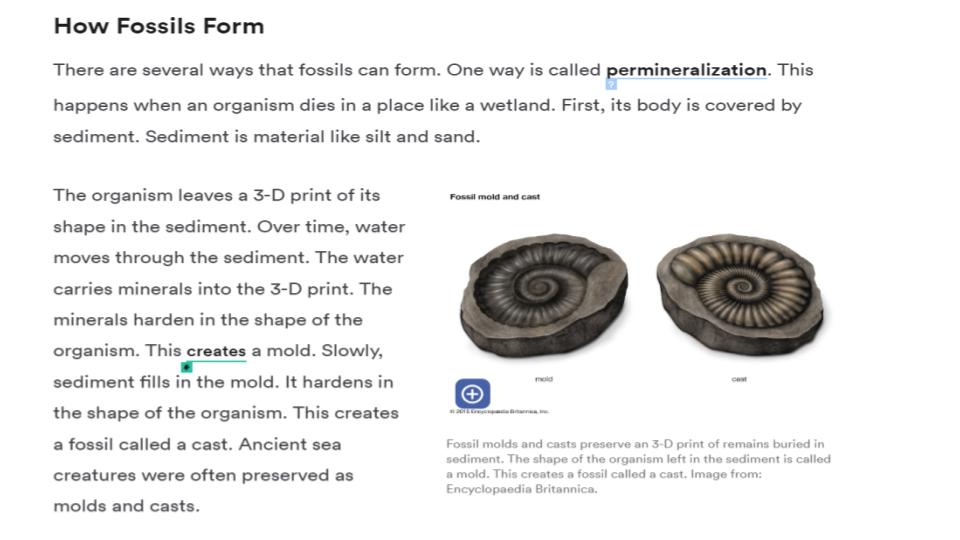
How does permineralization occur during fossil formation?
A When an organism is burned to ashes
B When an organism dies in a wetland and its body is covered by sediment
C When an organism turns into a ghost
D When an organism is frozen in ice
B When an organism dies in a wetland and its body is covered by sediment
500
What is the material like silt and sand called that covers the body of an organism during permineralization?
A Sedative
B Sediment
C Seashells
D Slime
B Sediment
500
Ancient sea creatures were often preserved as which type of fossils?
A Molds and Casts
B Seashells
C Rocks
D Mirrors
A Molds and Casts
500
Each answer choice describes a rabbit in an Arctic region with much snow. Drag and drop which rabbit is most likely to die out from predation and which ones will survive. (All answer choices need to go under a category.
A a rabbit that lost their fur and can not stay warm
B a rabbit that can stay warm
C a rabbit with dark brown fur
D a rabbit that quickly learns to run
Die Out
A a rabbit that lost their fur and can not stay warm
C a rabbit with dark brown fur
Survive
B a rabbit that can stay warm
D a rabbit that quickly learns to run