Food Chain & Food Webs
Biotic Vs. Abiotic
Biomes & Ecosystems
The main players
Vocab You Should Know
100
All food chains start where?
the sun
100
True or false, weather is an important abiotic factor?
True
100
True or False, Fish live only in terrestrial biomes.
False
100
What is an autotroph?
An organism that makes its own food.
100
What is an apex predator?
a predator with little to no predators above it in the food chain.
200
What does the direction of the arrows mean in an ecosystem?
the flow of energy
200
True or False, Leaves of a Cottonwood tree are biotic (living factors)
True
200
Name two types of biomes found on earth.
Taiga, deciduous forest, coral reef, etc.
200
Herbivores are which type of consumer?
primary consumers
200
What is a producer?
an organism—typically plants, algae, or bacteria—that creates its own food (energy) using sunlight, water, and carbon dioxide through photosynthesis
300
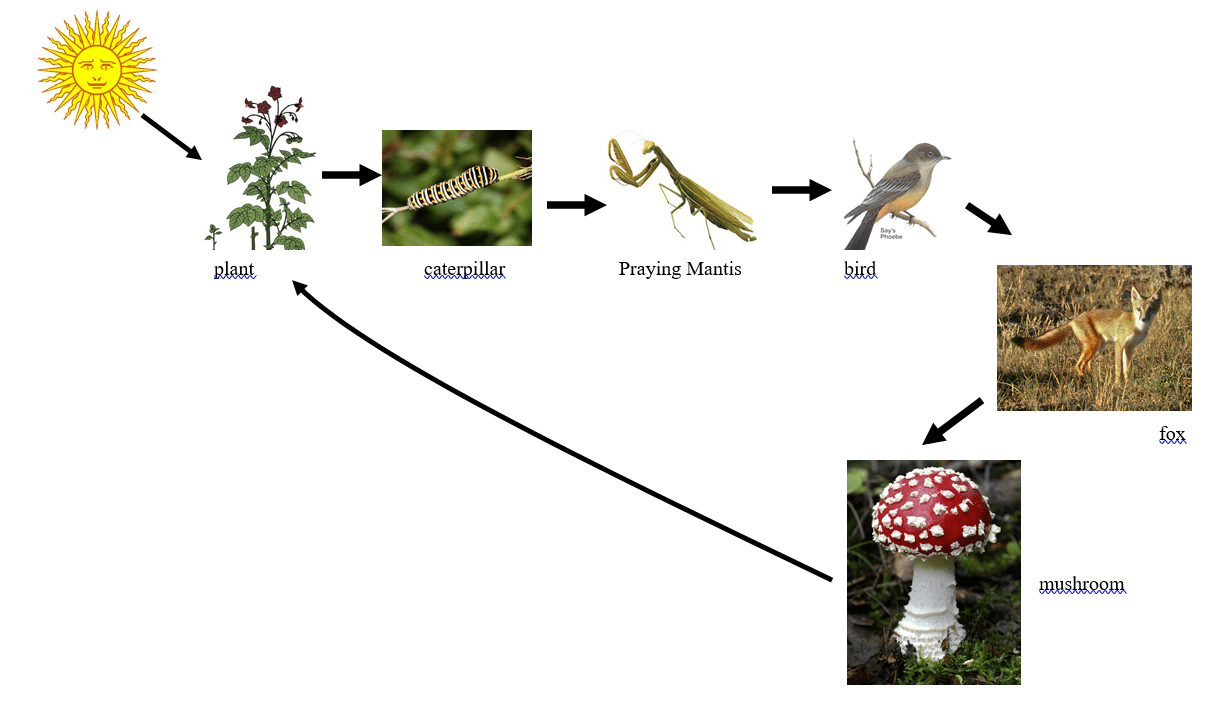
Is this a picture of a food chain or a food web?
Food Chain
300
Sandy soil is considered a(n) ________ factor
abiotic
300
Does more or less biodiversity create a stronger food web? Why?
More biodiversity because if one source of food disappears, there will be more options that help other animals survive.
300
What is a tertiary consumer?
the third eater
300
What is competition in an ecosystem?
When organisms fight for the same limited resources like food, water, or shelter.
400
Remember the food chain from Amoeba Sisters, what could happen to the population of snakes if most of the crickets disappeared?
A) The same number of snakes because snakes don’t eat crickets.
B) Fewer Snakes because there will be more grass.
C) Fewer Snakes because there will be fewer frogs to eat.
D) There is no way to predict changes to the Snake population.
C) Fewer Snakes because there will be fewer frogs to eat.
400
Grass seeds are considered a(n) _________ factor
biotic
400
Which statement is correct about biomes?
A) Biomes are found on land, but not in water.
B) A biome is made up of only one ecosystem.
C) A collection of ecosystems that have similar environments and organisms.
D) Climate does not affect a biome.
C) A collection of ecosystems that have similar environments and organisms
400
What is the purpose of a decomposer and how do they help the soil?
Decomposers consume dead organisms and other biomass and return nutrients to the soil.
400
What is the difference between a population versus a community?
Populations are made of one type of species. Communities are multiple populations living together.
500
1. Mayflies are a type of aquatic insect that live in freshwater ecosystems and eat aquatic producers called algae. Trout are a type of fish that eat mayflies, and herons are a type of bird that hunt trout. a. Complete the food chain for these organisms.
1) Algae 2) Mayflies 3) Trout 4) Herons
500
Name 2 biotic and 2 abiotic factors in a forest biome.
biotic: deer, tree, etc
abiotic: soil, rain, rocks, etc.
500
How much energy is lost from the producer to the first consumer?
About 90%
500
A Praying mantis is considered a __________ consumer because __________.
Secondary consumer because it is a carnivore that eats mostly bugs.
500
If mass is the amount of matter or "stuff" in something, what is biomass?
the mass produced by organisms in an ecosystem.