Moons
Dwarf Planets
Asteroids
Comets
Interplanetary Medium and Boundary Regions
100
What is the definition of a moon?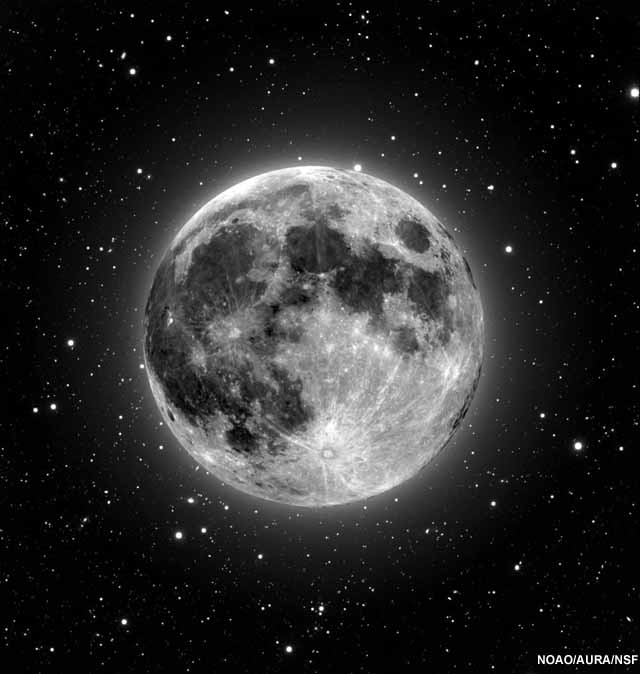
A natural object that goes around something that goes around a star.
(A moon can never orbit the sun directly.)
100
True or false: A dwarf planet is bigger than an asteroid but not quite a full-size planet. It must
- Orbit the Sun
- Be round-ish
- Share its path with space junk like asteroids
True! Think of a dwarf planet like a "middle child" in space. It is bigger than an asteroid but not quite a full-grown planet. To be a dwarf planet, an object must:
- Orbit the Sun (it's not a moon orbiting someone else).
- Be round-ish (it has enough gravity to pull itself into a ball shape).
- Share its path (unlike big planets, it still has lots of asteroids and space junk in its way).
100
What are asteroids made of?
Rock and metal
100
What are comets mostly made of?
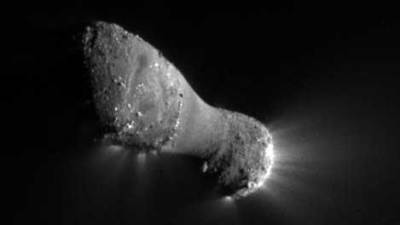
Ice, dust, and frozen gases. Think of dirty snowballs.
100
What is the "Interplanetary Medium" that fills the space between planets?

It is a thin "soup" of energy, gas, and dust that flows away from the Sun.
200
How many moons are in the solar system?
a) 10-50 b) 50-100 c) 100-500 d) 500-1000
d) 890 moons have been counted in our solar system as of 2025.
200
How many dwarf planets are there (so far)?
5! Ceres (the closest one), Pluto (the most famous one), Eris (the one that started the debate), Haumea (the football-shaped one), Makemake (the one named after a creator god)
200
Are asteroids round?
No. They are too small to have enough gravity and heat themselves up enough to melt into a ball. They are lumpy like potatoes.

200
What causes a comet to grow a glowing "tail"?
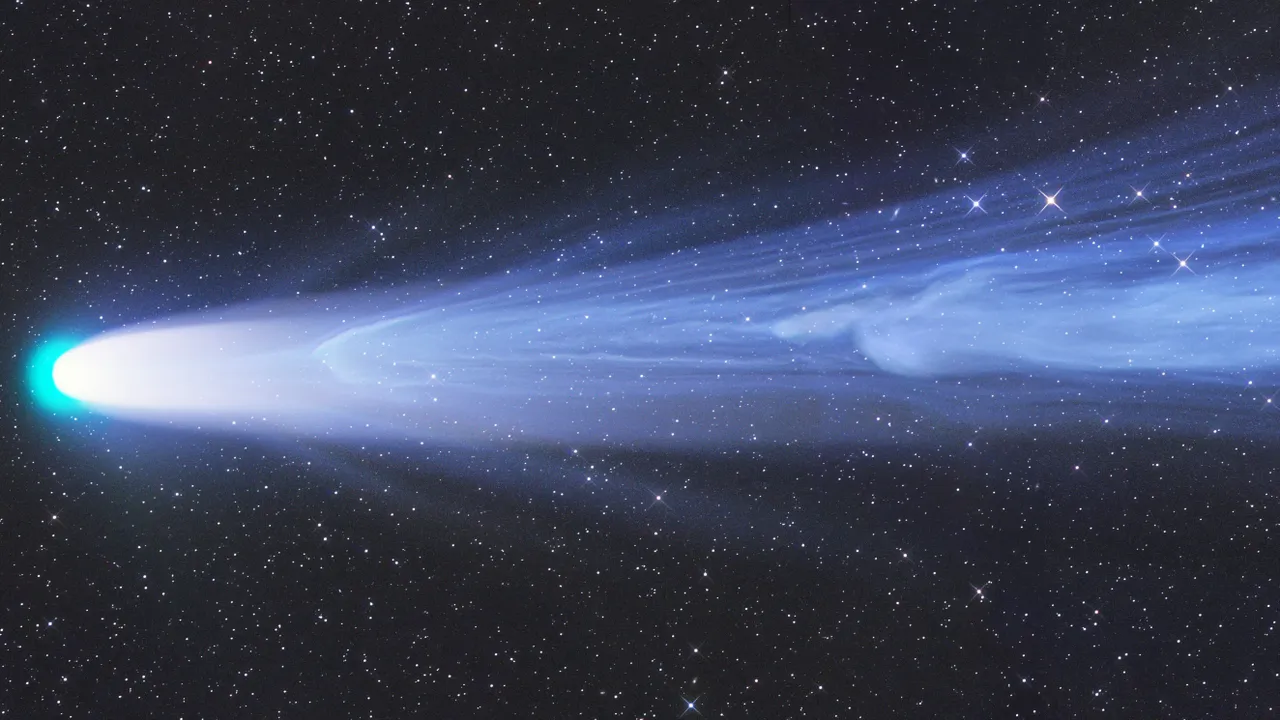
When a comet gets close to the Sun, the heat turns some of its ice into gas. This gas and dust blow backward, creating a tail that can be millions of miles long.
200
The heliosphere is a giant protective bubble created by the Sun's magnetic field. It's a lot like Earth's magnetic field but coming from the sun, and we are inside it. What does it do to protect YOU?
It acts like a shield that protects us from dangerous radiation coming from other stars.
300
What object in the solar system has the most moons?
Saturn has 285 moons, 11 of which were discovered in March 2026 and 128 were discovered last year.
At the start of 2025, we thought that Jupiter had the most at 115.
300
Why can't dwarf planets clear their orbit of debris like asteroids and bits of rock?
They're not big enough to have enough gravity to attract them.
300
Where is the main Asteroid Belt located in our solar system?
In the wide gap between the planets Mars and Jupiter.

300
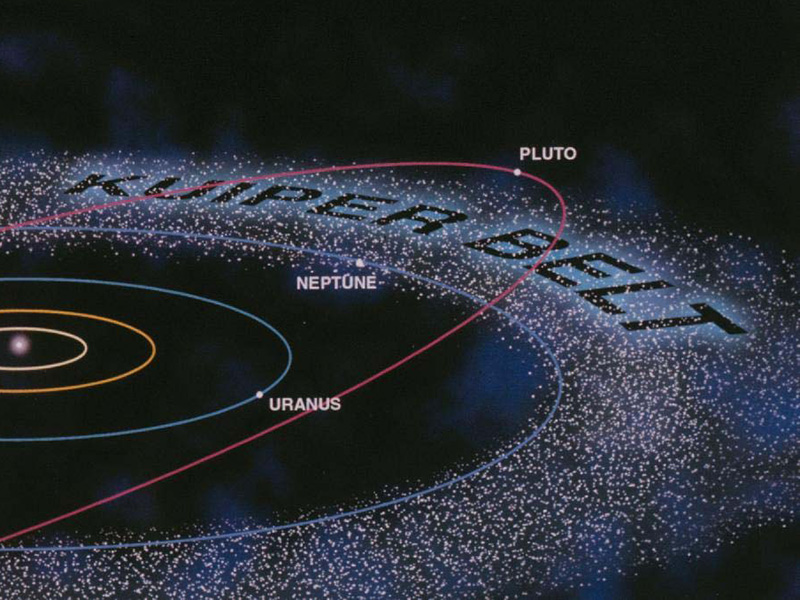
There is a giant ring of icy objects (including Pluto!) beyond Neptune. This donut-shaped ring is called the _____ Belt
The Kuiper belt (pronounced Ky-purr)
300
What do scientists call the fast-moving stream of energy and particles that blows off the Sun to create the heliosphere?
The solar wind. Just like wind on Earth, it "blows" through space, but it’s made of electricity and heat instead of air.
400
Can other objects besides planets have moons? Give one example.
Yes. Asteroids, comets, dwarf planets, and even other small rocky bodies like TNO's and Centaurs can have their own natural satellites (moons).
400
Why didn't we have a category of Dwarf Planets until recently?
We discovered more objects that were like Ceres and Pluto, and learned more about them. They all had so much in common scientists met and agreed they were different enough from planets to be in a category of their own.
400
Why didn't the rocks in the asteroid belt ever join together (accrete) to become a full-sized planet?
Jupiter's gravity kept tearing it apart, keeping them as separate chunks.
400
Far beyond the Kuiper Belt, there is a giant sphere of comets that encloses the entire solar system like a huge ball. It is called the _____
Oort Cloud
400
Where is the "edge" of our Sun's neighborhood (the Heliosphere) compared to where we live?
It is way past the Kuiper Belt.
500
What planet has the largest moon and what is that moon's name?
Jupiter has the largest moon, Ganymede.

500
Where are most dwarf planets located?
Beyond Neptune, in the Kuiper belt.
500
What do we call a small piece of an asteroid that breaks off and actually hits the surface of the Earth?
A meteorite 
500
What happens to a comet's tail as it moves away from the Sun and back into deep space?
The tail disappears. Without the Sun's heat to melt the ice, the comet freezes back up and becomes just a quiet, dark ball of ice again.
500
Has any spacecraft left the solar system?
Yes. Two Voyager spacecraft launched in 1977 and entered interstellar space in 2012. Voyager 1 is still transmitting information and they are 15 billion miles away, 100 AU from Earth. They could reach another star in 80,000 years but not going that way! 