R.2.1 | Text Features & Structure
R.2.4 | Development of an Argument
R.3.3 | Compare Authors
R.2.2 | Central Idea
V.1.2 & V.1.3 | Roots & Context
100
In the "Submersible" reading, what text features does the author use?
1. Photos, subheadings, and captions
2. Subheadings, footnotes, graphs
3. Captions, statistics, pictures
4. None of the above
1. Photos, subheadings, and captions
100
Which piece of evidence to shows how Walter Lord supports the claim that passengers from different classes received unequal treatment by the news media.
1. “In covering the Titanic, few reporters bothered to ask the Third Class passengers anything.” (paragraph 15)
2. “Except for Lorraine Allison, all 29 First and Second Class children were saved, but only 23 out of 76 steerage children.” (paragraph 10)
3. "In fairness to the White Star Line, these distinctions grew not so much from set policy as from no policy at all." (paragraph 13)
4. As the sea closed over the Titanic, Lady Cosmo Duff Gordon in Boat 1 remarked to her secretary Miss Francatelli, “There is your beautiful nightdress gone.” (paragraph 1)
1. “In covering the Titanic, few reporters bothered to ask the Third Class passengers anything.” (paragraph 15)
100
True or False: When comparing texts you look at the text structure and features.
True
100
How do you find the central idea of a text?
Look for ideas supported throughout the text.
100
Based on its morphology, which word is an adjective meaning "lacking distinct attributes"
1. separating
2. impractical
3. featureless
4. discouraged
3. featureless
200
Which detail best conveys the meaning of the painting/ image by Max Beckmann?
“There were apparently a mere 20 boats and rafts available, each capable of holding at most 60 persons. / Yet the ship was built to carry 2,435 passengers and 860 in the crew–a total of 3,295 persons.” (paragraphs 33–34)
“When the last lifeboat full of priceless human life swung away from the Titanic, it left behind on the decks of the doomed ship hundreds of men who knew that the vessel’s fatal wound meant death for them.” (paragraph 38)
“There was a collision bulkhead to safeguard the ship against the invasion of water should the bow be torn away. In a word, the boat was as safe and sound as the shipbuilder could make it.” (paragraph 29)
“The tragedy has aroused public opinion, calling for the formation of new and drastic regulations that include lifesaving equipment on every ship as well as periodic inspection of the appliances and a frequent drill of the crew.” (paragraph 36)
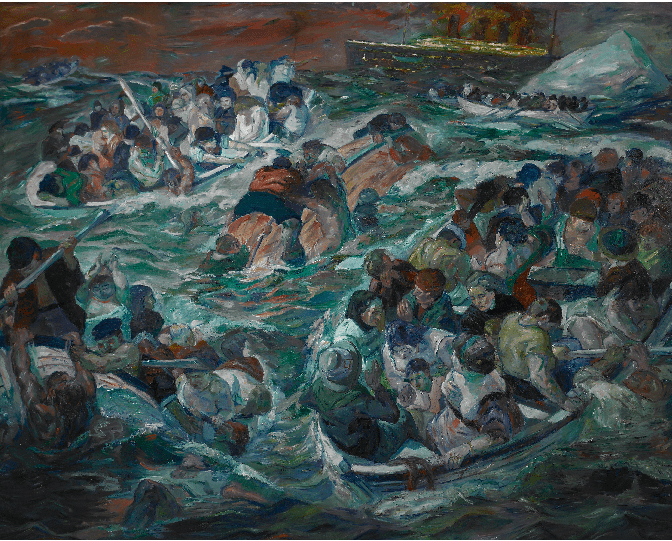
1 “There were apparently a mere 20 boats and rafts available, each capable of holding at most 60 persons. / Yet the ship was built to carry 2,435 passengers and 860 in the crew–a total of 3,295 persons.” (paragraphs 33–34)
200
What is the central idea of "Most Appalling Ocean Horror?
The ship’s activities were unimportant compared to events that were happening in the world.
The ship had many luxuries but had not properly planned how to save everyone on board.
The steel compartments and collision bulkhead were not strong enough to prevent water damage.
Any man who took a spot in a lifeboat lacked the courage and chivalry that the times demanded.
2. The ship had many luxuries but had not properly planned how to save everyone on board.
200
Which statement contrasts paragraph 39 of “Most Appalling Ocean Horror” with paragraph 16 of “There Is Your Beautiful Nightdress Gone”?
by claiming that the women and children first rule only applied to the wealthy
by detailing the account that the women and children first rule was not applied at all
by stating that the women and children first rule applied to all, regardless of class
by showing how many more women and children were saved than men of the wealthiest class
1. by claiming that the women and children first rule only applied to the wealthy
200
In paragraphs 27-29 of "Most Appalling Ocean Horror" how does the author develop the central idea that the Titanic was built using the latest technologies?
by providing a list of furnishings found in each part of the ship
by describing the inspections the ship underwent before sailing
by pointing out all the parts that made the ship safe and sound
by comparing it to other ocean liners built around the same time
3. by pointing out all the parts that made the ship safe and sound
200
Read the paragraph 32 below:
“What was it, in those agonizing hours, to the men who painfully remained aboard, or to the women and children placed in the boats, that there were three electric elevators, squash courts and Turkish baths, a hospital with an operating room, private decks and luxurious cabins? . . . In that midnight crisis the one thing needed was not provided. The one inadequacy was the lack of lifeboats.” (paragraph 32)
What is the meaning of the word agonizing as it is used in this paragraph? (V.1.3)
tolerable
unbearable
all knowing
uninterested
2. unbearable
300
What interesting information does the reader learn from the text features in the "Submersible" reading?
1. How rich the CEO of OceanGate was
2. The ages of the passengers
3. How the submersible was controlled
4. What the submersible sounded like
3. How the submersible was controlled
300
What is the best piece of evidence to support the central idea of "Most Appalling Ocean Horror?"
“The ship that sank two miles below the sea’s calm surface represented all that science and art could contribute to ocean travel and to the comfort and enjoyment of voyagers.” (paragraph 27)
“How unimportant the ordinary activities of mankind seem – the outcomes of politics, the noisy competition between candidates, the bargaining of investors in the stock market.” (paragraph 25)
“Let there be an end to boasting about the superiority of man to the laws and forces of nature. Let mankind be calmed, not in grieving, but in improving the conditions that brought about the saddest episode in the history of ships at sea . . .” (paragraph 37)
“Whatever the richness of the furnishings, the magnificence of the carvings and the paintings, and the abundance of the space provided for the promenade, it seems incredible that no preparation was made for the rescue of at least 2,000 of the floating population of the Titanic.” (paragraph 35)
4. “Whatever the richness of the furnishings, the magnificence of the carvings and the paintings, and the abundance of the space provided for the promenade, it seems incredible that no preparation was made for the rescue of at least 2,000 of the floating population of the Titanic.” (paragraph 35)
300
How can the central ideas of both passages be compared?
a ship thought to be unsinkable should still be prepared for any disaster
a ship’s crew may have to remain onboard if problems arise on the ship
a ship should not have to offer all its passengers the same experiences
a ship’s crew should know that not all precautions will work in an emergency
1. a ship thought to be unsinkable should still be prepared for any disaster
300
Identify two central ideas of “There Is Your Beautiful Nightdress Gone”
Third Class passengers were discriminated against.
Safety measures changed after the sinking of the Titanic.
Passengers did not need the luxuries on board the Titanic.
The sinking of the Titanic was mostly the fault of the conditions at sea.
1. Third Class passengers were discriminated against.
2. Safety measures changed after the sinking of the Titanic.
300
Only three of the witnesses were Third Class passengers. Two of these said they were kept from going to the Boat Deck...Again, the testimony doesn’t suggest any deliberate hush-up—it was just that no one was interested.
The British Court of Enquiry was even more cavalier. Mr. W. D. Harbinson, who officially represented the Third Class interests, said he could find no trace of discrimination, and Lord Mersey’s report gave a clean bill of health—yet not a single Third Class passenger testified . . .
What is the context clue for cavalier. What type of clue is it?
The text states “no one was interested” and gives a definition
400
How do the text features included in the Submersible text create meaning?
diagram- helps the reader visualize and organize information, photo- understand exactly what something looks like, map- visual representation of a section of land and water, captions
400
What two details support the claim that humans cannot defeat nature?
The owners and the commander pridefully assumed that what has happened could not possibly occur.” (paragraph 30)
“There was a collision bulkhead to safeguard the ship against the invasion of water should the bow be torn away.” (paragraph 29)
“‘Women first,’ the common law of humanity, born of chivalry and the nobler spirit of self-sacrifice, prevailed.” (paragraph 39)
“Man’s pride is deeply humbled: he must confess that the victory this time has gone to the blind, unstoppable forces of nature. . . .” (paragraph 26)
“The ship that sank two miles below the sea’s calm surface represented all that science and art could contribute to ocean travel and to the comfort and enjoyment of voyagers.” (paragraph 27)
1. The owners and the commander pridefully assumed that what has happened could not possibly occur.” (paragraph 30)
4. “Man’s pride is deeply humbled: he must confess that the victory this time has gone to the blind, unstoppable forces of nature. . . .” (paragraph 26)
400
How the do the authors of “Most Appalling Ocean Horror” and “There Is Your Beautiful Nightdress Gone” address the topic similarly?
1. depicting the terror and tragedy of the night the Titanic sank
2. reporting facts and statistics about the event
3. the aftermath of the tragedy, including the trial and legal changes in sea travel
4. the reasons why the Titanic should have remained unsinkable
2. reporting facts and statistics about the event
400
In “There Is Your Beautiful Nightdress Gone,” which statement describes the central idea that ships could no longer set sail without lifeboats for all those on board.
After a tragic event occurs, people usually demand quick action to prevent something similar from happening again.
Many people could not escape the sinking ship, which meant the owners had not followed existing safety regulations.
Many people died in the Titanic disaster as a result of lack of preparation, bringing about safety changes in sea travel.
After the Titanic sank, people recognized the honesty of the ship’s owners for admitting they didn’t have enough lifeboats.
3. Many people died in the Titanic disaster as a result of lack of preparation, bringing about safety changes in sea travel.
400
Read this section from Passage 2.
“In fairness to the White Star Line, these distinctions grew not so much from set policy as from no policy at all. At some points the crew barred the way to the Boat Deck; at others they opened the gates but didn’t tell anyone; at a few points there were well-meaning efforts to guide the steerage up. But generally Third Class was left to shift for itself. A few of the more enterprising met the challenge, but most milled helplessly about their quarters—ignored, neglected, forgotten.” (paragraph 13)
Select the word that is a verb in the past tense that means to “not be picked up or selected”
1. Fairness
2. Generally
3. Enterprising
4. Neglected
4. Neglected
500
How do the text features in "Submersible" and "There is Your Beatiful Nightdress Gone" support the authors' purpose?
1. They use quotes to provide specific details for the reader.
2. They use headings to persuade the reader.
3. They use images to show the reader information.
4. They use definitions to explain information.
1. They use quotes to provide specific details for the reader.
500
How does the author of "There is Your Beautiful Nightdress Gone" develop the central idea that class distinction causes inequalities in the survival rates of passengers in paragraph 9?
The author uses statistics and facts to show how many more Third Class Women and Children survived the sinking of the Titanic.
500
How do the two authors address the same topic throughout the texts?
1. Talks about laws and rules changing because of what happened.
2. Lists examples of the ship’s safety features.
3. Author seems to be a survivor of the tragedy.
4. Describes who made it onto the lifeboats
4. Describes who made it onto the lifeboats
500
In what way does the author of "There is Your Beautiful Nightdress Gone" support his purpose?
1. He uses quotes and detailed support to inform the reader.
2. He uses definitions to prove his ideas and persuade the reader.
3. He uses figurative language to entertain the reader.
4. He uses quotes to persuade the reader.
1. He uses quotes and detailed support to inform the reader.
500
The word expedition can be used as a noun, meaning “a journey undertaken by a group of people with a particular purpose” or as a noun, meaning “promptness or speed in doing something.” Which meaning is used in "Discovery of the Titanic"
1. a journey undertaken by a group of people with a particular purpose
2. promptness or speed in doing something
1. a journey undertaken by a group of people with a particular purpose