Derivatives
Graphing Characteristics
Absolute Maxima
E(p) - Price elasticity of demand
100
Name a rule that wouldn't work for the following function:
f(x) = 2^x
Power Rule! This is not a function to an exponent i.e.
x^n
100
Define critical point
A critical point is a point where f'(x) is either 0 or undefined.
100
What is an absolute max/min?
This is the max/min of a function on an interval and where the function reaches its maximum/minimum possible value (not just relative)
100
What is Price Elasticity of Demand?
Price elasticity describes what would happen if your current price (p) is raised by 1%. The demand (q) will decrease by E(p) % from the current demand.
This is essentially a measure of how sensitive your demand is to a change in price.
200
Take the derivative of f(x) for the following function (don't simplify)
f(x) = (4x-x^2)^3/(x^2+x)^2
Ethan will write on the board!
200
Define Inflection Point
An inflection point is where f''(x) = 0
200
What is the Extreme Value Theorem? How does it help us to find absolute maxima
The extreme value states that for a continuous function f on a CLOSED interval [a,b] there exists both an absolute max and an absolute min. This means that given a closed interval, we know that the absolute max/min exists. Combined with the knowledge that these will happen at critical points or the ends of the intervals, we can find them
200
If...
E(p) > 1
E(p) < 1
E(p) = 1
Then demand is... (3 answers)
In this order: Elastic, Inelastic, and of unitary elasticity.
300
What is the derivative of the following function at x = 2?
f'(2) = 1
300
Find the critical value(s) of the following function:
f(x) = x^3+6x^2+12x
x = -2
300
On this interval [-2,2], is the absolute maximum on the end of the interval or at a critical point? What about the absolute minimum?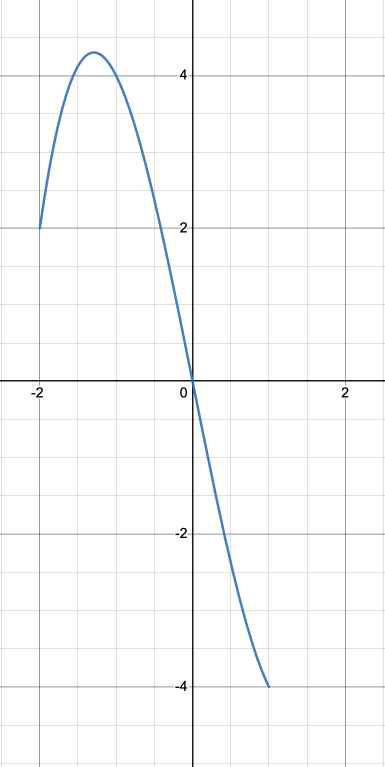
The absolute maximum is at a critical point.
The absolute minimum is at the end of the interval (x=2).
300
How should you change your price if...
- Demand is elastic
- Demand is inelastic
- Demand is of unitary elasticity
Lower, Raise, Leave it!
400
Compute the following and put your answer in one fraction:
d/dx(x/(x-3))
-3/(x-3)^2
400
If they exist, find the critical values, intervals of increasing/decreasing, inflection values, and interval of concavity for the following function
f(x) = x^2-4x
Critical Value: x=2
Inc: (2,inf) Dec: (-inf, 2)
No inflection values. F''(x) is always positive so f(x) is always concave up (-inf,inf)
400
Using the Extreme Value Theorem, determine the absolute minimum and maximum of the following function on the interval [0,2]:
f(x)= x^2-x^3
Absolute Min: (2,-4)
Absolute Max:
(2/3,4/27)
400
For the following demand function, state whether demand is elastic, inelastic, or of unitary elasticity at p = 1
q = 5 + p/(p+8)
At E(1), this is inelastic since it will result in a negative number (by inspection). But if you wanted to find the exact value of E(1), you could by plugging in 1 to E(p) which would give you -0.01932 which means this is BARELY inelastic and your price is almost just right.
500
Sketch a graph on the interval [-2,2] with the following derivatives:
f'(0) is undefined
f'(1) = 2
f'(-1) = -1
Ethan will sketch one possible answer!
500
Sketch a function on the interval [-3,2] with the following characteristics:
- 1 critical point
- An interval of decreasing from [-3,2]
- The absolute minimum and maximum not occurring at a critical point
Ethan will sketch one possible answer!
500
Could you give an example of products the might be elastic or inelastic in their demand? Think about the definition here.
Things like prescription medicines are extremely inelastic - A raise in price doesn't really affect demand because these are a necessity (This is why prescription medicines can be so expensive!)
Items that are infrequently bought like cars, appliances, etc. are highly elastic. If your car is too expensive, someone might delay buying it OR go buy your competitor's car. The price very highly affects the demand.