Cells & Organelles
Cell Transport
Cellular Energy
DNA Structure & Replication
Cell Cycle & Mitosis
100
Name the three differences between an animal cell and a plant cell.
Plant cells... have a cell wall, chloroplast, and a larger vacuole.
100
Describe the difference between active and passive transport.
Active transport requires ATP energy, and passive transport does not require energy.
100
What organelle does cellular respuration occur in?
What organelles does photosynthesis occur in?
Cellular Respiration: Mitochondria
Photosynthesis: Chloroplast
100
What are the 3 parts of a nucleotide?
Sugar, phosphate, and nitrogenous base
100
What are the two major parts of the cell cycle?
Interphase and mitosis
200
What organelle's function is to produce ATP?
The mitochondria
200
Describe the direction that molecules move within a concentration gradient during active transport.
Molecules move against the concentration gradient. (L -> H)
200
Name the products and reactants of cellular respiration.
Reactants: Oxygen and glucose
Products: Carbon dioxide, ATP, water
200
What is the base pairing rule?
A links with T
C links with G
200
What are the three stages of interphase, and what happens in each stage?
G1 - Growth and organelles are replication
S - DNA replication
G2- Normal cell growth
300
Describe the differences between prokaryotic and eukaryotic cells.
Prokaryotic cells are single - celled, lack a nucleus, lack membrane bound organelles, and DNA is in the cytoplasm.
Eukaryotic cells are multicellular, have a nucleus, membrane bound organelles are present, and DNA is found in the nucleus.
300
Name and describe one method of passive transport.
Diffusion - small molecules move from high to low across the cell membrane.
Facilitated Diffusion - a protein is used to transport large molecules from high to low concentration gradient across the cell membrane.
Osmosis - water is move from a high concentration to a lower concentration across the cell membrane.
300
What gas is a reactant in photosynthesis? What gas is a waste product of photosynthesis?
Reactant: Carbon dioxide
Waste product: Oxygen
300
What are the three steps of DNA replication?
Initiation, elongation, and termination
300
What are the 5 stages of mitosis?

400
Provide an example of a prokaryotic cell.
Provide an example of a eukaryotic cell.
Prokaryotic: Bacteria
Eukaryotic: Animals, plants, fungi
400
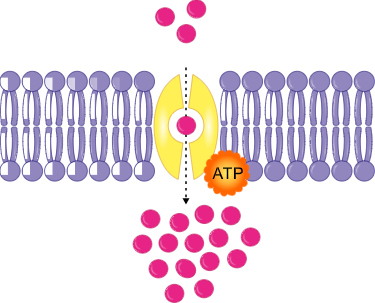
What type of transport is occurring in the picture?
Active transport
400
What is produced in the light reaction of photosynthesis?
ATP
400
What is the complementary strand of bases for the following sequence? ATG - CCT
TAC - GGA
400
What stage of mitosis is occurring in the illustration?

Metaphase
500
 Are the cells pictured above prokaryotic or eukaryotic?
Prokaryotic - they lack a dark spot (nucleus)
500

Will water enter or exit the cell? How will the mass of the cell change? What type of solution is the cell in?
Enter, the cell's mass will increase, the cell is in a hypotonic solution.
500
Describe the relationship between cellular respiration and photosynthesis.
The reactants of cellular respiration are the products of photosynthesis. The reactants of photosynthesis are the products of cellular respiration.
500
Why is DNA replication important?
All of our cells contain DNA.
Cells replicate needing more DNA.
Cell replication is important for growth.
500
What stage of mitosis is occurring in the image?
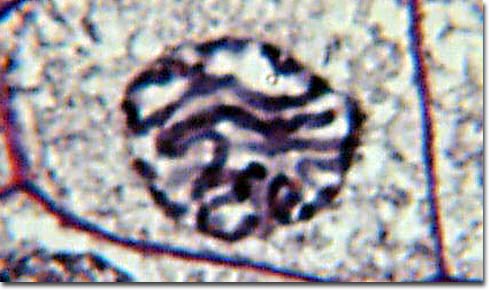
Prophase