Quadratic Functions
Higher Degree Polynomial Functions
Exp/Log Functions
Rational Functions
Sinusiodal Functions
Function Transformations
Function Operations
Sequences & Series
Limits & Continuity
Trigonometry
100
Determine the equation of a quadratic function with roots at (-2,0) and (6,0) and contains the point (1,-10). Present your equation in standard form.
y=2/3x^2-8/3x-8
100
State the end behavior, y -intercept and roots of the function y=-1/6(x+3)^2(x^2-4)(x+1)^3 .
As x->-oo, y->oo
As x->oo, y->-oo
y intercept at (0,6)
Roots at x={-3,-2,-2,2} .
100
Solve for x .
16^(-x+1)/4^x=32
x=-1/6
100
Give the equation of a rational function with the following properties:
- x -intercepts at 3 and 7.
-Vertical asymptotes at x=-5 and x=1 .
-Contains the point (-1,12).
y=(-3(x-3)(x-7))/((x+5)(x-1))
100
Determine an equation for the function graphed below.
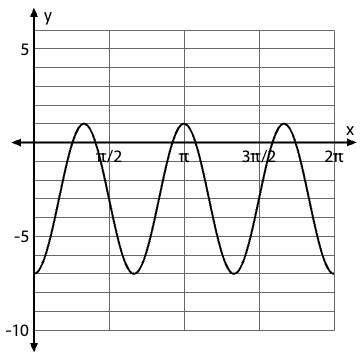
y=-4cos(3x)-3
100
Describe the set of teansformations that maps f(x)=sqrt(x) onto the function f^'(x)=-sqrt(x+2)-8
-Left 2 units (anytime).
1. Reflection over x -axis.
2. Down 8 units.
100
Find the inverse of the function f(x)=2x^3-14 .
f^-1(x)=root3((x+14)/2
100
Find the 22nd term in the sequence -44,-30,-16,...
a_22=250
100
Evaluate lim_(x->-2)((sqrt(x+6)-2)/(x+2))
1/4
100
Evaluate (tan^2((2pi)/3)-sin(-pi/2))/(cos^2((5pi)/4))
8
200
Complete the square to put the function y=-4x^2-24x+32 into vertex form.
y=-4(x+3)^2+68
200
Determine the equation of a polynomial function with a y -intercept at 3, that crosses the x -axis at -3 and 1 and bounces at x=2 . Leave your equation in factored form.
y=-1/4(x+3)(x-1)(x-2)^2
200
Condense the expression below into one logarithmic expression.
log_3a-2log_3b+5log_3c-4
log_3((ac^5)/(81b^2))
200
Solve the inequality below:
(2x^2-3x-2)/(x^2+3x)>=-6
xsubset(-oo,-3),[-2,0),[1/8,oo)
200
Determine the equation of a sinusoidal function with a period of pi/3 , an amplitude of 4, a midline of -5 and contains the point (pi/6,-9)
y=-4cos(pi/3(x-pi/6))-5 or y=-4sin(pi/3x)-5
200
Determine the domain and range of the function f(x)=(4x+1)/(2x+5)
D_f: xsubset(-oo,-5/2),(-5/2,oo)
R_f: xsubset(-oo,2),(2,oo)
200
Evaluate lim_(x->-4)(2x^2-11x-6)/(x^2+8x+16)
DNE (+oo)
200
Evaluate cos^-1(sin((5pi)/4))
(3pi)/4
300
GRAPHING CALCULATOR ALLOWED
A two-way street passes under a parabolic arch that touches the ground on the side boundaries of the road. The street is 26 feet wide, with each lane being 13 feet wide, and the highest point of the tunnel is 54 feet above the roadway.
A delivery truck that is 10 feet wide and 13 feet tall must stay in its lane while passing through the tunnel.
a) Will the truck fit through the tunnel?
b) By how many feet?
The truck will clear the tunnel by 3.5 feet.
300
What interest rate is required for a $300 investment to quadruple in 22 years if interest is compounded monthly? Round your answer to the nearest hundredth of a percent.
6.32%
300
Determine the location of the hole in the function below:
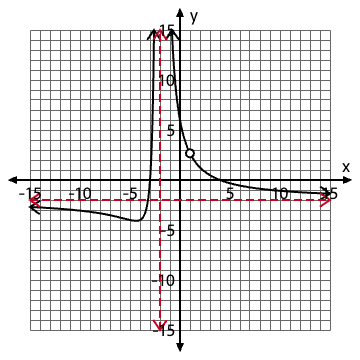
(1,24/9)
300
Determine all solutions to the equation below:
sin^2(2x)/cos^2(2x)=3
xsubsetpi/6+pi/2k, ksubsetZ
xsubsetpi/3+pi/2k, ksubsetZ
300
Determine the equation of the graph provided.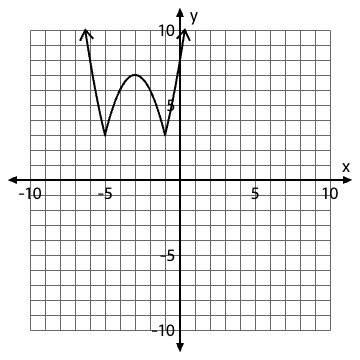
y=abs((x+3)^2-4)+3
300
Evaluate lim_(x->-oo)(sqrt(5x^6-x^3+2x-1)/(3x^3-5x+17))
-sqrt5/3
300
Prove:
(secxsinx)/(tanx+cotx)=sin^2x
(sinx/cosx)/(sinx/cosx+cosx/sinx)=sin^2x
sin^2x/(sin^2x+cos^2x)=sin^2x
sin^2x/1=sin^2x
sin^2x=sin^2x
400
GRAPHING CALCULATOR ALLOWED
A 4000 ft. long suspension bridge is to be constructed above a river, with towers on either end that extend 350 ft. above the roadway.
A cable that is paraboloc in shape supports the roadway, connecting to it in the center and fastening to the tops of each tower on its ends.
Radar guns are to be placed on the cables to catch cars that are speeding but they must be placed at a height that is no higher than 220 ft. above the road. How far from the ends of the bridge must the radar be fastened, to the nearest tenth of a foot?
414.4 feet.
400
Solve for x .
log_15(x+2)-1=-log_15x
x=3
400
A trough in the shape of an open half cylinder has a volume of 120 ft3.
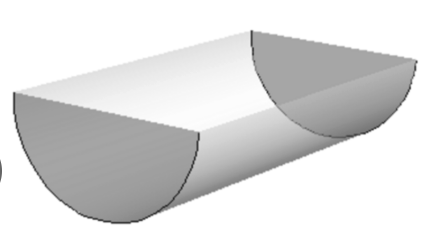
Determine the length of the radius required to minimize the surface area of the trough. Round your final answer to the nearest hundredth of a foot.
3.37 ft.
400
Solve for all values of xsubset[0,2pi)
2sin^2x-2cos^2x=-1
x={pi/6,(5pi)/6,(7pi)/6,(11pi)/6}
400
For A(x)=4/(x+1) and B(x)=(2x)/(x-2) determine each of the following:
a) D_(A-B)
b) D_(AoB)
c) D_(A/B)
a) xsubset(-oo,-1),(-1,2),(2,oo)
b) xsubset(-oo,-1),(-1,2/3),(2/3,oo)
c) xsubset(-oo,-1),(-1,0),(0,2),(2,oo)
400
Determine all points of discontinuity for the function given below.
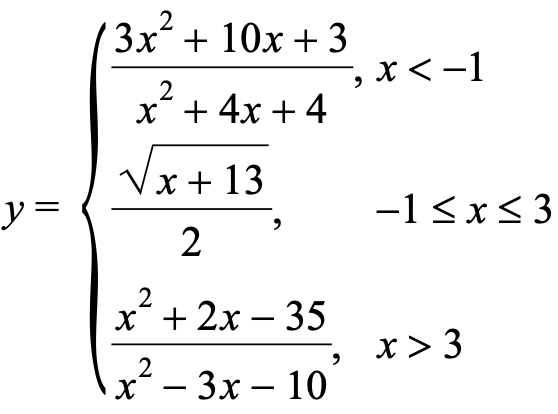
Vertical asymptote @ x=-2
Jump @ x=-1
Hole @ x=5
400
Evaluate cos(2Arcsin(-(sqrt19)/10))
31/50
500
GRAPHING CALCULATOR ALLOWED
The price Jake charges for each lawn he mows is modeled by the demand equation p(x)=150-2x , where x is the number of lawns he mows each week. His upfront cost is $120 for the equipment, plus $3.50 in gas and materials for each lawn he mows.
Determine the number of lawns Jake must mow to maximize his profit each week.
38 lawns
500
A cylindrical entryway is formed by the rotation of a rectangular door about its side axis. The perimeter of the door must be 64 ft.
When the volume of the entryway is minimized, what is the area of the door itself? Round your final answer to the nearest tenth of a square foot.
232.3 ft2
500
A sample of a new element deteriorates to half its mass in 28.31 years. If its change in mass follows the law of uninhibited decay, how much of the element will be left of a 48 gram sample in 100 years? Round your final answer to the nearest gram.
4 grams.
500
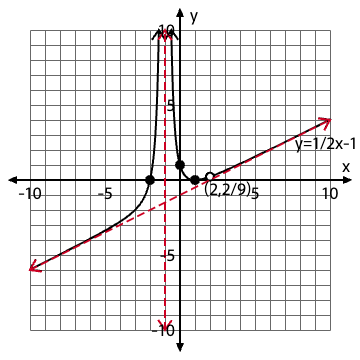
Sketch a graph of the rational function below using the HAIL method.
y=(x^4-2x^3-3x^2+8x-4)/(2x^3-6x-4)
500
Determine the domain of the function f(g(x)) if f(x)=sqrt(2x-2) and g(x)=6x^3-5/2x^2-x+1 .
xsubset[1/4,0],[1/3,oo)
500
Determine all possible values for a and b that allow the function below to be continuous.
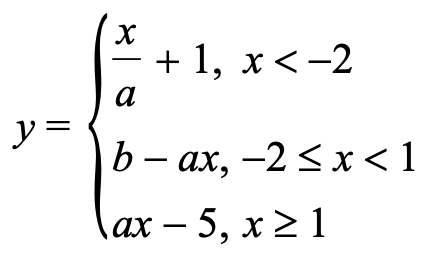
a=1/2, b=-4
or
a=1, b=-3
500
Evaluate tan(sec^-1(-13/5)-sin^-1(-sqrt(13)/7))
(2940-1014sqrt13)/972