Force 1
Force 2
Motion 1
Motion 2
Electricity
100
Force always makes an object move.
TRUE or FALSE?
FALSE.
Forces can cancel each other (balanced forces) and cause no movement.
100
Force always opposes motion.
TRUE or FALSE?
FALSE
Applied force and friction are both forces; applied force can be in the direction of motion.
100
What measurement of motion is this?
How fast an object moves. = Total distance ÷ Time. Scalar.
Speed
100
What measurement of motion is this?
Speed in a specific direction. = Displacement ÷ Time. Vector.
Velocity
100
What do you call the material that resists electricity flow?
Insulator
200
Force can change the mass of an object.
TRUE or FALSE?
FALSE
Force can change shape, speed, and direction — but NEVER mass.
200
What type of force is this?
It opposes sliding motion between surfaces, causes moving objects to slow down
Friction Force
200
What measurement of motion is this?
Total path length traveled. Scalar (no direction). Always positive.
Distance
200
What measurement of motion is this?
Change in position from start to end. Vector (has direction). Can be zero.
Displacement
200
It is the flow of electric charges through a conductor. Unit: Ampere (A)
Electric current or Current
300
What type of flight force is this?
A forward force propelling an aircraft or vehicle
Thrust
300
What type of flight force is this?
Upward force on aircraft wings; acts opposite to weight
Lift
300
What is Newton's First Law of Motion?
An object at rest stays at rest; an object in motion stays in motion at constant speed — UNLESS acted upon by an unbalanced (net) force.
300
A student walks 10 m east in 5 seconds, then walks 10 m west in 5 seconds.
What is the student’s average speed?
What is the student’s average velocity?
Total distance = 20 m → Average speed = 2 m/s
Displacement = 0 m → Average velocity = 0 m/s
300
Explain what is Grounding.
A wire/connection that safely directs excess/fault current into the Earth, preventing electrocution.
400
A fruit is falling from a tree.
What are the forces involved?
Weight and Air resistance where
weight > air resistance
400
What is the unit of force?
Newton (N)
400
An astronaut carries a tool kit that weighs 196 N on Earth.
What is the mass of the tool kit?
What would be its weight on the Moon where gravity is 1.6 m/s2?
(Use gEarth=9.8 m/s2)
m = W/g = 196/9.8 = 20 kg
W = mg = 20 x 1.6 = 32 N
400
A runner jogs 3 km north, then 4 km south along the same road.
What is the total distance traveled?
What is the runner’s displacement?
Distance = 7 km
Displacement = 1 km south
400
What do you call this?
Opposition to the flow of electric current. Unit: Ohm (Ω)
Resistance
500
A box on a ramp is held in equilibrium by THREE forces.
What are these forces and how do they act?
Weight + Normal Force + Friction
Weight acts downward. Normal force acts perpendicular to the ramp surface. Friction acts up the slope to prevent sliding.
500
What is the movement of an airplane when
thrust = drag and lift = weight?
Airplane is cruising at constant altitude & speed.
500
What is acceleration?
It is the rate of change of velocity. = (vf − vi) ÷ t.
Can be positive (speeding up) or negative (slowing down/decelerating).
500
Interpret the graphs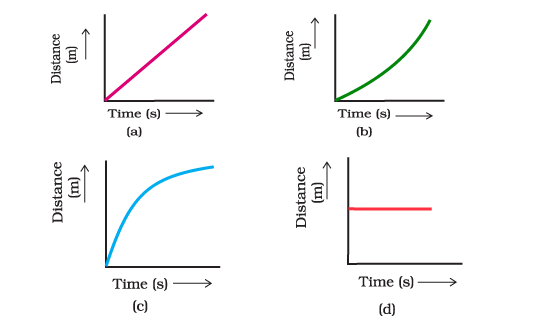
(a) The object is in uniform motion because it travels equal distances in equal time intervals.
(b) The object is in non-uniform motion because its speed increases over time.
(c) The object is in non-uniform motion because its speed decreases over time.
(d) The object is at rest (uniform motion with zero speed) because its distance does not change over time.
500
State at least 3 differences between series and parallel circuits.
Series Circuit: Components connected in ONE path, Same current flows through all components, If one bulb goes out → ALL go out, Voltage is SHARED among components, Bulbs are dimmer
Parallel circuit: Components connected in MULTIPLE paths, Each branch gets the full voltage, If one bulb goes out → others STAY ON, Each bulb glows at FULL brightness, Bulbs are brighter