Concavity
Second Derivative Test
Graph of f, f', and f''
Connections f, f', f''
100
Is the graph concave up or down at x=3?
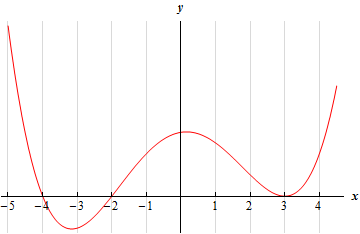
Concave up
100
Let f'(3)=0 and f''(3)=9
What type of extrema would occur at x=3?
Relative minimum
100
The graph below shows the DERIVATIVE of h(x).
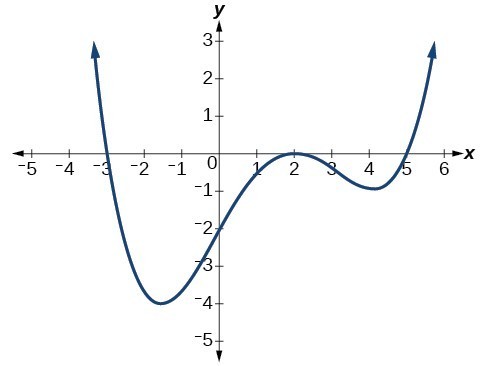
When is h(x) decreasing?
(-3,2) and (2,5)
100
Let g be a function such that g(x)>=0 for all x

For which intervals is g(x) decreasing?
(-oo,-5) and (-5,1)
200
Let f(x)=2x^4-8x+3
Determine intervals of concavity.
f'(x)=8x^3-8
f''(x)=24x^2
24x^2=0
x=0
f(x) is concave up (-oo,0)and(0,oo)
200
Determine the x-value of the relative maximum of the function.
f(x)=5+3x^2-x^3
f'(x)=6x-3x^2
3x(2-x)=0
x=0 and x=2
f''(x)=6-6x
f''(0)=6
f''(2)=-6
Relative maximum at x=2
200
The graph below shows f(x).

When is f'(x)<0 ?
(-oo,0) and (2,oo)
200
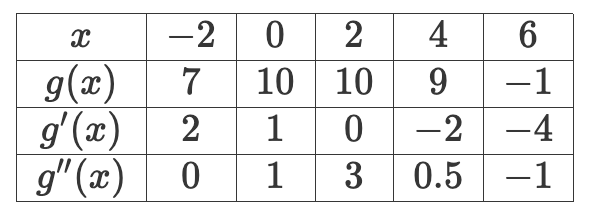
On the graph of g(x), what occurs at x=2?
Relative minimum
300
Identify point(s) of inflection, if any, of f(x)=x^3-3x^2-4
f'(x)=3x^2-6x
f''(x)=6x-6
6x-6=0
x=1
f''(x) changes from negative to positive
300
At what value(s) of x does f(x)=x^4-8x^2 have a relative minimum?
f'(x)=4x^3-16x
4x(x^2-4)=0
x=0 and x=+-2
f''(x)=12x^2-16
f''(0)<0
f''(-2)>0
f''(2)>0
Relative minimum at x=-2 and x=2
300
The graph shows y=g'(x)
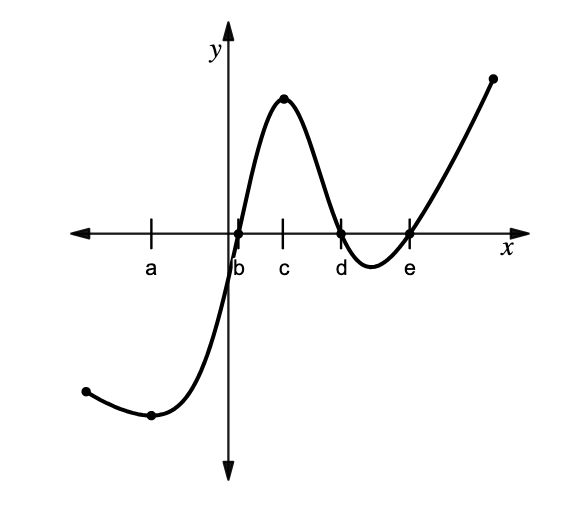
Determine the x-value(s) of the local minimum(s) of function g. Justify your answers.
Local minimum at x=b and x=e because g'(x) changes from negative to positive
300
Let g be a function such that g(x)>=0 for all x

For which values of x does g have a point of inflection? Justify your answer.
x=-5 and x=4 because g"(x)=0 and g" changes sign
400
Let g(x)=3x^4-4x^3
On what interval(s) is the g(x) concave up?
g'(x)=12x^3-12x^2
g''(x)=36x^2-24x
12x(3x-2)=0
x=0, x=2/3
g(x) is concave up (-oo,0) and (2/3,oo)
400
Let f(x)=x+2sinx on the interval (0,2pi)
Determine the x-value of the relative maximum.
g'(x)=1+2cosx
1+2cosx=0
cosx=-1/2
x=(2pi)/3 and x=(4pi)/3
g''(x)=-2sinx
g''((2pi)/3)<0
g''((4pi)/3)>0
f(x) has a relative maximum at
x=(2pi)/3
400
The graph of function f(x) is shown.
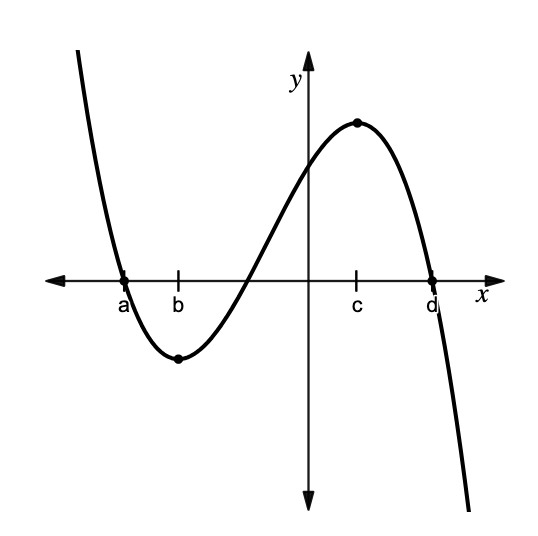
At which x-value is it true that f'(x)<f(x)<f''(x) ?
x=a
400
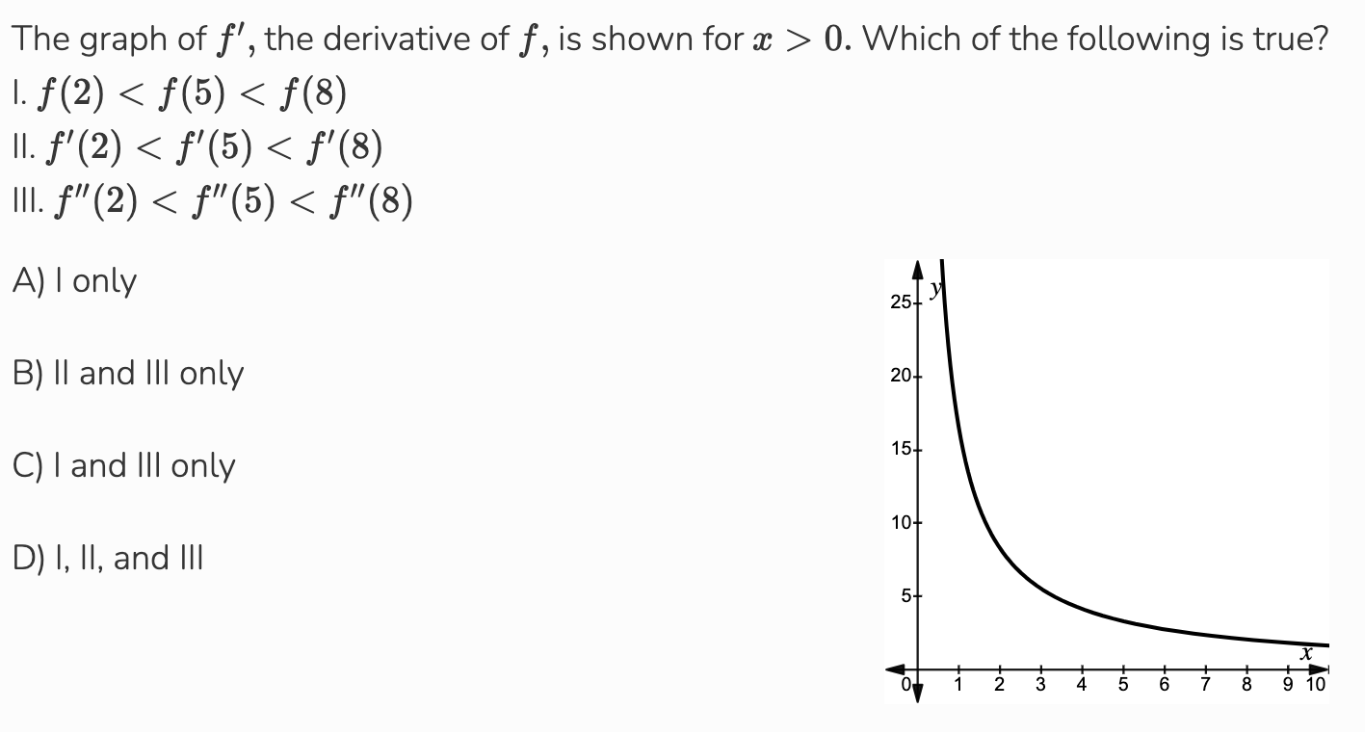
C) I and III
500
Determine the interval(s) of concavity.
f(x)=xe^x
f'(x)=e^x(1)+x(e^x)
f''(x)=e^x+e^x(1)+x(e^x)
f''(x)=2e^x+xe^x
f''(x)=e^x(2+x)
x=-2
f(x) is concave down (-oo,-2)
f(x) is concave up (-2,oo)
500
Find the relative maximum of f(x)=sin(4x) on the interval (0,2pi)
f'(x)=4cos4x
4cos4x=0
cos4x=0
4x=pi/2, (3pi)/2
x=pi/8, (3pi)/8
f''(x)=-16sin(4t)
f''(pi/8)<0
Relative maximum at x=pi/8
500
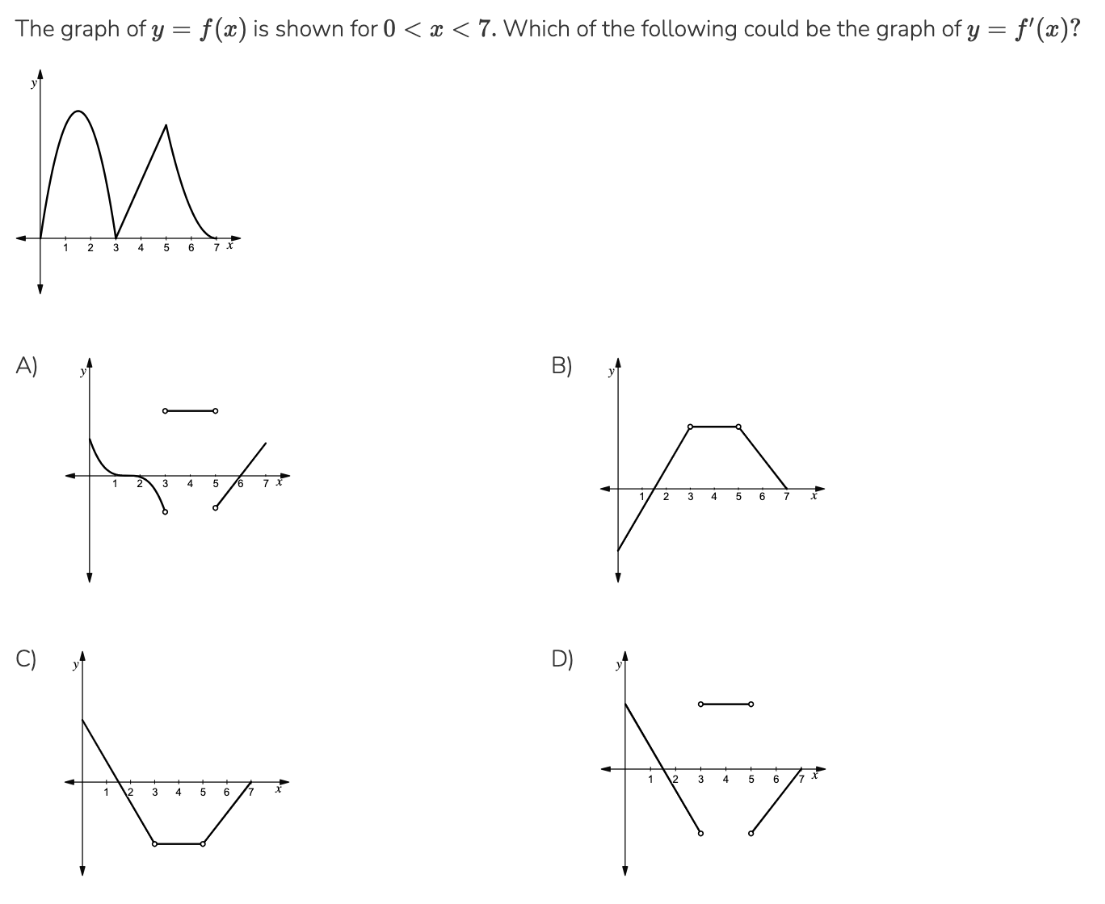
D
500
Given the function h(x)=x^3-2x^2+x , find the interval(s) when h is concave up AND decreasing at the same time.
h'(x)=3x^2-4x+1
(3x-1)(x-1)=0
x=1/3 and x=1
Decreasing (1/3,1)
h''(x)=6x-4
6x-4=0
x=2/3
Concave up (2/3,oo)
Both (2/3,1)