Riemann Sums
Definite Integrals
Antiderivatives
Area and Volume
100
Sebastian runs a race, and notes his pace at 5 second intervals. They are:

Use the trapezoid rule to estimate the length of the race
392.5
100
\int_1^2(2x+3)/(x^2+3x+2)\dx=
ln(2)
100
\int\ 4x\cot(x^2)\dx=
\ln(\sin^2(x^2))+C
100
Find the positive area of all regions enclosed by the curves 2x^3-8x and -3x^2+12
517/16
200
Rosie computed the approximate area under a function using the Left-Hand, Right-Hand, Trapezoid and Midpoint-Tangent Rules with n=10 slices each. She wrote down the numbers she got for the four approximations, but has forgotten which one is which. Here are the numerical results: 11.30, 11.43, 11.52, and 11.74.
Which one of the numbers is the Trapezoid Rule result and how do you know?
11.52
200
Put the following six integrals in ascending order:
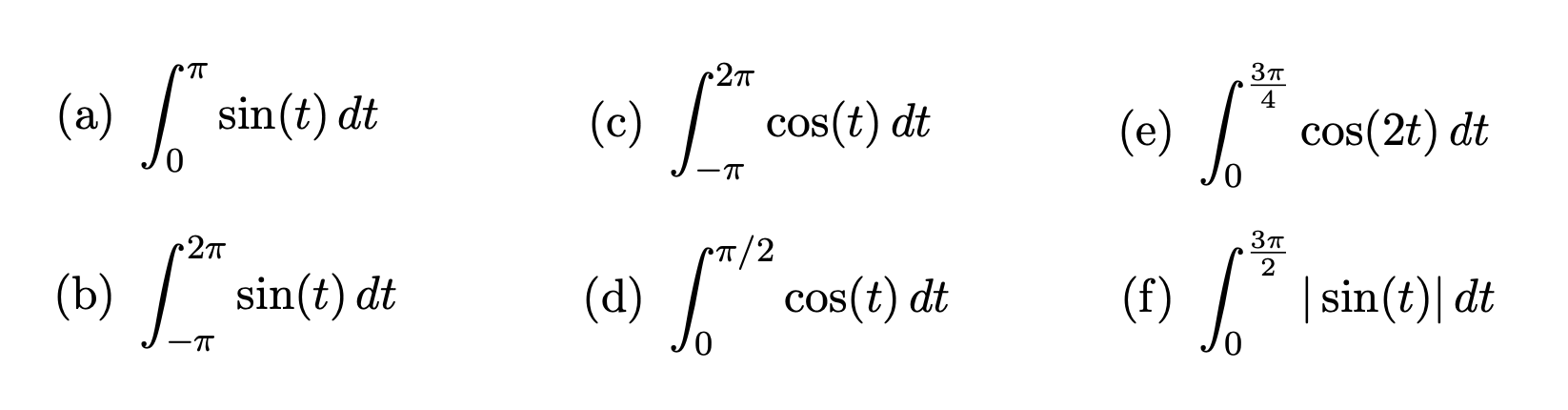
b<e<c<d<a<f
200
int\ ((\ln(x))/x)^2\dx=
-1/x((\ln(x))^2+2\ln(x)+2)+C
200
Find the area enclosed between the curve tan(x) and the line that crosses it when y=0 and when y=1
pi/4+ln(1/2) or
pi/4-ln(2)
300
Prove that \int_0^a\x\dx=(a^2)/2 by computing the limit of the Riemann Sum.
(do on the board)
300
\int_{-\pi/2}^{\pi/2}x^5\cos(x)+x^2\sin(x)\dx=
0
300
\int\ \cos(\ln(x))\ dx=
(e^x\cos(x)+e^x\sin(x))/2+C
300
Find the volume of the shape made by rotating the region enclosed between y=x and y=x^2 around line y=-x
(7\pi)/15
400
Find a function f(x) such that \int_1^3f(x)\dx=\lim_{n\rightarrow infty}\sum_{k=1}^n(2n^2+8kn+8k^2)/n^3
f(x)=x^2
400
\int_{-3}^1 \sqrt{144-36(x+1)^2}+3\ dx=
12\pi+12
400
\int (x^3e^(x^2))/(x^2+1)^2\ dx =
(-x^2e^(x^2))/(2(x^2+1))+(e^(x^2))/2+C
400
A line intersects the curve y=sin(x^2) at x=0 and x=\sqrt(pi/4) .What is the volume of the shape achieved by rotating the region enclosed between the line and the curve around the y-axis?
(\sqrt(2))/2-1+(\sqrt(2)pi)/12