International Financial Institutions
Multinational Corporations (MNC)
Investment Strategies
Market Entry Modes
Images
100
You discovered a DOUBLE QUESTION!
Answer both questions to win 300 points. If you answer one question only you will lose bonus +200 points.
What is an IFI?
What is the difference between MDB and Bretton Woods institutions? (bonus question)
1. What is an IFI?
An International Financial Institution (IFI) is an organization created by several countries to support economic development and financial stability. IFIs provide loans, grants, and technical assistance to countries, especially developing economies.
2. What is the difference between MDB and Bretton Woods institutions?
Multilateral Development Banks (MDBs) are institutions created by many countries to finance long-term development projects such as infrastructure, energy, and transport. Bretton Woods institutions were established in 1944 to rebuild the global economy and maintain international financial stability. The main Bretton Woods institutions are the IMF and the World Bank.
100
What is a multinational corporation (MNC)?
A multinational corporation (MNC) is a company that operates and controls business activities in more than one country.
100
What is foreign direct investment (FDI)?
Foreign direct investment (FDI) is when a company invests directly in business operations in another country, such as building a factory, acquiring a company, or opening a subsidiary.
100
What is franchising as a market entry mode?
Franchising is when a company allows a foreign business to use its brand name and business model in exchange for fees, while the local partner manages daily operations.
100
What market entry modes are illustrated in the image?
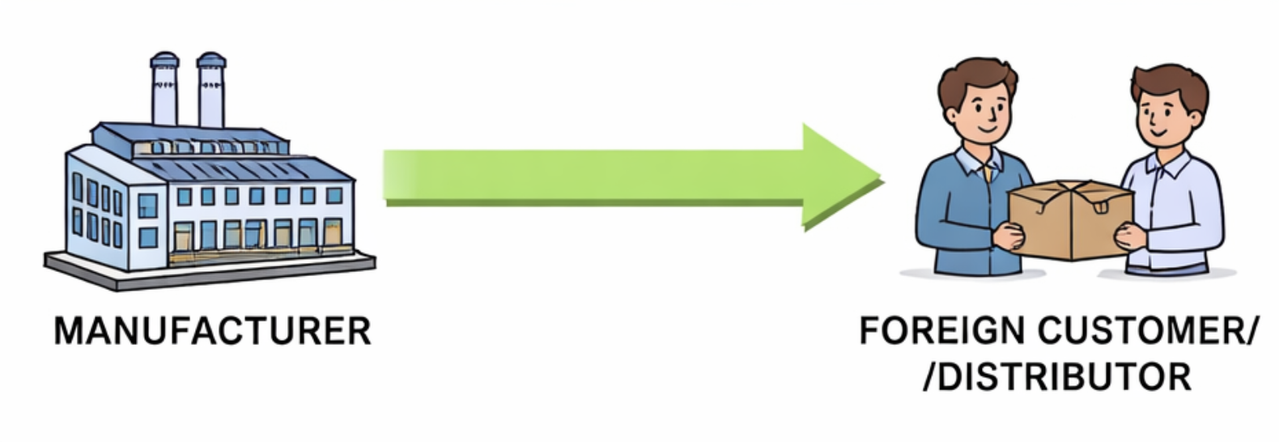
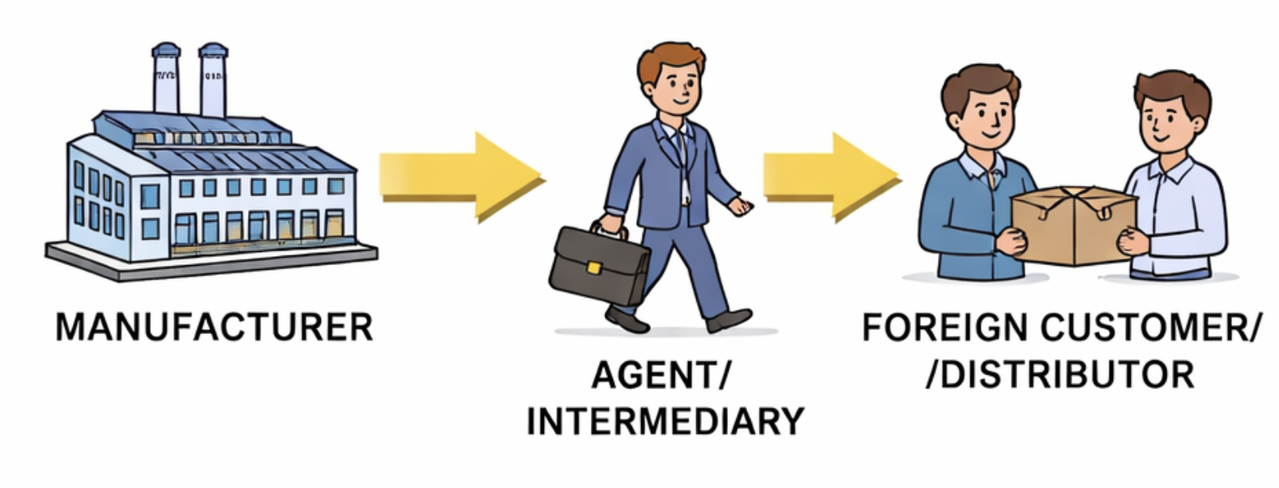
Direct exporting and indirect exporting.
200
Which two institutions were created at the Bretton Woods Conference in 1944 to support global financial stability and economic development?
The two main Bretton Woods institutions are the International Monetary Fund (IMF) and the World Bank.
200
What is the main difference between a multinational corporation and a transnational corporation?
A multinational corporation has a centralized headquarters, while a transnational corporation has decentralized operations in multiple countries.
200
What is a joint venture in international investment?
A joint venture is a partnership between two or more companies from different countries that invest and share ownership, risks, and profits in a business project.
200
You discovered a RISK QUESTION!
If your answer is wrong, you will lose 200 points.
What is the difference between direct exporting and indirect exporting?
Direct exporting means the company sells products directly to foreign customers or distributors without intermediaries in the home country. Indirect exporting involves using intermediaries such as export agents or trading companies in the home country to handle international sales.
200
Which market entry strategy is shown in the image?
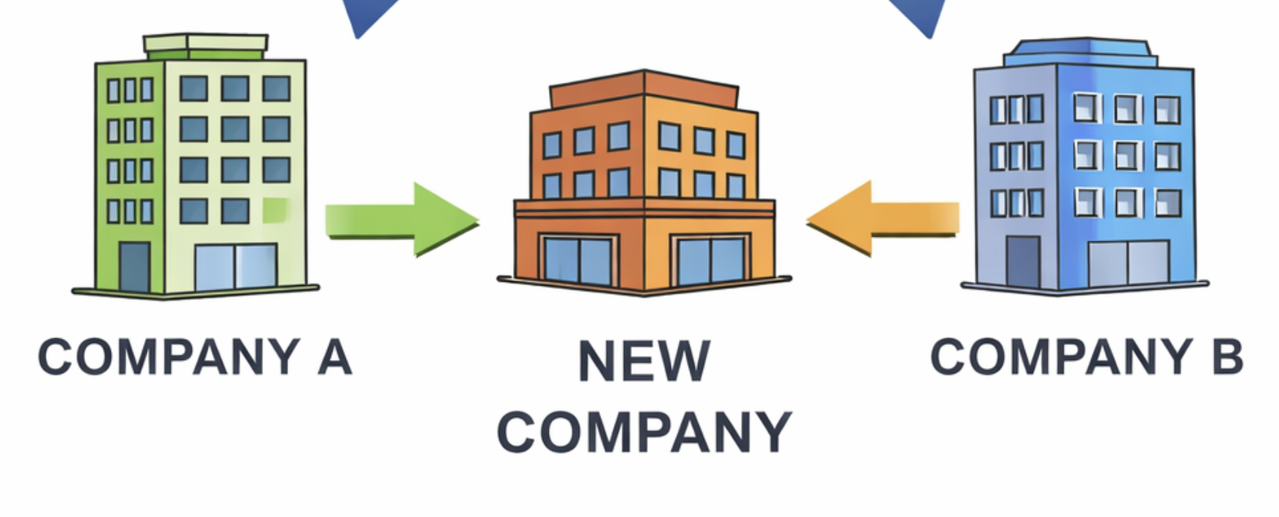
Joint venture.
300
What is the main difference between multilateral development banks and bilateral development banks?
Multilateral development banks are created and financed by many countries, while bilateral development banks are created by one country to finance development projects in another country.
300
Name three motives of multinational corporations for investing abroad.
Resource seeking, market seeking, and efficiency seeking.
300
What is the difference between Greenfield investment and acquisition?
Greenfield investment means building a new business or facility from the beginning in a foreign country. Acquisition means entering a foreign market by purchasing an existing company.
300
What is the difference between joint venture and wholly owned subsidiary?
A joint venture is shared ownership between two or more companies, while a wholly owned subsidiary is fully owned and controlled by the foreign parent company.
300
What type of market entry mode is illustrated?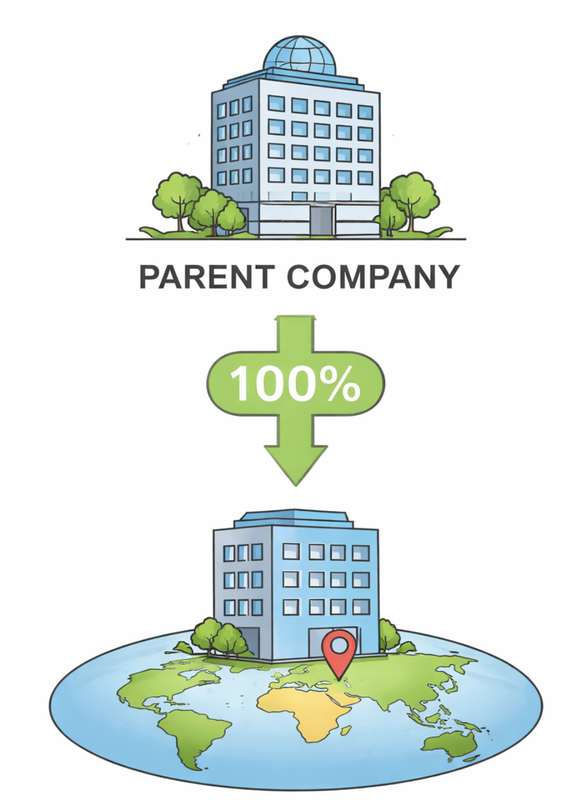
Wholly owned subsidiary.
400
What is LIBOR and what was it used for in international finance?
LIBOR (London Interbank Offered Rate) was a benchmark interest rate used to measure borrowing costs between major international banks. It was widely used as a reference rate for loans, financial contracts, and international investments.
400
What is vertical integration in multinational corporations?
Vertical integration is when a multinational corporation controls several stages of the production and distribution process. This may include raw material supply, manufacturing, transportation, and sales. The goal is to reduce costs, improve efficiency, and increase control over the entire value chain.
400
What is a strategic alliance in international investment? (main characteristics)
A strategic alliance is a cooperative agreement between companies from different countries to share resources, technology, or market access without full ownership. Companies remain independent but work together to achieve common goals.
400
What is a wholly owned subsidiary and what are two ways to establish it in a foreign market?
A wholly owned subsidiary is a company that is fully owned and controlled by a foreign parent company. It can be established in two ways: by creating a new operation from scratch (Greenfield investment) or by acquiring an existing local company (acquisition).
400
What type of integration is shown and what are the two directions illustrated?
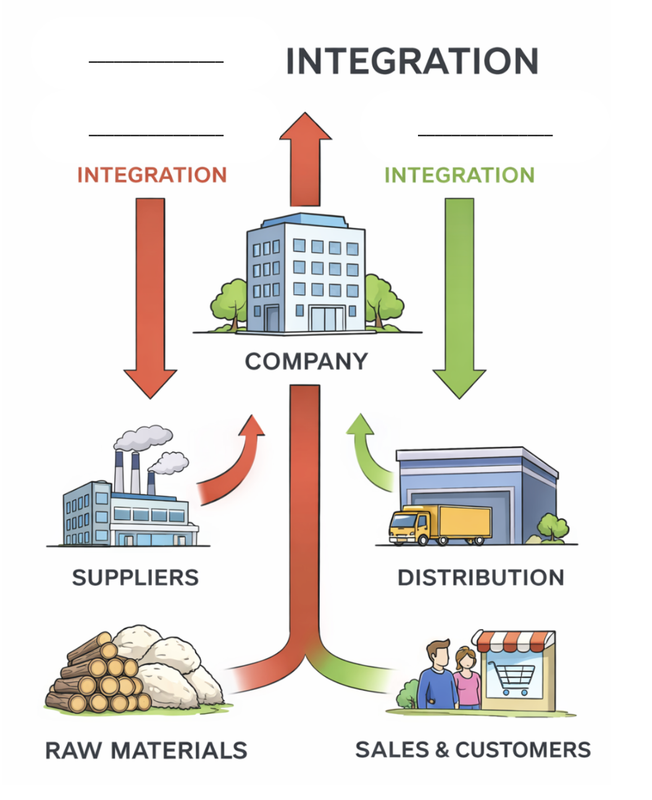
Vertical integration. The two directions are backward integration (control of suppliers/raw materials) and forward integration (control of distribution and sales).
500
What is the difference between the Paris Club and the London Club?
The Paris Club is a group of government creditors that deals with restructuring public debt owed by countries. The London Club is a group of private commercial banks that restructure private debt owed by countries.
500
What is the Transnationality Index (TNI)? What is the meaning of higher TNI?
The Transnationality Index (TNI) measures how international a multinational corporation is. It is calculated using three indicators: the ratio of foreign assets to total assets, foreign sales to total sales, and foreign employment to total employment. A higher TNI means the company has more operations outside its home country.
500
Which investment strategy is typically used by service companies such as banks, and why is this strategy necessary?
Service companies such as banks usually use direct foreign investment. This strategy is necessary because services cannot be easily exported, and they require direct interaction with customers. Therefore, companies must establish subsidiaries or branches in the foreign country to provide services locally.
500
Why do companies often move from exporting to licensing and then to foreign direct investment when entering international markets?
Companies usually start with exporting to test the market with low risk. After gaining experience, they use licensing to expand with limited investment. Finally, they move to foreign direct investment to gain greater control, higher profits, and stronger market presence.
500
What type of integration (specific) is shown and what is the main purpose of this strategy?
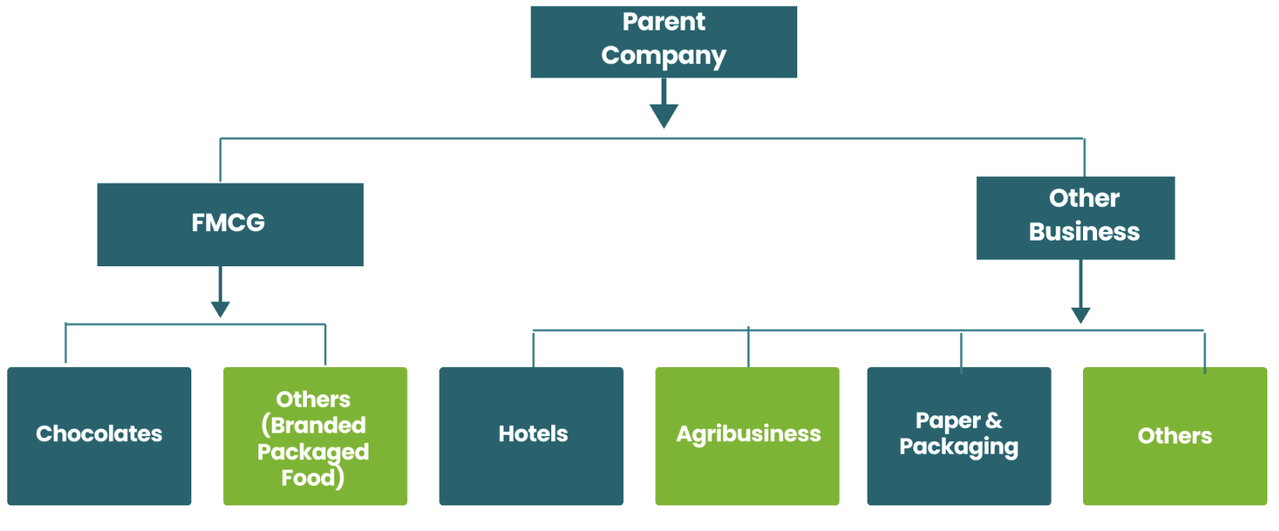
Conglomerate integration. The main purpose is diversification across different industries to reduce risk and spread investments across multiple markets.