States of Matter
Physical Properties
Mixtures & Solutions
Particles of Matter
Challenge Questions
100
A student is trying to classify a group of items: a pencil, a staple, a paper clip, a plastic straw, and an eraser. The student uses a magnet to determine if the items are magnetic or not. Which items will be attracted to the magnet?
A. pencil, staple, and paper clip
B.pencil, plastic straw, and eraser
C.staple and paper clip
D. plastic straw and eraser
C.staple and paper clip
100
A plastic cap floats when placed in water, while a glass bead sinks. What can you say about the relative density of each object compared with water?
The plastic cap is less dense than water, while the glass bead is more dense than water.
100
A mixture contains plastic beads and small steel tacks. What property could be used to separate the materials, and what tool should be used?
Magnetism can be used. A magnet will attract the steel tacks but not the plastic beads.
100
A balloon is weighed before and after it is filled with air. Why is the second measurement greater?
Air has mass even though particles are too small to see.
100
A metal spoon and a wooden spoon are left in a bowl of hot soup. After several minutes, the metal spoon's handle feels much warmer. Why?
Metal is a good thermal conductor and transfers thermal energy more easily, while wood is an insulator.
200
Ricky and Leila are measuring the volumes of different objects.
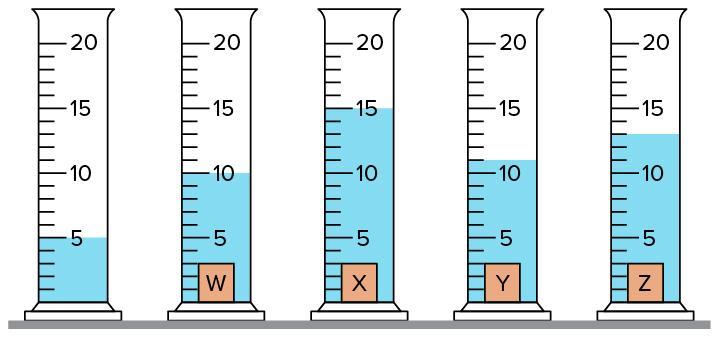
Which statement correctly compares the volumes of the objects
A. .X has a greater volume than Y.
B. W and Z have equal volumes.
C. W has a greater volume than X.
D. X and Y have equal volumes.
A. .X has a greater volume than Y.
200
A student was helping his father prepare soup for dinner. His father asked him to use a wooden spoon to stir the soup as it heated.
Why would the student's father ask him to use a wooden spoon?
The wooden spoon is a good insulator of thermal energy
200
Tyler puts 100 mL of water into a beaker and heats the water on a hot plate. What will he observe when the water starts to boil.
a. A liquid changing into a gas
b. A gas changing into a solid
c.A liquid changing into a solid
d. A solid changing into a liquid
a. A liquid changing into a gas
200
Two sealed syringes have their openings blocked. One contains air and the other contains water. When the plungers are pushed, the air-filled syringe can be compressed much more easily. What does this reveal about the particles in air compared with particles in water?
Air particles are farther apart and can be pushed closer together, while water particles are already much closer together and are not easily compressed.
200
Which of the mixtures in the image above maintained all of the physical properties of their ingredients?
Pebbles and sand, sand and water, salt and iron filings
300
The graduated cylinder below is filled with substances that have different densities.
Which substance is less dense than water?
A. oil
B. soap
C. milk
D. honey
A. oil
300
A student has three unknown objects. Describe how you could test relative density, solubility, and magnetism to help identify them.
Test float/sink in water, try dissolving in water, and check with a magnet.
300
A student mixes 18 g of a soluble powder with 242 g of water in a sealed container. What should the total mass of the solution be after the powder completely dissolves? Explain.
260 g. The total mass stays the same because matter is conserved when the powder dissolves.
300
The diagram above shows juice in different states of matter over the course of time.
Classify the state of matter of the juice at each time in the diagram.
1:00PM — __________________
2:00PM — __________________
3:00PM — __________________
1:00PM — Solid
2:00PM — Liquid
3:00PM — Solid
300
A student is given an unknown powder. Describe an investigation the student could perform to determine whether the powder forms a solution when mixed with water. What observation would provide the strongest evidence?
Mix the powder thoroughly with water and observe the mixture. If the powder is no longer visible, does not settle, and is evenly distributed throughout the water, that provides evidence that a solution has formed.
400
7.
Amar has a mixture of salt and sand.
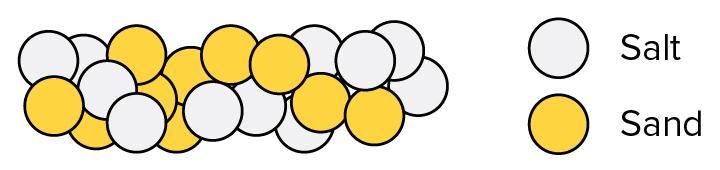
Which property of matter can Amar use to separate the salt from the sand?
a. solubility
b. mass
c. magnetism
d. size
a. solubility
400
Liquid is poured into three graduated cylinders. The volume of each liquid is shown below.
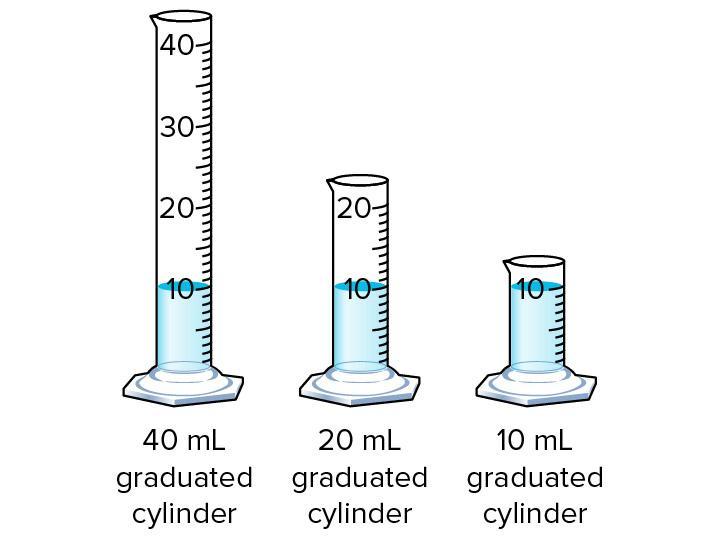
Which statement correctly describes the volume of the liquid?
A. The 10 mL graduated cylinder contains the greatest volume of liquid.
B. The 20 mL graduated cylinder contains the greatest volume of liquid.C.The 40 mL graduated cylinder contains the greatest volume of liquid.
D. The three graduated cylinders all have the same volume of liquid.
D. The three graduated cylinders all have the same volume of liquid.
400
A beaker contains water, sand, and dissolved salt. Describe a sequence of steps that could be used to recover both the sand and the salt separately.
Filter the mixture to remove the sand, then evaporate the water from the remaining salt solution to recover the salt.
400
Students add food coloring to a beaker of water. It spreads out evenly without stirring. What does this show about particles?
Particles are in constant motion, causing mixing and spreading.
400
student heats 250 milliliters of water in a cup to approximately 50 degree Celsius and adds 6 grams of salt. The mixture of salt and water is then stirred for 15 seconds.
Which results will the student MOST LIKELY observe after the mixture has been stirred for 15 seconds?
The salt will disslove.
The water will remain clear
500
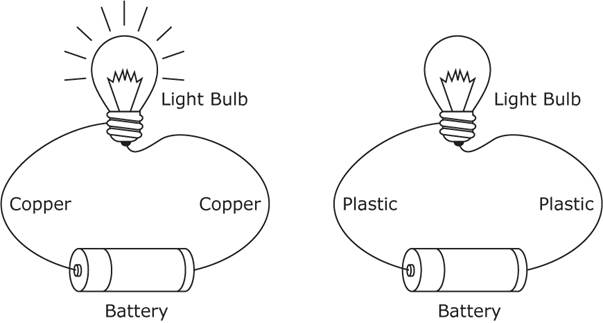 Look at the diagram. Complete the statement.
In the circuit, , _____________like copper, causes the light to turn on. , _____________like plastic, does not turn on the light.
In the circuit, ,conductor like copper, causes the light to turn on. , Insulator like plastic, does not turn on the light.
500
A student is asked to compare conductors and insulators of thermal and electrical energy. Give one example of each and explain why the difference matters.
Conductor: copper (lets energy flow). Insulator: rubber (blocks energy). Important for safety and correct material use.
500
A student dissolves a colored powder in water. Later, the water is allowed to evaporate and solid material is left behind. Explain how this observation provides evidence that the dissolved powder never disappeared.
The powder's particles remained in the solution even when they could not be seen. When the water evaporated, the solid was recovered, showing that the matter was still present and conserved.
500
Design an investigation to prove that matter is made up of particles too small to see. Be specific about steps and observations.
Weigh a balloon before/after filling, or observe diffusion of food coloring in water as evidence of invisible particles.
500
Matter is anything that has _______ and takes up ______
mass, space