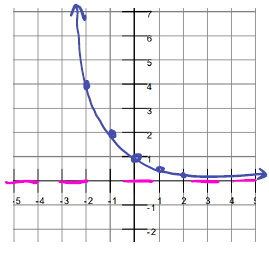
Word Problems
Solving
Transformations
Key Features
Mystery
100
$8500 in a mutual fund increases earning by 10.5% every year. How much will the fund be worth in 15 years?
$38,006.08
100
5^(3b)=5^(-b-2)
b=(-1)/2
100
Given the parent function
f(x)=2^x
name transformation(s):
g(x)=2^(x+1)
Horizontal Shift Left 1
100
Identify the domain:
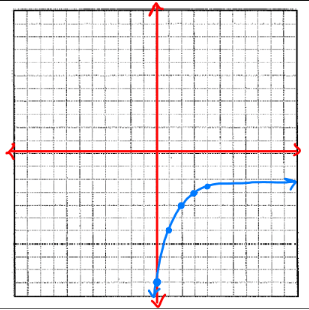
(-∞,∞)
100
When solving for a population you should always round you answer ______ .
DOWN to the nearest whole number
200
Steve has $10,000 and spends half of his current amount every month. Write the equation that represents the scenario. How much money does he have left after 4 months?
$625
200
6^(-3p-3)=36
p=(-5)/3
200
Given the parent function
f(x)=2^x
name transformation(s):
g(x)=2^(x-3)+1
Horizontal Shift Right 3 and Vertical Shift Up 1
200
Identify the interval of increase:
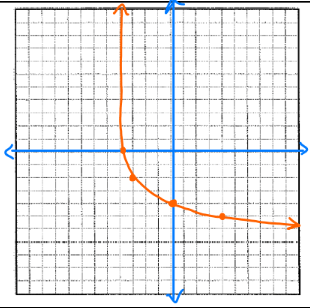
None!
200
3^(-r-3)=27
r=-6
300
A new car that sells for $18,000 depreciates 25% each year. Write a function that models the value of the car. Find the value of the car after 4 years.
$5,695.31
300
625^(v+1)=25^(2-2v)
v=0
300
Given the parent function
f(x)=2^x
name transformation(s):
g(x)=-1/3*2^(x+7)
Reflection over the x-axis, Vertical Shrink BAFO 1/3 and Horizontal Shift left 7
300
Identify the asymptote:
y=2(3)^(1/3x)+4
y=4
300
Write the equation for compounded continuously.
A=Pe^(rt)
400
You have 80 grams of a radioactive kind of thallium. If its half-life is 2 minutes, how much will be left after 8 minutes?
5 grams
400
64^(3-x)=(1/8)^(2x-3)
No Solution
400
Given the parent function
f(x)=2^x
name transformation(s):
g(x)=5*2^(-x)-1
Vertical Stretch BAFO 5, Reflection over the y-axis and Vertical Shift Down 1
400
Identify the range:
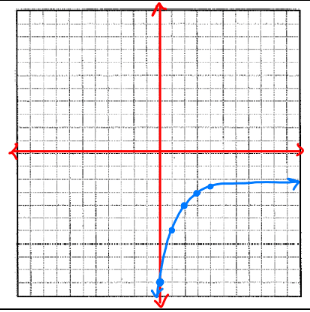
(-∞,-2)
400
Given
f(x)=4^x
write a function that has a horizontal shrink BAFO 1/2 and a horizontal shift right 4
g(x)=4^(2x-8)
500
Suppose you have $2000 that you want to deposit into a savings account. You earn 6% interest compounded quarterly. How much money will you have after 3 years?
$2,391.24
500
9^(3n)*81^(-2n-1)=(1/9)^(2n)
n=2
500
Given
f(x)=4^x
write a function that has a reflection over the x-axis, a horizontal stretch BAFO 3 and a vertical shift down 2
g(x)=-4^(1/3x)-2
500
Identify the end behavior:
x->-oo , f(x)->??
x->oo , f(x)->??
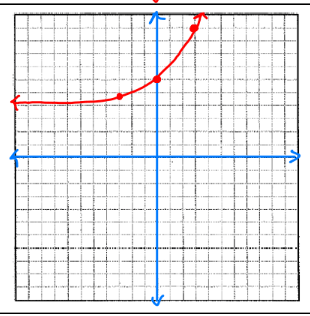
x->-oo , f(x)->4
x->oo , f(x)->oo
500
Flip your boards over to the graph side and graph
f(x)=(1/2)^x