Earth's Systems
Layers of the Atmosphere
Heat Transfer & Weather/Climate
Quarter 1 Review
Quarter 1 Review
100
In the picture below, a slow-moving mass of ice has gradually weathered and eroded rock away in a mountain valley. The landscape of rock has greatly changed.
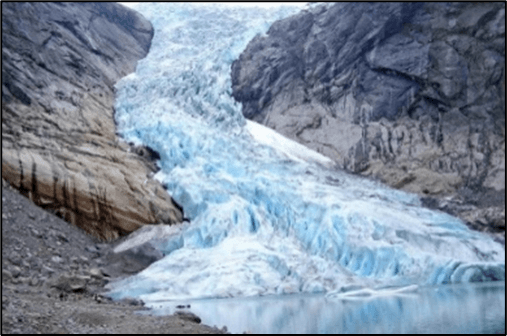
Which statement below best explains the sphere that was affected in the transformation?
A. geosphere: because the cryosphere scraped rock away as it slowly moved
B. geosphere: because the hydrosphere scraped rock away as it slowly moved
C. biosphere: because the cryosphere flooded the valley eliminating trees and plants
D. biosphere: because the hydrosphere flooded the valley eliminating trees and plants
A. geosphere: because the cryosphere scraped rock away as it slowly moved
100
What is the coldest layer of the atmosphere?
The mesosphere
100
If you walk barefoot on hot asphalt, energy is transferred by which process?
- convection
- radiation
- conduction
- reflection
- conduction
100
People rely on scientific knowledge to make important decisions every day. Why is scientific knowledge considered dependable?
A. It is published in reputable sources.
B. It changes as new evidence is found.
C. It has many different areas that can be studied.
D. It shows the reasons why the natural world works in certain ways.
B. It changes as new evidence is found.
100
Paula pushes a skateboard over a level surface. The skateboard gradually slows and stops. Which of the following best describes why the skateboard comes to a stop?
A. Gravity slows the skateboard.
B. Friction slows the skateboard.
C. The skateboard has positive acceleration.
D. Paula did not push the skateboard with enough force.
B. Friction slows the skateboard.
200
When dead plants decompose, nitrogen is returned to the soil. Which two spheres are involved in this process?
A. biosphere and hydrosphere
B. atmosphere and geosphere
C. geosphere and hydrosphere
D. biosphere and geosphere
D. biosphere and geosphere
200
The stratosphere contains the Earth’s ozone layer. The ozone blocks some solar radiation. Which of the following would most likely happen if the ozone layer was removed from the atmosphere?
A. The removal of the ozone layer would cause higher temperatures.
B. The removal of the ozone layer would cause an extinction of all life.
C. The removal of the ozone layer would cause a higher rate of skin cancer.
D. The removal of the ozone layer would cause the depletion of natural resources.
C. The removal of the ozone layer would cause a higher rate of skin cancer.
200
If you visit the beach on a hot summer day you will probably feel a sea breeze coming off the water onto the land. Which of the following causes this sea breeze?
- During the day, solar radiation warms the land more than the water.
- The water is warmer than the land during the day.
- Earth is tilted toward the Sun, causing air to move inland from the water.
- Hurricanes that form in the oceans blow air into the shore.
- During the day, solar radiation warms the land more than the water.
200
Use the diagram below of a pendulum to think about the answer to the question.
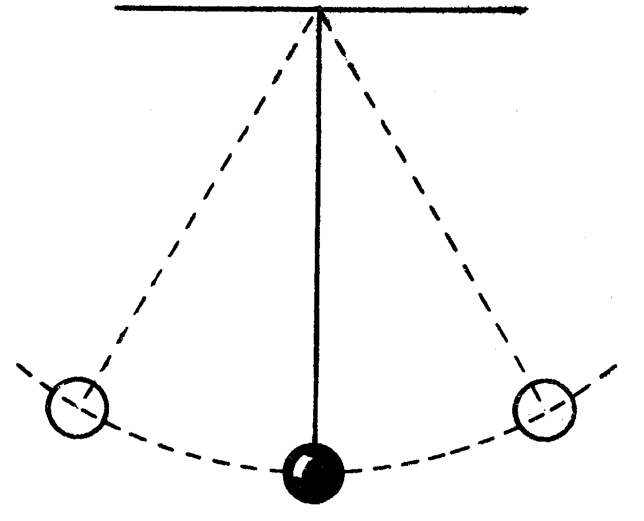
A pendulum is released from a high position. Because of friction, the pendulum eventually stops swinging. Which of the following actions occurs as the pendulum stops swinging?
A. Kinetic energy increases.
B. Potential energy decreases.
C. Kinetic energy remains the same.
D. Potential energy remains the same
B. Potential energy decreases.
200
The graph below shows the speed of a traveling object. The x-axis shows time in seconds (s). The y-axis shows distance in meters (m).
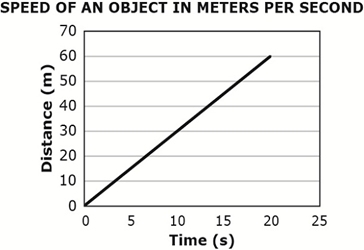
How long did it take for the object to travel 45 meters?
A. 3 seconds
B. 10 seconds
C. 15 seconds
D. 20 seconds
C. 15 seconds
300
Water evaporates from the surface of a lake. What two spheres are involved in this process?
A. atmosphere and geosphere
B. geosphere and hydrosphere
C. hydrosphere and atmosphere
D. cryosphere and hydrosphere
C. hydrosphere and atmosphere
300
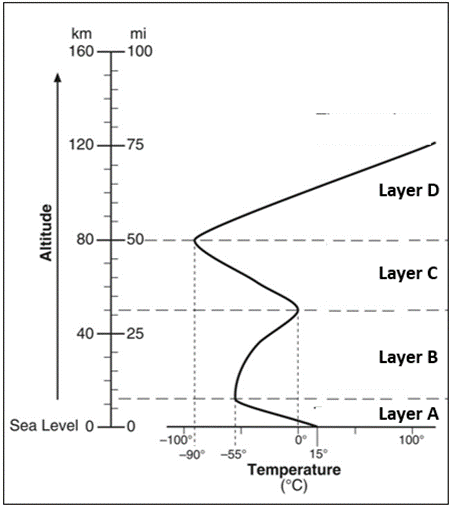
The diagram shows how temperature changes with altitude in the atmosphere. How does layer C of the atmosphere protect Earth’s surface?
A. The mesosphere’s thickness helps break down meteors.
B. The stratosphere’s thickness helps break down meteors.
C. The mesosphere contains the ozone layer which helps absorb the Sun’s radiation.
D. The stratosphere contains the ozone layer which helps absorb the Sun’s radiation.
A. The mesosphere’s thickness helps break down meteors.
300
Which statement regarding air temperature is NOT true?
- Cool air rises and warm air falls.
- Air heats up more quickly than land.
- Warm air is less dense than cool air.
- Air heats up more quickly than water.
- Cool air rises and warm air falls.
300
Susan and Fred performed an experiment to investigate the rates at which various colored cotton T-shirts absorb energy from the Sun.
- They used a white shirt, a black shirt, a green shirt, and a red shirt.
- They placed the shirts outside in direct sunlight.
- The students used a thermometer to measure the temperatures of each shirt every 15 minutes.
- The students recorded the data.
Where should the students put a duplicate set of the shirts to use as a control group?
A. outside and away from direct sunlight
B. outside and encased in an airtight container
C. inside a climate-controlled science classroom
D. in direct sunlight next to the shirts being tested
A. outside and away from direct sunlight
300
Below is an image of a basketball after it has been thrown in the air.
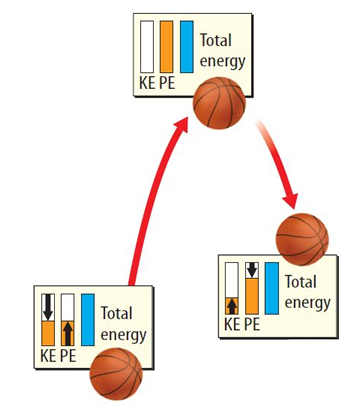
Which of the following best describes the change in energy of the basketball in the image?
A. As the ball moves upward, its kinetic energy increases.
B. As the ball moves downward, its potential energy decreases.
C. When the ball is at its lowest point, the total energy is at its lowest.
D. When the ball is at its highest point, the total energy is at its highest.
B. As the ball moves downward, its potential energy decreases.
400
Plants absorb sunlight and a gas called carbon dioxide from the air to make sugars. These sugars are stored and used as an energy source for the plants. When animals eat the plants, they acquire the energy stored in the plants. Which two spheres are described within these interactions?
A. atmosphere and biosphere
B. cryosphere and biosphere
C. hydrosphere and biosphere
D. geosphere and biosphere
A. atmosphere and biosphere
400
In the diagram, how does layer A support life on Earth?
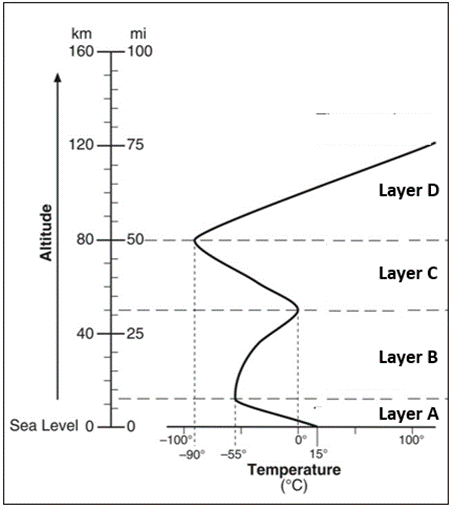
A. The mesosphere’s thickness helps break down meteors.
B. The thermosphere shields us from dangerous radiation from the sun.
C. The troposphere contains the gases we breathe and the water cycle we depend on.
D. The stratosphere contains the ozone layer which helps absorb the suns radiation.
C. The troposphere contains the gases we breathe and the water cycle we depend on.
400
Which of the following provides the energy that affects the movement of the atmosphere?
- green plants
- fossil fuels
- the Moon
- the Sun
d. the Sun
400
Samantha wanted to ride a roller coaster. The roller coaster is shown below.
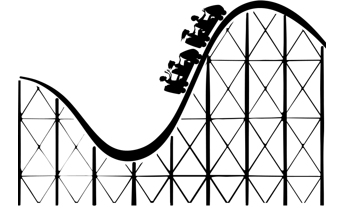
Which statement best describes the energy changes taking place as the roller coaster moves from the bottom of one hill up to the top of the next hill?
A. Both potential energy and kinetic energy increase.
B. Both potential energy and kinetic energy decrease.
C. Kinetic energy decreases and potential energy increases.
D. Potential energy decreases and kinetic energy increases.
C. Kinetic energy decreases and potential energy increases.
400
A contact force is any force that requires contact to occur. Which of the following describes motion caused by a contact force?
A. a marble rolling down a sloped board
B. a leaf falling to the ground from a tree
C. wind blowing a sailboat across a lake
D. iron filings being pulled up by a magnet
C. wind blowing a sailboat across a lake
500
In 1815 a volcano erupted, spewing billions of tons of ash into the sky. This ash “cloud” caused global annual temperatures to drop below normal, causing “a year without a summer” in 1816. Which spheres are included in this description?
A. biosphere and geosphere
B. geosphere and atmosphere
C. atmosphere and hydrosphere
D. hydrosphere and cryosphere
B. geosphere and atmosphere
500
Earth’s atmosphere helps to maintain the various climates found around the world and keeps Earth from becoming extremely cold all over. How does the atmosphere help to keep Earth insulated and warm?
A. The atmosphere creates heat as Earth moves through space, helping to insulate Earth.
B. The atmosphere traps the heat generated by Earth’s core and helps maintain Earth’s climate.
C. The atmosphere helps spread the warmth from the water near the equator to other parts of Earth.
D. The atmosphere helps trap heat energy from the Sun and energy radiated from Earth to maintain the climate.
D. The atmosphere helps trap heat energy from the Sun and energy radiated from Earth to maintain the climate.
500
Alise is trying to describe the climate of her home state, Florida, to a friend who lives in California. Which statement best describes the climate where she lives?
- It typically rains in the afternoon during the summer.
- The average yearly temperature is 22°C (72°F).
- Yesterday the temperature was 32°C (90°F) and it was raining.
- It is usually hot at the beach.
b. The average yearly temperature is 22°C (72°F).
500
A famous scientist has a hypothesis that is different from the current scientific theory. What should happen to this scientist's hypothesis?
A. The hypothesis should be rejected if it does not agree with the current theory.
B. People can accept the hypothesis if they want, but others can choose to reject it.
C. If the scientist is famous, then the hypothesis should be accepted and the theory should be changed.
D. The hypothesis should be tested and the results should be used to determine if the theory should change.
D. The hypothesis should be tested and the results should be used to determine if the theory should change.
500
Bailey is investigating the relationship between an object's mass and its force of impact. She places a hard-boiled egg at the base of a ramp, then releases a toy car from the top of the ramp. After the car strikes the egg, she describes what the egg looks like. She repeats this process with cars of different masses, using a new egg each time. Her results are shown below.
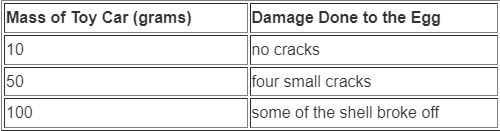
What is the independent (test) variable of the experiment?
A. height of the ramp
B. mass of the toy cars
C. speed of the toy cars
D. damage done to the eggs
B. mass of the toy cars